Loading...
Done
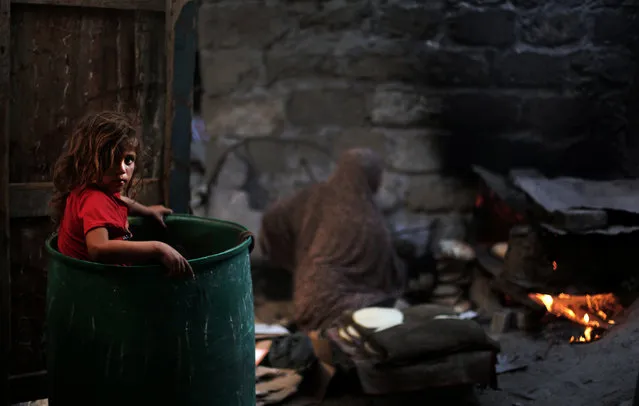
In this Monday, June 20, 2016 photo, a Palestinian girl plays in a barrel as her mother bakes bread for a Ramadan dinner at their house in el-Zohor slum, on the outskirts of Khan Younis refugee camp, southern Gaza Strip. (Photo by Khalil Hamra/AP Photo)

In this Monday, June 20, 2016 photo, a Palestinian girl plays in a barrel as her mother bakes bread for a Ramadan dinner at their house in el-Zohor slum, on the outskirts of Khan Younis refugee camp, southern Gaza Strip. (Photo by Khalil Hamra/AP Photo)
Details
23 Jun 2016 12:23:00
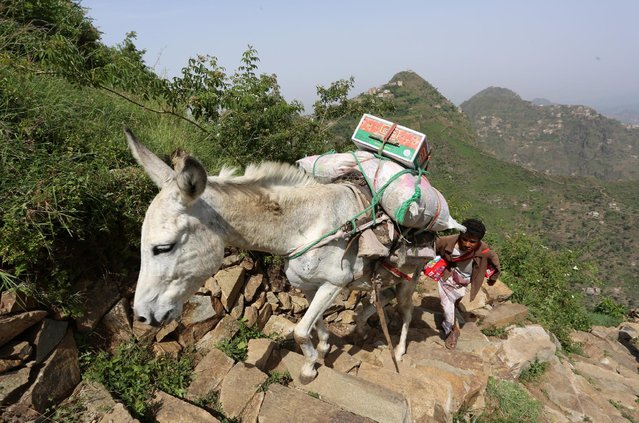
A man carries food supplies on a donkey to Dhalamlam Mountain in the Jafariya district of the western province of Raymah, Yemen June 2, 2016. (Photo by Abduljabbar Zeyad/Reuters)

A man carries food supplies on a donkey to Dhalamlam Mountain in the Jafariya district of the western province of Raymah, Yemen June 2, 2016. In villages perched high on a mountain in Western Yemen, residents are a safe distance from a conflict raging throughout most of the country but have had to turn the clock back on their lifestyles by centuries. (Photo by Abduljabbar Zeyad/Reuters)
Details
13 Sep 2016 09:23:00
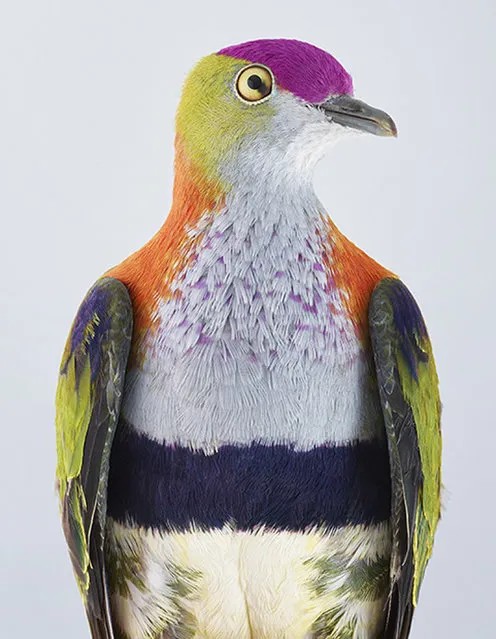
The series, which was photographed between 2015 and 2017, is currently on display at the Purdy Hicks Gallery in London, running through August 24, 2018. (Photo by Leila Jefferies/Caters News Agency)

This photographer has made it her mission to change people’s perception of pigeons – focusing on some of the most beautiful of the more than 300 species found globally. Rather than focus on the gray, nondescript birds people usually associate with the term “pigeon”, Leila Jeffreys has instead decided to snap the more vibrant varieties. Whether it be the wompoo pigeon, with its deep purple breast and green wings, or the rose-crowned fruit dove, with its pink head, Jeffreys, 46, gives the birds the same attention she would give a human model. (Photo by Leila Jefferies/Caters News Agency)
Details
14 Aug 2018 00:01:00
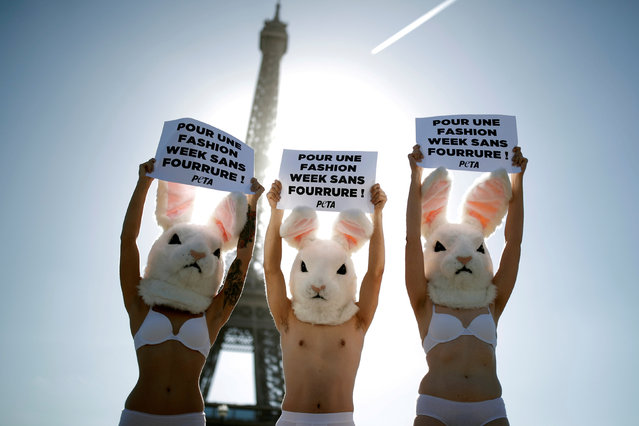
Activists from the People for the Ethical Treatment of Animals (PETA) demonstrate with slogans in protest of the designers use of fur, during the Paris Fashion Week, in front of the Eiffel Tower, in Paris, France, September 25, 2018. Placards read: “For a Fashion Week without fur”. (Photo by Benoit Tessier/Reuters)

Activists from the People for the Ethical Treatment of Animals (PETA) demonstrate with slogans in protest of the designers use of fur, during the Paris Fashion Week, in front of the Eiffel Tower, in Paris, France, September 25, 2018. Placards read: “For a Fashion Week without fur”. (Photo by Benoit Tessier/Reuters)
Details
26 Sep 2018 08:40:00
A Rohingya migrant woman, who arrived in Indonesia by boat, carries a bottle of drinking water inside a temporary compound for refugees in Kuala Cangkoi village in Lhoksukon, Indonesia's Aceh Province May 17, 2015. (Photo by Reuters/Beawiharta)

A Rohingya migrant woman, who arrived in Indonesia by boat, carries a bottle of drinking water inside a temporary compound for refugees in Kuala Cangkoi village in Lhoksukon, Indonesia's Aceh Province May 17, 2015. (Photo by Reuters/Beawiharta)
Details
02 Jul 2015 14:53:00
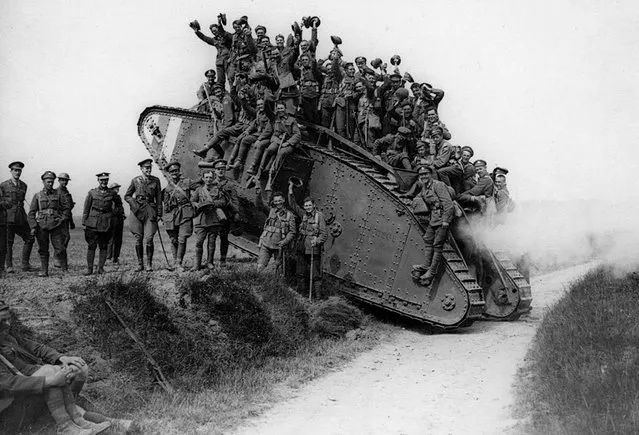
These black-and-white photos are taken from the new book “Armoured Warfare in the First World War 1916 – 1918” by Anthony Tucker-Jones and published by Pen & Sword Military. “Interestingly the British, French and Germans took completely different approaches with varying results”. The British military produced “Little Willie” in Autumn 1915 weighing 18 tonnes, which had a crew of two plus four gunners. “Inspired by a tracked artillery tractor “Little Willie” was referred to as a water tank – hence the name tank – to ensure secrecy”, said Anthony. “This led to the strange looking Mark I with its peculiar rhomboid shape, designed to cross trenches with guns in sponsons on either side. The Germans saw the tank as unchivalrous and were slow to grasp its utility. They favoured the Stormtrooper (specialist soldiers used to infiltrate enemy trenches) and artillery, not the tank”, said Anthony. “However, they didn’t hesitate to make use of captured British tanks. Although the tank helped secure victory and German soldiers dubbed it “Germany’s Downfall” the country was ultimately brought to its knees by the Allies blockade”. Here: British troops hitch a ride on a Mark IV after the massed tank fleet spearheading attack at Cambrai on November 20, 1917. (Photo by Anthony Tucker-Jones/Mediadrumworld.com)

These black-and-white photos are taken from the new book “Armoured Warfare in the First World War 1916 – 1918” by Anthony Tucker-Jones and published by Pen & Sword Military. Here: British troops hitch a ride on a Mark IV after the massed tank fleet spearheading attack at Cambrai on November 20, 1917. (Photo by Anthony Tucker-Jones/Mediadrumworld.com)
Details
23 Feb 2017 00:02:00
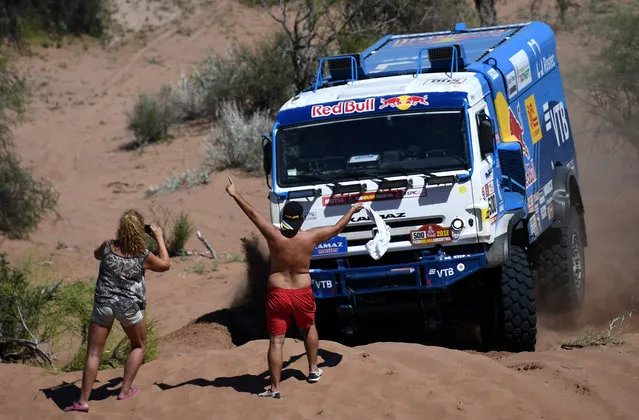
Kamaz Russian driver Eduard Nikolaev, co- driver Evgeny Yakovlev and mechanic Vladimir Rybakov compete during the 2018 Dakar Rally' s Stage 13 between San Juan and Cordoba in Argentina, on January 19, 2018. (Photo by Franck Fife/AFP Photo)

Kamaz Russian driver Eduard Nikolaev, co- driver Evgeny Yakovlev and mechanic Vladimir Rybakov compete during the 2018 Dakar Rally' s Stage 13 between San Juan and Cordoba in Argentina, on January 19, 2018. (Photo by Franck Fife/AFP Photo)
Details
23 Jan 2018 06:46:00
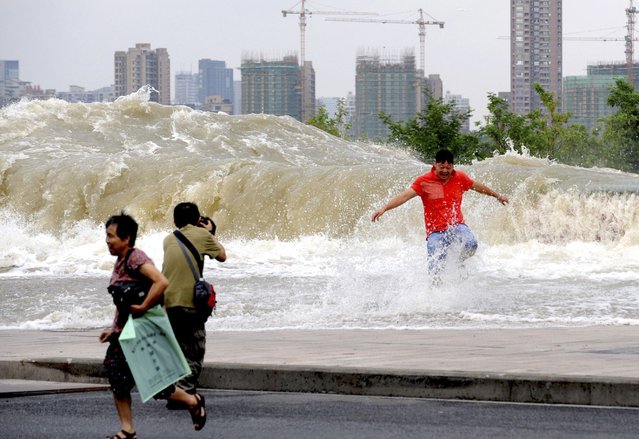
A man (2nd L) takes pictures as visitors run away from a wave caused by a tidal bore which surged past a barrier on the banks of Qiantang River, in Hangzhou, Zhejiang province August 14, 2014. (Photo by Reuters/Stringer)

A man (2nd L) takes pictures as visitors run away from a wave caused by a tidal bore which surged past a barrier on the banks of Qiantang River, in Hangzhou, Zhejiang province August 14, 2014. (Photo by Reuters/Stringer)
Details
19 Aug 2014 10:40:00