Loading...
Done
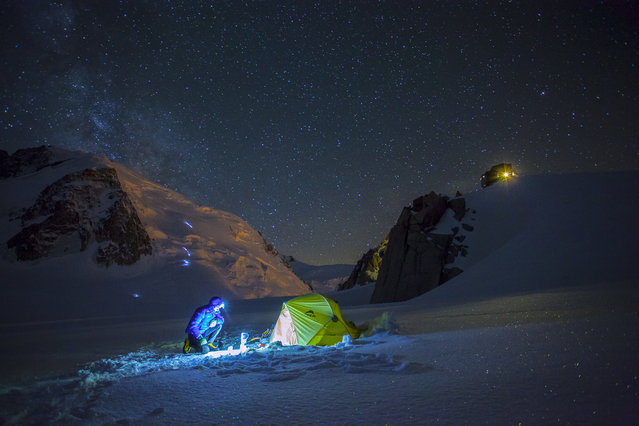
“A snapshot from mountaineer's life”. Have you ever wondered how does a mountaineer's day start? (Photo and caption by Kamil Tamiola/National Geographic Traveler Photo Contest)

“A snapshot from mountaineer's life”. Have you ever wondered how does a mountaineer's day start? I will give you a hint: you wake up at 3 am, set the stove, wake up your partner, pretend it is warm, quickly consume a high-calorie breakfast, watch your friends slowly ascending the icy slopes of your dream summit with their tiny head torches glimmering against perfectly blue ice, and hope for the good weather. One would ask: why all this trouble? The answer is easy: for the love of the adventure and the unknown. Location: Chamonix, Haute Savoye, France. (Photo and caption by Kamil Tamiola/National Geographic Traveler Photo Contest)

ATTENTION! All pictures are presented in high resolution. To see Hi-Res images – just TWICE click on any picture. In other words, click small picture – opens the BIG picture. Click BIG picture – opens VERY BIG picture.
Details
27 Jun 2013 12:47:00
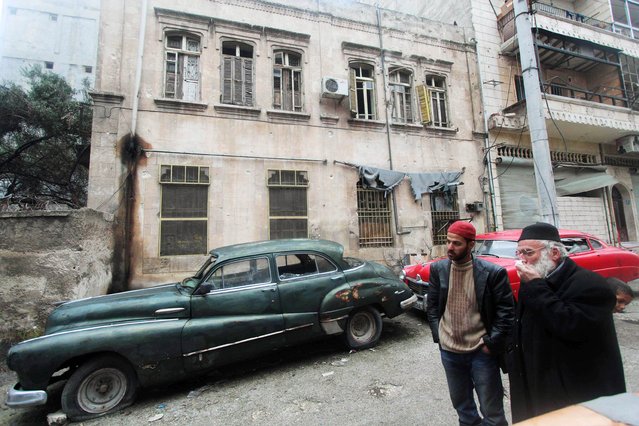
Mohamed Badr al-Din (R) stands in front of his vintage cars along a street where he keeps them, in the al-Shaar neighborhood of Aleppo January 31, 2015. The 66-year-old collector nicknamed Abu Omar inherited the hobby from his father and has a large collection of vintage cars, some of which he says belonged to former Syrian officials and were used in several movies and shows. (Photo by Abdalrhman Ismail/Reuters)

Mohamed Badr al-Din (R) stands in front of his vintage cars along a street where he keeps them, in the al-Shaar neighborhood of Aleppo January 31, 2015. The 66-year-old collector nicknamed Abu Omar inherited the hobby from his father and has a large collection of vintage cars, some of which he says belonged to former Syrian officials and were used in several movies and shows. Before the unrest, Abu Omar planned to open a museum to display his cars, which are guarded from pedestrians by a turkey that he owns. He hopes that the turmoil in the country will end so that he can pursue his hobby and repair his cars, which are heavily damaged from shelling. (Photo by Abdalrhman Ismail/Reuters)
Details
01 Feb 2015 10:34:00
Spectacular images offering insight into the lives of the Huaorani people in the Ecuadorian Amazon have been revealed showing how they use traditional methods to hunt monkeys for food. The stunning pictures were taken by conservation photographer Pete Oxford from Torquay, Devon in the Ecuadorian Amazon. “The Huaorani Indians are a forest people highly in tune with their environment. Many are now totally acculturated since the 1950s by missionaries”, said Pete. “Today they face radical change to their culture to the proximity of oil exploration within their territory and the Yasuni National Park and Biosphere Reserve, they are vastly changed. Some still live very traditionally and for this shoot, through my Huaorani friend, a direct relative of those photographed he wanted to depict them as close to their original culture as possible. They still largely hunt with blow pipes and spears eating a lot of monkeys and peccaries”. The Huaorani are also known as the Waorani, Waodani or the Waos and are native Amerindians. Their lands are located between the Curaray and Napo rivers and speak the Huaorani language. Pete says that during his visit he was welcomed into the group and hopes that ancient cultures can be saved. Here: The tribe were seen celebrating after a hunter returned to camp with a wild pig. (Photo by Pete Oxford/Mediadrumworld.com)

Spectacular images offering insight into the lives of the Huaorani people in the Ecuadorian Amazon have been revealed showing how they use traditional methods to hunt monkeys for food. The stunning pictures were taken by conservation photographer Pete Oxford from Torquay, Devon in the Ecuadorian Amazon. Here: The tribe were seen celebrating after a hunter returned to camp with a wild pig. (Photo by Pete Oxford/Mediadrumworld.com)
Details
20 Jan 2017 07:58:00
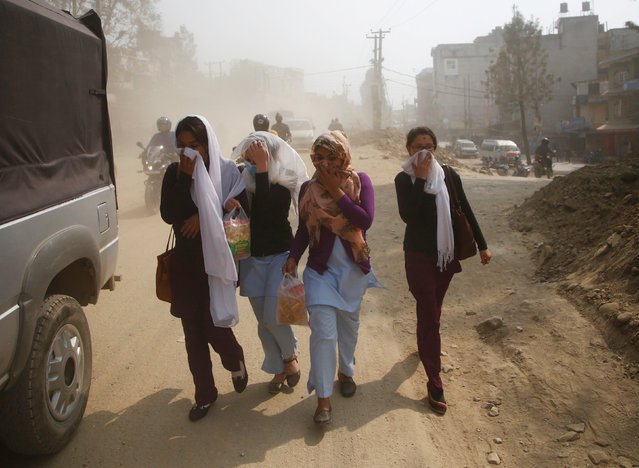
Pedestrians cover their face as they walk along the dusty road in Kathmandu, Nepal February 27, 2017. Nepal has forced 2,500 old vehicles off roads in its capital city of Kathmandu, part of a fight against alarming air pollution levels that have hit nine times World Health Organisation (WHO) limits. Air pollution has been a chronic problem in rapidly growing Kathmandu, which sits in a Himalayan valley and is home to more than 3mn people. Rising public anger with the smog is turning into a headache for a beleaguered government headed by former Maoist rebels. Dust from road works, exhaust from old, poorly maintained vehicles and smoke from coal-burning brick kilns blend in a murky haze that hangs over the ancient city, raising the risk of cancer, stroke, asthma and high blood pressure, experts say. Officials hope the ban on vehicles more than 20 years old will be a step towards a cleaner future. (Photo by Navesh Chitrakar/Reuters)

Pedestrians cover their face as they walk along the dusty road in Kathmandu, Nepal February 27, 2017. Nepal has forced 2,500 old vehicles off roads in its capital city of Kathmandu, part of a fight against alarming air pollution levels that have hit nine times World Health Organisation (WHO) limits. Air pollution has been a chronic problem in rapidly growing Kathmandu, which sits in a Himalayan valley and is home to more than 3mn people. (Photo by Navesh Chitrakar/Reuters)
Details
04 Mar 2017 00:04:00
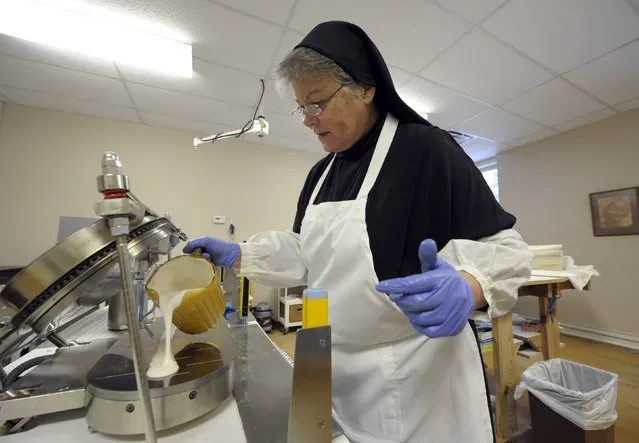
Sister Rebecca Leis pours low-gluten alter bread batter into a machine that bakes the thin bread at the Benedictine Sisters of Perpetual Adoration monastery in Clyde, Missouri, December 18, 2014. The Sisters have made communion wafers since 1910 and began making a low-gluten version in 2003 and have gone from 143 customers in 2004 to more than 11,000 customers from around the world. (Photo by Dave Kaup/Reuters)

Sister Rebecca Leis pours low-gluten alter bread batter into a machine that bakes the thin bread at the Benedictine Sisters of Perpetual Adoration monastery in Clyde, Missouri, December 18, 2014. The Sisters have made communion wafers since 1910 and began making a low-gluten version in 2003 and have gone from 143 customers in 2004 to more than 11,000 customers from around the world. (Photo by Dave Kaup/Reuters)
Details
25 Dec 2014 13:21:00
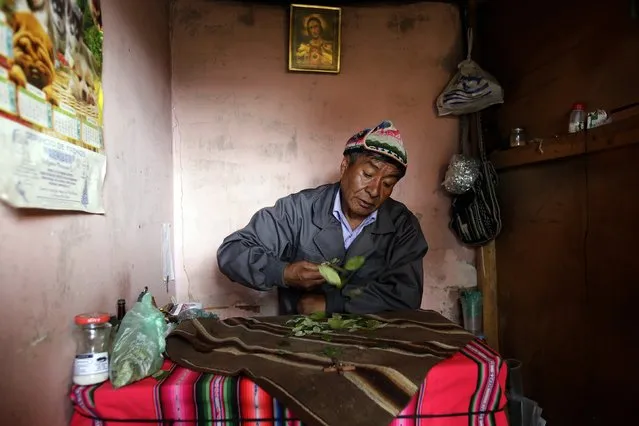
Aymara witchdoctor Ricardo Quispe, also called “Lord of the Lake”, throws coca leaves during a ritual to predict the future, at the witches market of El Alto, on the outskirts of La Paz, December 31, 2014. Dozens of witch doctors tend to a warren of stalls in El Alto, making offerings to give thanks, to promise luck at work or in love, or to call up spirits and banish curses at the end of the year. (Photo by David Mercado/Reuters)

Aymara witchdoctor Ricardo Quispe, also called “Lord of the Lake”, throws coca leaves during a ritual to predict the future, at the witches market of El Alto, on the outskirts of La Paz, December 31, 2014. Dozens of witch doctors tend to a warren of stalls in El Alto, making offerings to give thanks, to promise luck at work or in love, or to call up spirits and banish curses at the end of the year. (Photo by David Mercado/Reuters)
Details
01 Jan 2015 14:05:00
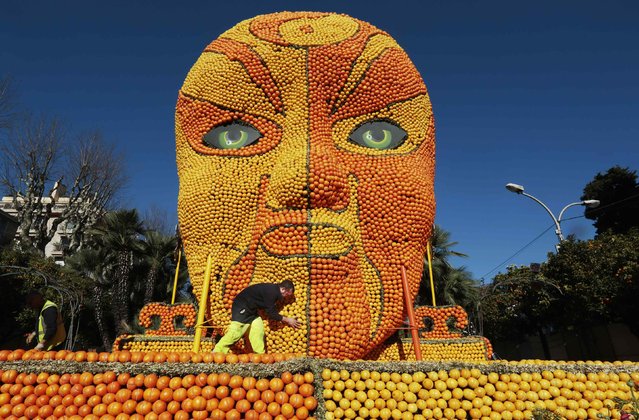
A worker puts the final touches to a replica of a Beijing opera mask made with lemons and oranges during the 82th Lemon festival in Menton February 12, 2015. Over 20,000 hours work for teams to set up the festival and some 145 metric tons of lemons and oranges are used to make displays during the 82th festival, which is themed “Tribulations of a lemon in China”, and runs from February 14 through March 4. (Photo by Eric Gaillard/Reuters)

A worker puts the final touches to a replica of a Beijing opera mask made with lemons and oranges during the 82th Lemon festival in Menton February 12, 2015. Over 20,000 hours work for teams to set up the festival and some 145 metric tons of lemons and oranges are used to make displays during the 82th festival, which is themed “Tribulations of a lemon in China”, and runs from February 14 through March 4. (Photo by Eric Gaillard/Reuters)
Details
13 Feb 2015 13:11:00
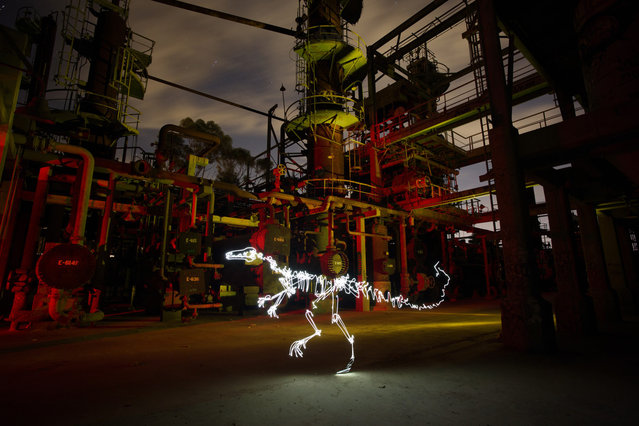
Dinosaur Light Paintings By Darren Pearson

Have you ever tried painting with light? Yes, you’ve heard us right. It is not a figure of speech, and it is actually possible to draw with light if you have a good camera and a tripod. All you have to do is to set your camera on a tripod in a dark place (preferably at night in some park), set exposure time to the max, turn on a single bright light (the screen of your mobile phone will do), and you can start painting. Darren Pearson is a photographer who specializes in making such drawings. The level of intricacy with which he creates his paintings is astounding, considering the fact that making such a drawing is like painting with a blindfold on.

See also: Skateboarding Light Skeletons
Details
26 Feb 2015 05:28:00