Loading...
Done
France's Christian Lavieille and co-pilot Jean-Michel Polato compete with their Proto Dessoude during the first stage of the Dakar Rally 2013 from Lima to Pisco January 5, 2013. (Photo by Jacky Naegelen/Reuters)

France's Christian Lavieille and co-pilot Jean-Michel Polato compete with their Proto Dessoude during the first stage of the Dakar Rally 2013 from Lima to Pisco January 5, 2013. (Photo by Jacky Naegelen/Reuters)
Details
12 Jan 2013 11:08:00
Breath at sunset, captures a sea turtle at a dive site called Black Rock. Kāʻanapali, Hawaiʻi, August 2013. (Photo by Christopher Doherty/Smithsonian.com)

Breath at sunset, captures a sea turtle at a dive site called Black Rock. Kāʻanapali, Hawaiʻi, August 2013. (Photo by Christopher Doherty/Smithsonian.com)
Details
28 Apr 2014 12:20:00
A participant dressed up in a costume attends the 2021 Prague Comic Con in Prague, Czech Republic, October 16, 2021. (Photo by David W. Cerny/Reuters)

A participant dressed up in a costume attends the 2021 Prague Comic Con in Prague, Czech Republic, October 16, 2021. (Photo by David W. Cerny/Reuters)
Details
10 Jun 2022 04:28:00
2016 Rio Olympics, Weightlifting, Final, Women's 63kg, Riocentro, Pavilion 2, Rio de Janeiro, Brazil on August 9, 2016. Marina Rodriguez (CUB) of Cuba competes. (Photo by Stoyan Nenov/Reuters)

2016 Rio Olympics, Weightlifting, Final, Women's 63kg, Riocentro, Pavilion 2, Rio de Janeiro, Brazil on August 9, 2016. Marina Rodriguez (CUB) of Cuba competes. (Photo by Stoyan Nenov/Reuters)
Details
10 Aug 2016 10:34:00
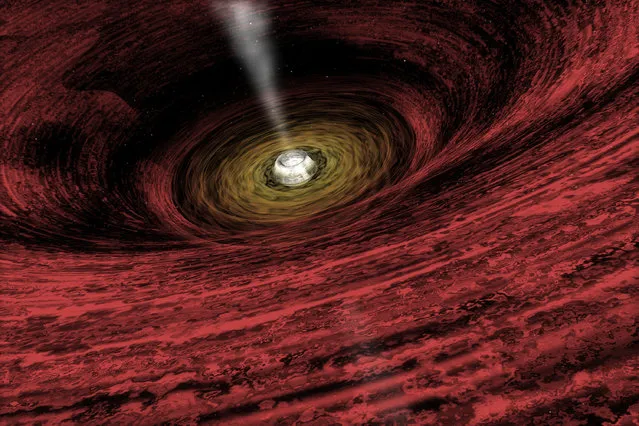
An artist's impression of a growing supermassive black hole located in the early Universe is seen in this NASA handout illustration released on June 15, 2011. Using the deepest X-ray image ever taken, astronomers found the first direct evidence that massive black holes were common in the early universe. This discovery from NASA's Chandra X-Ray Observatory shows that very young black holes grew more aggressively than previously thought, in tandem with the growth of their host galaxies. (Photo by Reuters/NASA/Chandra X-Ray Observatory/A.Hobart)

An artist's impression of a growing supermassive black hole located in the early Universe is seen in this NASA handout illustration released on June 15, 2011. Using the deepest X-ray image ever taken, astronomers found the first direct evidence that massive black holes were common in the early universe. This discovery from NASA's Chandra X-Ray Observatory shows that very young black holes grew more aggressively than previously thought, in tandem with the growth of their host galaxies. (Photo by Reuters/NASA/Chandra X-Ray Observatory/A.Hobart)
Details
11 Feb 2016 12:57:00
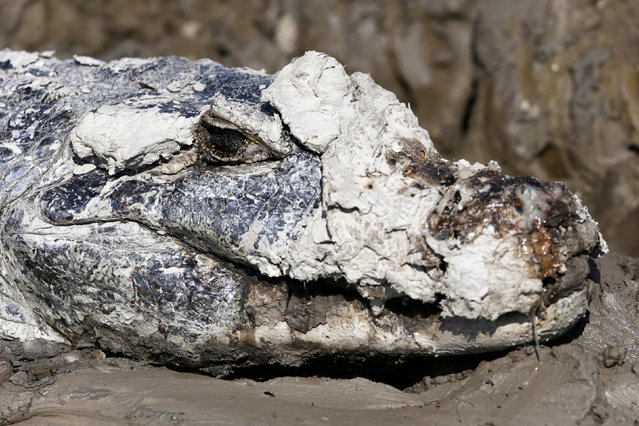
An alligator is pictured stuck in the mud of the dry Pilcomayo river, which is facing its worst drought in almost two decades, on the border between Paraguay and Argentina, in Boqueron, July 3, 2016. (Photo by Jorge Adorno/Reuters)

An alligator is pictured stuck in the mud of the dry Pilcomayo river, which is facing its worst drought in almost two decades, on the border between Paraguay and Argentina, in Boqueron, July 3, 2016. (Photo by Jorge Adorno/Reuters)
Details
06 Jul 2016 15:57:00
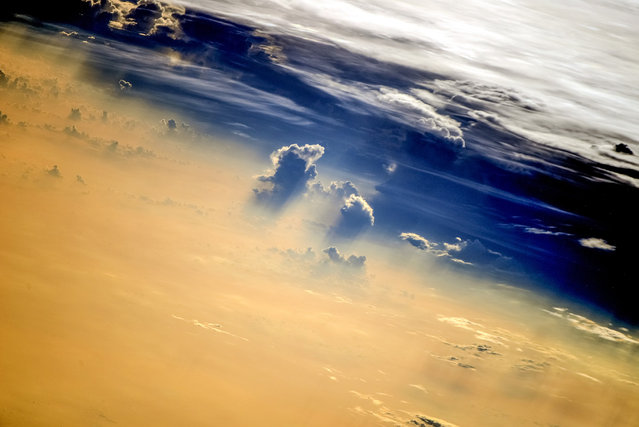
Image of the Clouds taken in August 2014 by astronauts on board the International Space Station (ISS).  A year from space photographs of hurricanes, typhoons and meteorite craters show an astronauts-eye view of our planet from hundreds of miles above the earth. The illuminating images were taken by astronauts onboard the International Space Station (ISS) over the course of 2014. (Photo by NASA/SPL/Barcroft Media)

Image of the Clouds taken in August 2014 by astronauts on board the International Space Station (ISS). A year from space photographs of hurricanes, typhoons and meteorite craters show an astronauts-eye view of our planet from hundreds of miles above the earth. The illuminating images were taken by astronauts onboard the International Space Station (ISS) over the course of 2014. (Photo by NASA/SPL/Barcroft Media)
Details
31 Dec 2014 14:47:00
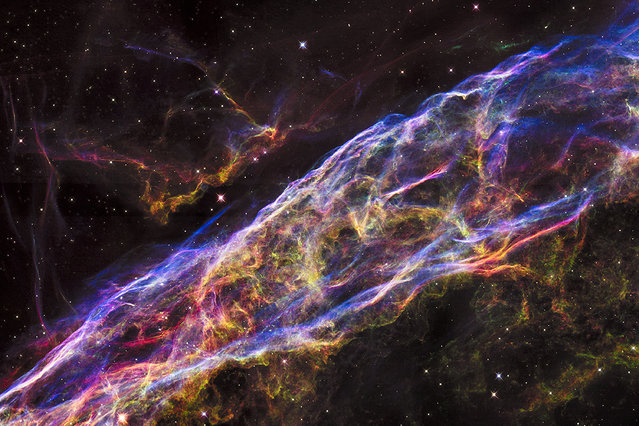
A small section of the expanding remains of the Veil Nebula, a massive star that exploded about 8,000 years ago. The entire nebula is 110 light-years across, covering six full moons on the sky as seen from Earth, and resides about 2,100 light-years away in the constellation Cygnus, the Swan. Image taken by NASA's Hubble Space Telescope. Released September 24, 2015. (Photo by Reuters/NASA/ESA/Hubble Heritage Team)

A small section of the expanding remains of the Veil Nebula, a massive star that exploded about 8,000 years ago. The entire nebula is 110 light-years across, covering six full moons on the sky as seen from Earth, and resides about 2,100 light-years away in the constellation Cygnus, the Swan. Image taken by NASA's Hubble Space Telescope. Released September 24, 2015. (Photo by Reuters/NASA/ESA/Hubble Heritage Team)
Details
10 Dec 2015 08:01:00