Performer from the Mangueira samba school parades during carnival celebrations at the Sambadrome in Rio de Janeiro, Brazil, Tuesday, February 9, 2016. (Photo by Silvia Izquierdo/AP Photo)
A person in costume is pictured during the annual Easter Parade and Bonnet Festival on 5th Ave in Manhattan, New York City, U.S., April 17, 2022. (Photo by Andrew Kelly/Reuters)
In this April 4, 2017 photo keeper German Alonso straps a leg prothesis to on the left leg of secretarybird Soeckchen (Sagittarius seprentarius) at the bird park in Walsrode, northern Germany. The prothesis was made in a 3D-printer after his left leg was amputated. (Photo by Philipp Schulze/DPA via AP Photo)
An Indian girl, Aritri Bannerjee, gets dressed as the Goddess Durga, during the Kumari Puja as part of the Durga Puja festival at Shidaspur village, far north of Kolkata, eastern India, 22 October 2023. During the Kumari Puja, devotees worship a girl aged between six and twelve, symbolizing the Kanya Kumari (virgin) form of the Goddess Durga Devi. Hindu devotees believe that Kanya is a living embodiment of the goddess Durga. (Photo by Piyal Adhikary/EPA/EFE)
A dachshund portraying a racehorse, trots down Duval Street in Key West, Florida, December 31, 2014. About 175 dachshunds and other dogs participated in the event that preludes four warm-weather takeoffs on New York City's Times Square ball drop. (Photo by Steve Panariello/Reuters/Florida Keys News Bureau)
A knight parades in the street during the traditional carnival parade in Cologne, western Germany, Monday, February 16, 2015. (Photo by Martin Meissner/AP Photo)
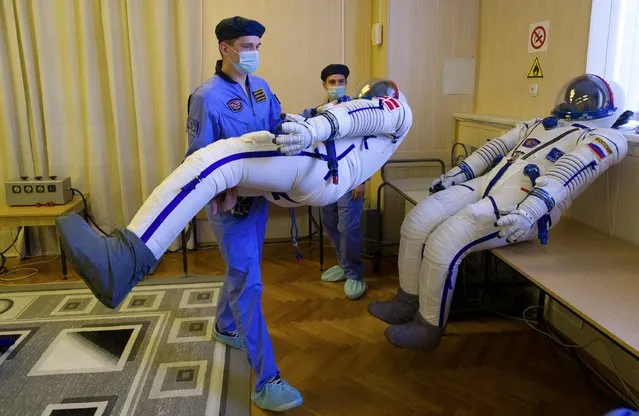
Employees prepare spacesuits at the Russian-leased Baikonur cosmodrome in Kazakhstan on August 19, 2015. Members of the main crew of the 45/46 expedition to the International Space Station ISS, Kazakhstan's cosmonaut Aydyn Aimbetov, Russian cosmonaut Sergei Volkov and Denmark's astronaut Andreas Mogensen from the European Space Agency, are scheduled to blast off to the International Space Station (ISS) on September 2, 2015. (Photo by AFP Photo)
“Asaro from the Eastern Highlands”. The mudmen could not cover their faces with mud because the people of Papua New Guinea thought that the mud from the Asaro river was poisonous. So instead of covering their faces with this alleged poison, they made masks from pebbles that they heated and water from the waterfall, with unusual designs such as long or very short ears either going down to the chin or sticking up at the top, long joined eyebrows attached to the top of the ears, horns and sideways mouths. (Photo and caption by Jimmy Nelson)