Loading...
Done
A young boy walks to his school bus on a foggy day in Dubai on March 14, 2024. (Photo by Chris Whiteoak/The National)

A young boy walks to his school bus on a foggy day in Dubai on March 14, 2024. (Photo by Chris Whiteoak/The National)
Details
01 Aug 2024 05:18:00
People attend in costume the 2022 New York Comic Con, at the Jacob Javits Convention Center in Manhattan in New York City, New York, U.S., October 6, 2022. (Photo by Brendan McDermid/Reuters)

People attend in costume the 2022 New York Comic Con, at the Jacob Javits Convention Center in Manhattan in New York City, New York, U.S., October 6, 2022. (Photo by Brendan McDermid/Reuters)
Details
08 Oct 2022 03:09:00
A Pakistani devotee dances to celebrate the three-day annual festival to pay tribute to the famous saint Al-Sheikh Ali Bin Usman Al-Hajveri known as Data Ganjbaksh at outside his shrine in Lahore, Pakistan, Sunday, November 20, 2016. Thousands of people traveled from all over Pakistan to attend the celebrations. (Photo by K.M. Chaudary/AP Photo)

A Pakistani devotee dances to celebrate the three-day annual festival to pay tribute to the famous saint Al-Sheikh Ali Bin Usman Al-Hajveri known as Data Ganjbaksh at outside his shrine in Lahore, Pakistan, Sunday, November 20, 2016. Thousands of people traveled from all over Pakistan to attend the celebrations. (Photo by K.M. Chaudary/AP Photo)
Details
05 Dec 2016 11:33:00
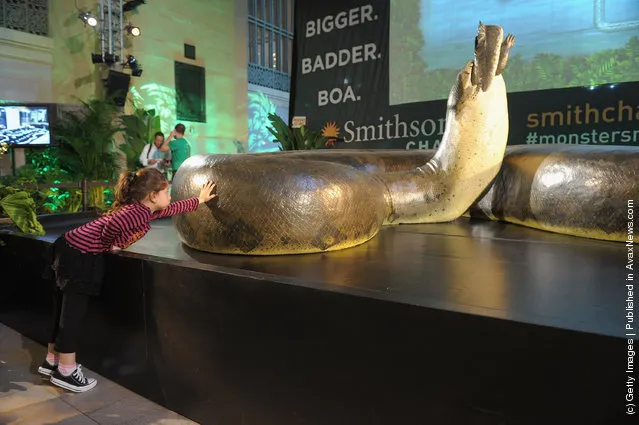
Attendees view a replica of the prehistoric Titanoboa, the largest snake to ever live, on display at Grand Central Terminal in New York City

“Titanoboa is a genus of snake that lived approximately 58–60 million years ago, during the Paleocene epoch, a 10-million-year period immediately following the dinosaur extinction event. The only known species is the Titanoboa cerrejonensis, the largest snake ever discovered, which supplanted the previous record holder, Gigantophis”. – Wikipedia

Photo: Leah Del Rio views a replica of the prehistoric Titanoboa, the largest snake to ever live, on display at Grand Central Terminal on March 23, 2012 in New York City. (Photo by Michael Loccisano/Getty Images)

Details
24 Mar 2012 10:14:00
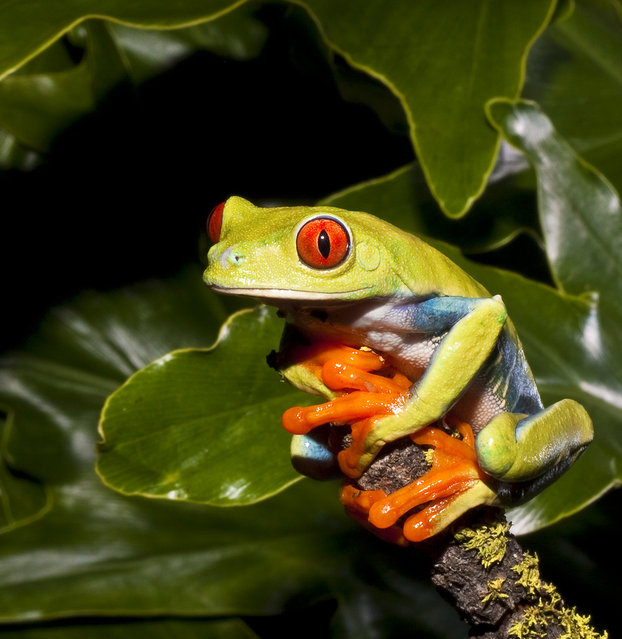
The Red-eyed Treefrog (Agalychnis callidryas)

“The Red-eyed Treefrog (Agalychnis callidryas) is an arboreal hylid native to Neotropical rainforests in Central America. Red-eyed tree frogs, as their name states, have red eyes with vertically narrowed noses, a vibrant green body with yellow and blue vertically striped sides, and orange or yellow webbed feet and toes”. – Wikipedia. (Photo by Donald Quintana)
Details
26 Jun 2012 10:13:00
Seven year old Hungarian herding dog Derci runs along the Olympiaberg hill during stormy weather in Munich, southern Germany, Monday, January 4, 2016. (Photo by Matthias Balk/DPA via AP Photo)

Seven year old Hungarian herding dog Derci runs along the Olympiaberg hill during stormy weather in Munich, southern Germany, Monday, January 4, 2016. (Photo by Matthias Balk/DPA via AP Photo)
Details
09 Jan 2016 08:01:00
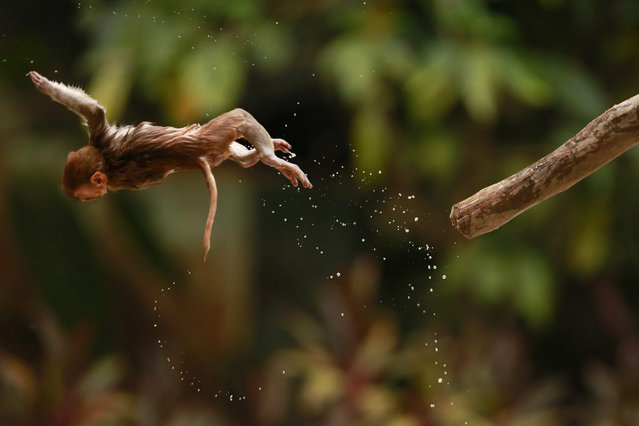
A monkey jumps from a branch at Yangon Zoological Gardens in Yangon, Myanmar, 06 April 2016. Yangon Zoological Gardens (Yangon Zoo) is the oldest and second largest zoo in Myanmar. (Photo by Lynn Bo Bo/EPA)

A monkey jumps from a branch at Yangon Zoological Gardens in Yangon, Myanmar, 06 April 2016. Yangon Zoological Gardens (Yangon Zoo) is the oldest and second largest zoo in Myanmar. (Photo by Lynn Bo Bo/EPA)
Details
10 Apr 2016 10:41:00
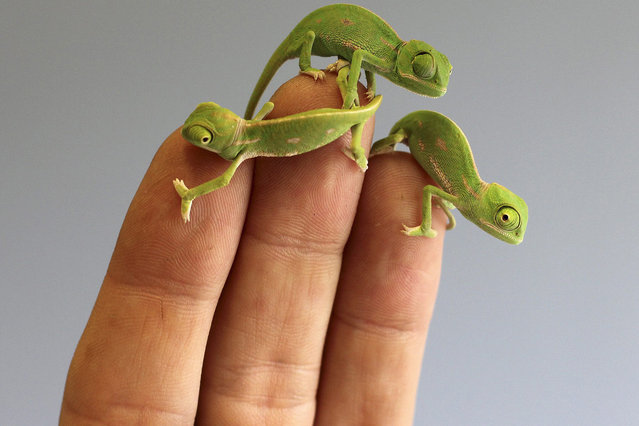
A handout image released by the Taronga Zoo shows Veiled Chameleon hatchlings at Taronga Zoo in Sydney, Australia, 11 March 2015. Taronga has welcomed more than 20 baby chameleons, with the last of three clutches of eggs hatching this week. Veiled Chameleons, or Chamaeleo calyptratus, are native to Saudi Arabia and Yemen and can live up to five years. (Photo by EPA/Taronga Zoo)

A handout image released by the Taronga Zoo shows Veiled Chameleon hatchlings at Taronga Zoo in Sydney, Australia, 11 March 2015. Taronga has welcomed more than 20 baby chameleons, with the last of three clutches of eggs hatching this week. Veiled Chameleons, or Chamaeleo calyptratus, are native to Saudi Arabia and Yemen and can live up to five years. (Photo by EPA/Taronga Zoo)
Details
21 Mar 2015 13:13:00