Loading...
Done
Zed Nelson by The Family

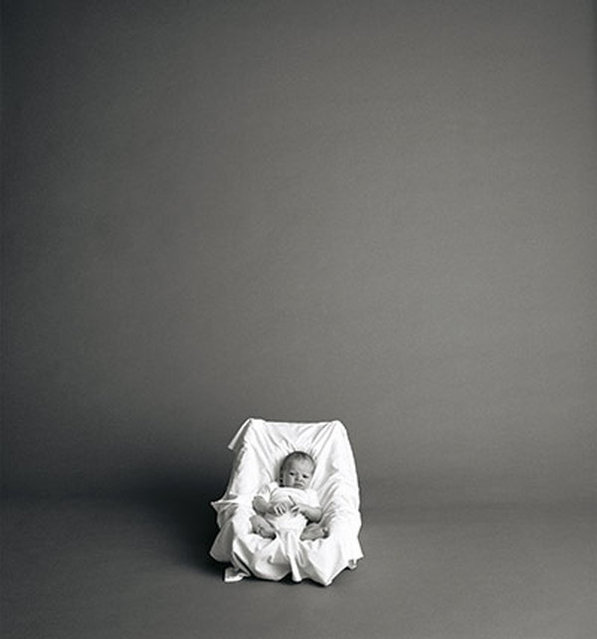
Zed Nelson has photographed the same family, once a year on the same day, for 20 years. I take hundreds of photo’s of my extended family all year round, some just languish on my computer screen unseen by anyone, some get printed, some framed. What is really interesting about this project is not only the obvious time scale but his “ analytical approach“. The same plain background is used for each session and he chooses only 1 frame to represent that years image. My many photographs are a mishmash of family events, his create a family history unfolding . Perhaps less really is more.
Details
22 Jun 2015 10:27:00
Animalistic Tendencies By Zarnala

Zarnala is a female illustrator with a knack for anthropomorphic illustration, combining human and animal elements to create something altogether new. Unlike other forms of anthropomorphic art one can find out there though, her work always retains a tasteful, professional edge similar to the feel I get from comics like Juanjo Garnido's take on Blacksad. With an awesome watercolor themed approach to all her illustration work and her use of graphic shapes to frame her characters, at times it gives her art a strangely retro look that reminds one of the works of Norman Rockwell and JC Leyendecker. Check out more of her work after the break!
Details
11 Dec 2013 11:08:00
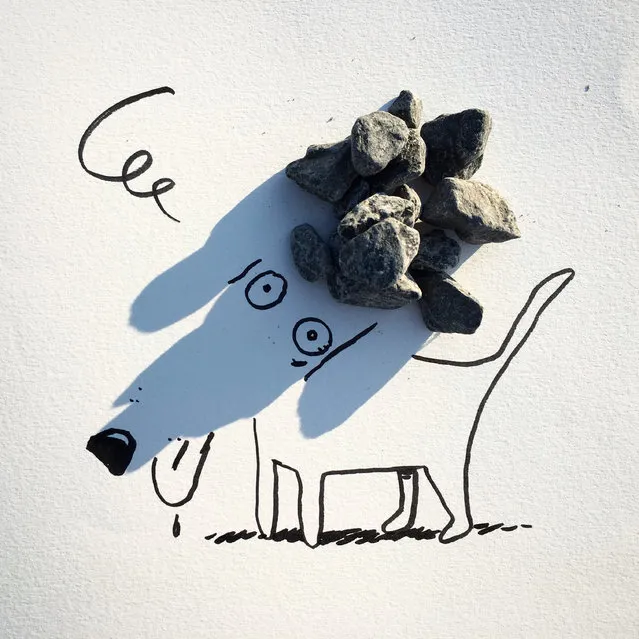
“Stonedog”. (Photo by Vincent Bal/The Guardian)

Earlier this year, Belgian film-maker and artist Vincent Bal stumbled upon an uncanny resemblance to an elephant in the shadow of his tea cup. This gave him the idea for Shadowology, a series of doodles that interact with the shadows of simple, everyday objects: a banknote, some ice cubes and a flower, for example, can turn into a church, a woman and a hippy. “I draw a few lines and I get my image. It’s really the shadows that inspire me”, Bal says. Here: “Stonedog”. (Photo by Vincent Bal/The Guardian)
Details
02 Oct 2016 08:28:00
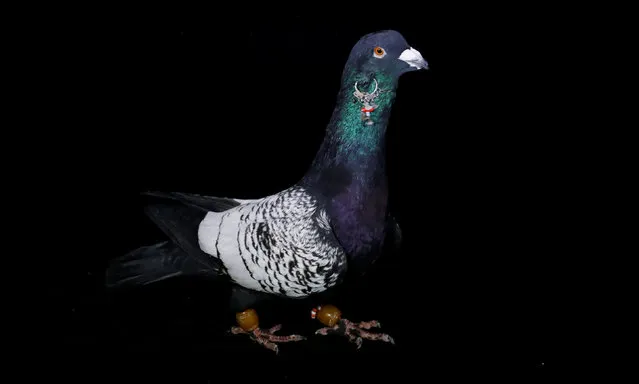
A pigeon, known as Siyah Kinifirli, with an approximate market value of 1000 Turkish Lira ($263), bred by 23-year-old Ismail Ozbek, is pictured in Sanliurfa, Turkey, December 23, 2016. As night-time approaches in Sanliurfa, southeastern Turkey, most of the alleyways of the city's old bazaar are emptying out of buyers and vendors, except for one. The bustle of daytime trading has died down, but on this little street, a stream of men carry cardboard boxes filled with pigeons to a cluster of three teahouses. Here, they sell the birds at Sanliurfa's famed auctions to a dedicated band of pigeon keepers and breeders, a pastime that has been thriving for hundreds of years across the region and over the nearby border into war-torn Syria. In a country where the minimum wage is about 1,400 Liras ($367) a month, enthusiasts regularly easily spend hundreds of dollars for one bird. “I once sold a pair of pigeons for 35,000 Turkish Lira”, says auctioneer Imam Dildas. “This is a passion, a hobby you cannot quit. I've been known to sell the fridge and my wife's gold bracelets to pay for pigeons”. (Photo by Umit Bektas/Reuters)

A pigeon, known as Siyah Kinifirli, with an approximate market value of 1000 Turkish Lira ($263), bred by 23-year-old Ismail Ozbek, is pictured in Sanliurfa, Turkey, December 23, 2016. As night-time approaches in Sanliurfa, southeastern Turkey, most of the alleyways of the city's old bazaar are emptying out of buyers and vendors, except for one. (Photo by Umit Bektas/Reuters)
Details
17 Jan 2017 12:05:00
Brtukan. “Being a girl of colour in a society where the majority of the people are white, I have had to get used to all the different ways people approach me. From being asked what kind of rap music you listen to and how you wash your hair, to getting told, “you don’t sound black”, “you’re pretty for a black girl” or “you’re not that black so it’s OK”, as if being black is such a bad thing”. (Photo by Lisa Minogue/The Guardian)

As part of FLAIR Melbourne – a Flinders Lane art festival – Melbourne’s Lisa Minogue presents stylised photographic portraits of Australian women of colour, their faces painted vibrantly to accentuate their individuality and encourage the viewer to study each face more closely. Minogue asked each woman the same question: “What do the words “coloured girl” mean to you?”. (Photo by Lisa Minogue/The Guardian)
Details
17 Aug 2016 11:16:00
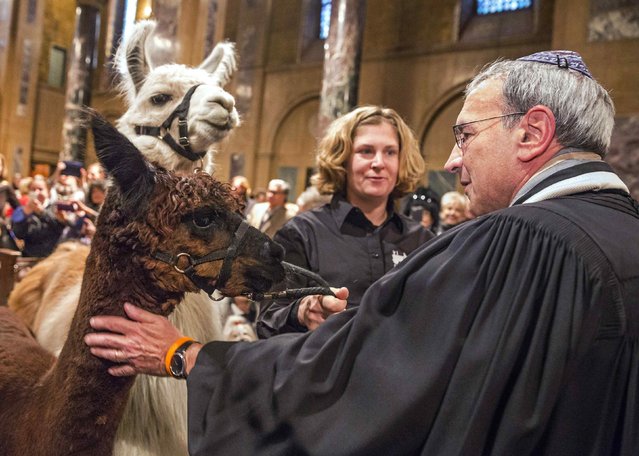
Farm animals are walked down the aisle and blessed by church officials during the “Blessing of the Animals” at the Christ Church United Methodist in Manhattan, New York December 7, 2014. (Photo by Elizabeth Shafiroff/Reuters)

Farm animals are walked down the aisle and blessed by church officials during the “Blessing of the Animals” at the Christ Church United Methodist in Manhattan, New York December 7, 2014. (Photo by Elizabeth Shafiroff/Reuters)
Details
08 Dec 2014 11:39:00
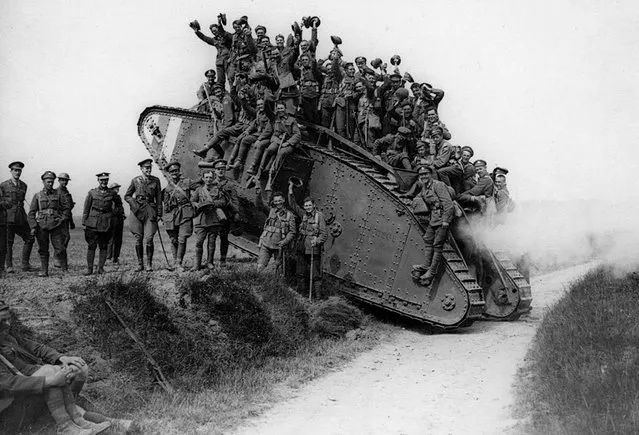
These black-and-white photos are taken from the new book “Armoured Warfare in the First World War 1916 – 1918” by Anthony Tucker-Jones and published by Pen & Sword Military. “Interestingly the British, French and Germans took completely different approaches with varying results”. The British military produced “Little Willie” in Autumn 1915 weighing 18 tonnes, which had a crew of two plus four gunners. “Inspired by a tracked artillery tractor “Little Willie” was referred to as a water tank – hence the name tank – to ensure secrecy”, said Anthony. “This led to the strange looking Mark I with its peculiar rhomboid shape, designed to cross trenches with guns in sponsons on either side. The Germans saw the tank as unchivalrous and were slow to grasp its utility. They favoured the Stormtrooper (specialist soldiers used to infiltrate enemy trenches) and artillery, not the tank”, said Anthony. “However, they didn’t hesitate to make use of captured British tanks. Although the tank helped secure victory and German soldiers dubbed it “Germany’s Downfall” the country was ultimately brought to its knees by the Allies blockade”. Here: British troops hitch a ride on a Mark IV after the massed tank fleet spearheading attack at Cambrai on November 20, 1917. (Photo by Anthony Tucker-Jones/Mediadrumworld.com)

These black-and-white photos are taken from the new book “Armoured Warfare in the First World War 1916 – 1918” by Anthony Tucker-Jones and published by Pen & Sword Military. Here: British troops hitch a ride on a Mark IV after the massed tank fleet spearheading attack at Cambrai on November 20, 1917. (Photo by Anthony Tucker-Jones/Mediadrumworld.com)
Details
23 Feb 2017 00:02:00
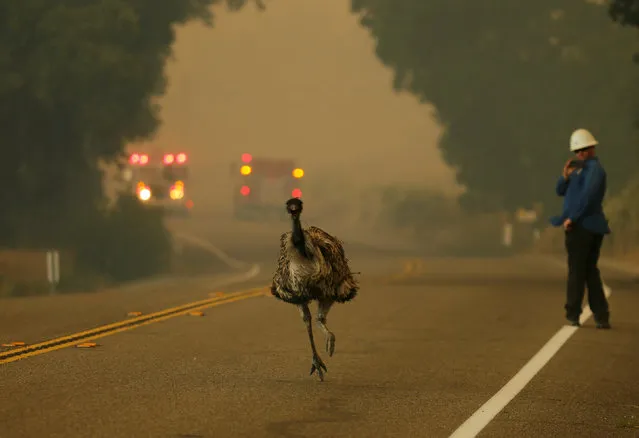
An emu runs to escape an approaching wildfire as it burns near Potero, California, U.S. June 20, 2016. (Photo by Mike Blake/Reuters)

An emu runs to escape an approaching wildfire as it burns near Potero, California, U.S. June 20, 2016. (Photo by Mike Blake/Reuters)
Details
21 Jun 2016 07:18:00