Loading...
Done
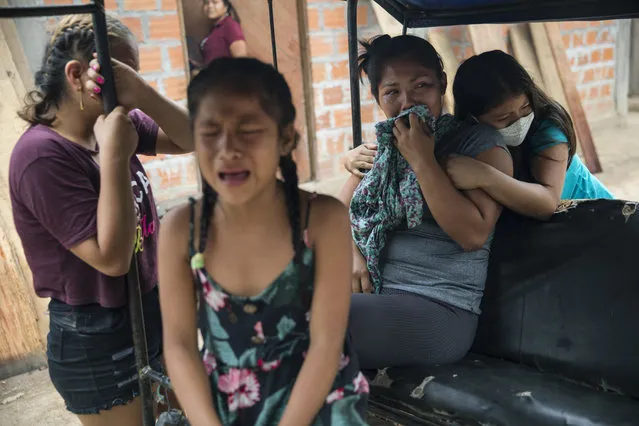
Family members mourn the passing of Manuela Chavez, who died from symptoms related to the new coronavirus at the age of 88, as a government team prepares to remove her body from inside her home, in the Shipibo Indigenous community of Pucallpa, in Peru's Ucayali region, Monday, August 31, 2020. While the lucky are cured with ancestral ailments, the less fortunate often die at home. A government team travels from one spartan, thatch-roofed home to the next, removing the dead from their homes where they took their last breaths. (Photo by Rodrigo Abd/AP Photo)

Family members mourn the passing of Manuela Chavez, who died from symptoms related to the new coronavirus at the age of 88, as a government team prepares to remove her body from inside her home, in the Shipibo Indigenous community of Pucallpa, in Peru's Ucayali region, Monday, August 31, 2020. While the lucky are cured with ancestral ailments, the less fortunate often die at home. A government team travels from one spartan, thatch-roofed home to the next, removing the dead from their homes where they took their last breaths. (Photo by Rodrigo Abd/AP Photo)
Details
18 Sep 2020 00:03:00
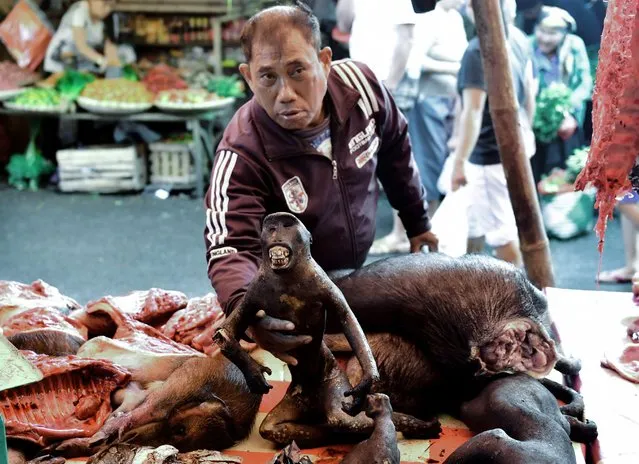
This picture taken on February 18, 2017 shows a customer holding a crested black macaque in Tomohon market in northern Sulawesi, Indonesia. (Photo by Bay Ismoyo/AFP Photo)

This picture taken on February 18, 2017 shows a customer holding a crested black macaque in Tomohon market in northern Sulawesi, Indonesia. Authorities and activists are stepping up efforts to persuade villagers on Sulawesi island to stop consuming the critically endangered crested black macaques, one of many exotic creatures that form part of the local indigenous community' s diet. The macaque' s meat is prized by the ethnic Minahasan people, a largely Christian group in the world' s most populous Muslim- majority country, who have no reservation about eating exotic animals, unlike Indonesia' s Islamic communities. (Photo by Bay Ismoyo/AFP Photo)
Details
04 Apr 2017 10:01:00
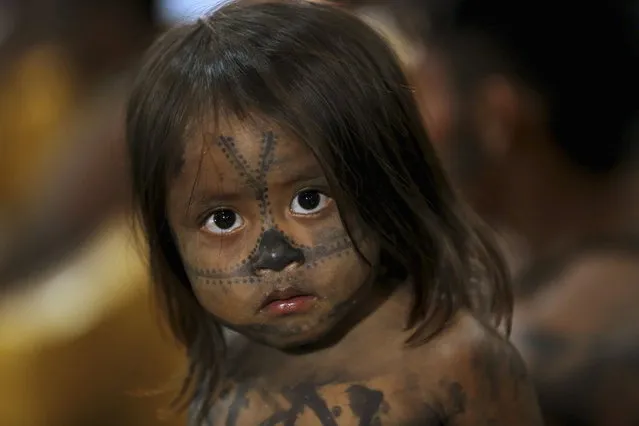
A Munduruku Indian child is pictured at the Planalto Palace, where a meeting with Minister of the General Secretariat of the Presidency of Brazil Gilberto Carvalho was being held with other Munduruku Indians, in Brasilia, June 4, 2013. (Photo by Ueslei Marcelino/Reuters)

A Munduruku Indian child is pictured at the Planalto Palace, where a meeting with Minister of the General Secretariat of the Presidency of Brazil Gilberto Carvalho was being held with other Munduruku Indians, in Brasilia, June 4, 2013. President Dilma Rousseff's government sought on Tuesday to defuse mounting conflicts with indigenous groups over its decision to stop setting aside farm land for Indians and plans to build more hydroelectric dams in the Amazon. The government flew 144 Munduruku Indians to Brasilia for talks to end a week-long occupation of the controversial Belo Monte dam on the Xingu river, a huge project aimed at feeding Brazil's fast-growing demand for electricity. (Photo by Ueslei Marcelino/Reuters)
Details
06 Jun 2013 09:25:00
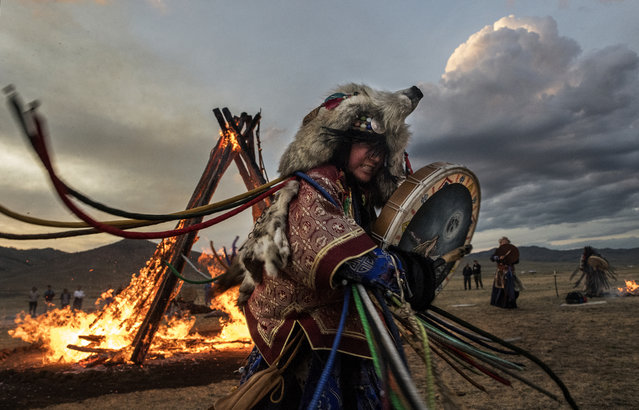
A Mongolian Shamaness or Buu, beats her drum while taking part with others in a fire ritual meant to summon spirits to mark the period of the Summer Solstice in the grasslands on June 22, 2018 outside Ulaanbaatar, Mongolia. (Photo by Kevin Frayer/Getty Images)

A Mongolian Shamaness or Buu, beats her drum while taking part with others in a fire ritual meant to summon spirits to mark the period of the Summer Solstice in the grasslands on June 22, 2018 outside Ulaanbaatar, Mongolia. Banned for 70 years under Communist rule, shamanism has seen a resurgence in Mongolia since 1992, when the ancient practice became protected by the country's Constitution. Known as Tengrism, in which Shamans channel ancestral spirits, it is widely regarded as Mongolia's national religion and part of its indigenous identity. (Photo by Kevin Frayer/Getty Images)
Details
30 Jun 2018 00:05:00
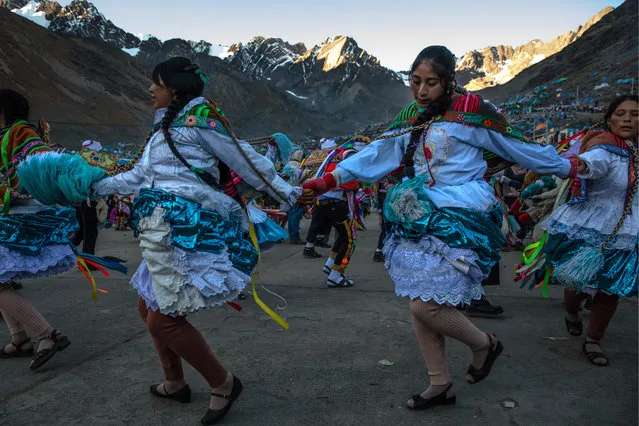
Costumed dancers parade on the first day of the annual Qoyllur Rit'i festival on May 27, 2018 in Ocongate, Peru. (Photo by Dan Kitwood/Getty Images)

Costumed dancers parade on the first day of the annual Qoyllur Rit'i festival on May 27, 2018 in Ocongate, Peru. Every year, since 1783 in the Sinakara Valley at the foot of Mt Ausagante, the Qoyllur Rit'i, or “Snow and Star” festival draws tens of thousands of pilgrims from across the Peruvian Andes and beyond to what is the biggest religious gathering of its kind. Since 1780 the event merged into a mosaic of indigenous, pagan and Catholic worship when an image of Jesus appeared on a boulder after the death of a young shepherd. (Photo by Dan Kitwood/Getty Images)
Details
05 Jun 2018 00:01:00
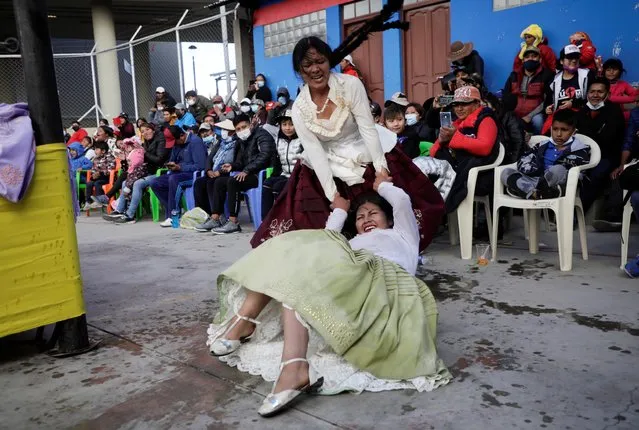
Barbara Quisbert and Susana La Bonita, cholitas wrestlers, fight during their return to the ring after the coronavirus disease (COVID-19) restrictions, in El Alto outskirts of La Paz, November 29, 2020. (Photo by David Mercado/Reuters)

The Fighting Cholitas are a group of female wrestlers who perform in El Alto, Bolivia. Tickets to the exhibitions cost $1. Like the general population of El Alto, which consists almost entirely of Aymara and Quechua residents, the Cholitas are indigenous. They wear braided hair, bowler hats and multilayered skirts in the ring. Here: Barbara Quisbert and Susana La Bonita, cholitas wrestlers, fight during their return to the ring after the coronavirus disease (COVID-19) restrictions, in El Alto outskirts of La Paz, November 29, 2020. (Photo by David Mercado/Reuters)
Details
12 Dec 2020 00:03:00
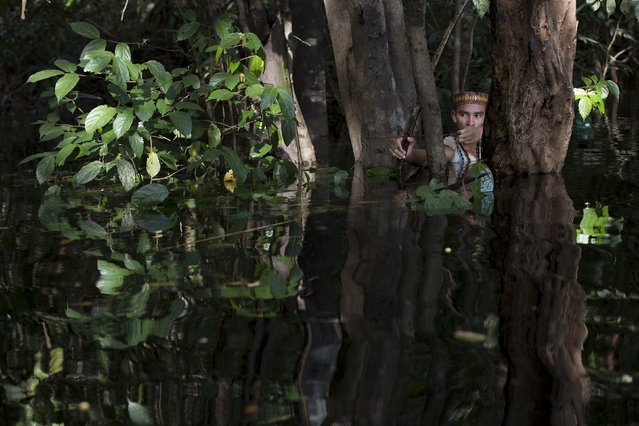
Kambeba Indian, Dream Braga, 18, aims his arrow in a jungle near the village Tres Unidos, Amazon state May 9, 2015. Dream Braga has been shooting fish with a bow and arrow for most of his life. In the Amazonian village where he grew up, that was what kids did for food and fun. (Photo by Bruno Kelly/Reuters)

Kambeba Indian, Dream Braga, 18, aims his arrow in a jungle near the village Tres Unidos, Amazon state May 9, 2015. Dream Braga has been shooting fish with a bow and arrow for most of his life. In the Amazonian village where he grew up, that was what kids did for food and fun. He participated in the Indigenous Archery Project which recruits Amazon native children to compete with modern archery equipment and try for a place on the national team, with the 2016 Olympics in Rio de Janeiro as their ultimate goal. After training with Olympic coaches for three months, he has now been promoted to Brazil's national team. (Photo by Bruno Kelly/Reuters)
Details
17 May 2015 11:19:00
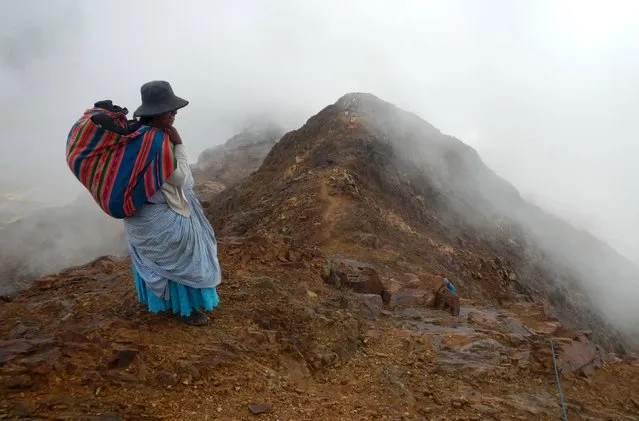
A porter stands at the bottom of the Illimani mountain, on the outskirts of La Paz, Bolivia, April 16, 2016. (Photo by David Mercado/Reuters)

A porter stands at the bottom of the Illimani mountain, on the outskirts of La Paz, Bolivia, April 16, 2016. For years, Lydia Huayllas, 48, has worked as a cook at base camps and mountain-climbing refuges on the steep, glacial slopes of Huayna Potosi, a 19,974-foot (6,088-meter) Andean peak outside of La Paz, Bolivia. But two years ago, she and 10 other Aymara indigenous women, ages 42 to 50, who also worked as porters and cooks for mountaineers, put on crampons – spikes fixed to a boot for climbing – under their wide traditional skirts and started to do their own climbing. (Photo by David Mercado/Reuters)
Details
22 Apr 2016 12:33:00