Loading...
Done
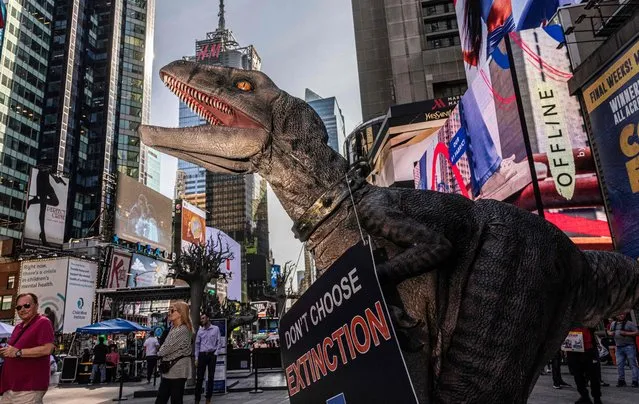
Frankie the Dinosaur, mascot of the United Nations Development Program “Don't Choose Extinction” visits Times Square spreading his climate-related message in New York on September 21, 2022. (Photo by Alex Kent/AFP Photo)

Frankie the Dinosaur, mascot of the United Nations Development Program “Don't Choose Extinction” visits Times Square spreading his climate-related message in New York on September 21, 2022. (Photo by Alex Kent/AFP Photo)
Details
29 Sep 2022 03:52:00
Isabeau Levito of the United States reacts after skating in the women's free program during the International Skating Union (ISU) World Figure Skating Championships in Montreal, Canada, on March 22, 2024. (Photo by Geoff Robins/AFP Photo)

Isabeau Levito of the United States reacts after skating in the women's free program during the International Skating Union (ISU) World Figure Skating Championships in Montreal, Canada, on March 22, 2024. (Photo by Geoff Robins/AFP Photo)
Details
30 Mar 2024 05:17:00
Participants hold flags during a demonstration lesson that is part of an extracurricular military-patriotic program, which involves weapon training, first aid treatment, camping skills and other courses, in Sevastopol, Crimea on May 19, 2023. (Photo by Alexey Pavlishak/Reuters)

Participants hold flags during a demonstration lesson that is part of an extracurricular military-patriotic program, which involves weapon training, first aid treatment, camping skills and other courses, in Sevastopol, Crimea on May 19, 2023. (Photo by Alexey Pavlishak/Reuters)
Details
10 Jun 2023 03:04:00
A Tampa Bay Buccaneers cheerleader, wear a military-inspired outfit as part of the NFL's Salute to Service program, flips her hair during a game between the Buccaneers and San Diego Chargers in Tampa, on November 11, 2012. (Photo by Phelan M. Ebenhack/Associated Press)

A Tampa Bay Buccaneers cheerleader, wear a military-inspired outfit as part of the NFL's Salute to Service program, flips her hair during a game between the Buccaneers and San Diego Chargers in Tampa, on November 11, 2012. (Photo by Phelan M. Ebenhack/Associated Press)
Details
15 Nov 2012 09:12:00


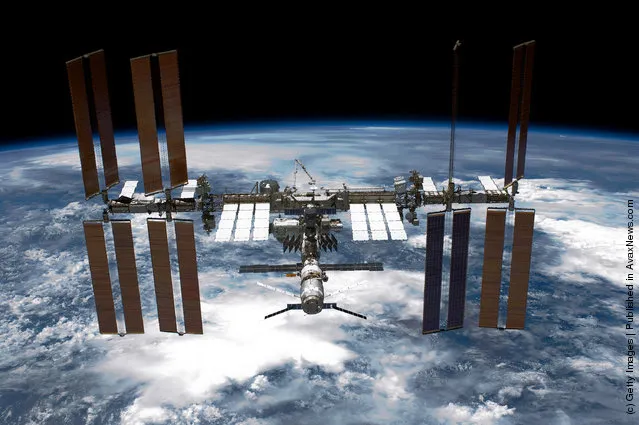
Back dropped by planet Earth the International Space Station (ISS) is seen from NASA space shuttle Endeavour after the station and shuttle began their post-undocking relative separation May 29, 2011 in space. After 20 years, 25 missions and more than 115 million miles in space, NASA space shuttle Endeavour is on the last leg of its final flight to the International Space Station before being retired and donated to the California Science Center in Los Angeles. Capt. Mark E. Kelly, U.S. Rep. Gabrielle Giffords' (D-AZ) husband, has lead mission STS-134 as it delivered the Express Logistics Carrier-3 (ELC-3) and the Alpha Magnetic Spectrometer (AMS-2) to the International Space Station. (Photo by NASA via Getty Images)
Details
01 Jun 2011 06:47:00
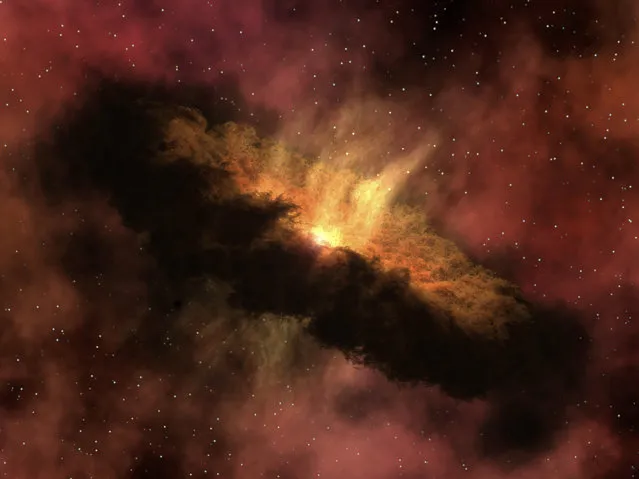
A fledgling solar system containing deep within it enough water vapor to fill all the oceans on Earth five times, located in our Milky Way galaxy about 1,000 light years from Earth in the constellation Perseus. (Photo by Reuters/NASA/JPL-Caltech)

A fledgling solar system containing deep within it enough water vapor to fill all the oceans on Earth five times, located in our Milky Way galaxy about 1,000 light years from Earth in the constellation Perseus. (Photo by Reuters/NASA/JPL-Caltech)
Details
28 Sep 2016 11:01:00
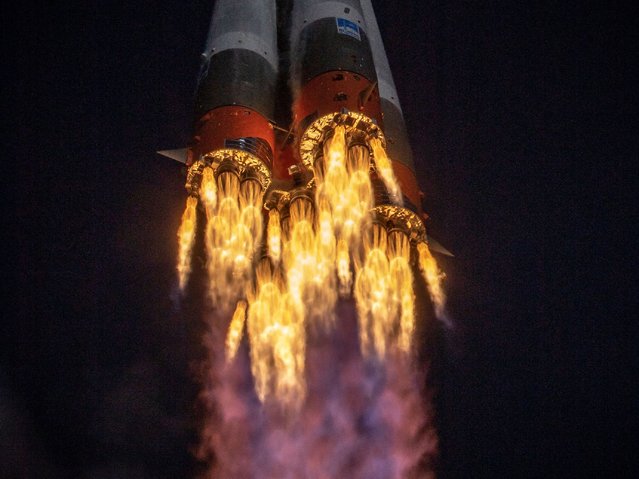
The Soyuz MS-17 spacecraft carrying the International Space Station (ISS) expedition 64 crew of NASA astronaut Kate Rubins and Russian cosmonauts Sergey Ryzhikov and Sergey Kud-Sverchkov blasts off to the ISS from the Russian-leased Baikonur cosmodrome in Kazakhstan on October 14, 2020. (Photo by Roscosmos/Handout via AFP Photo)

The Soyuz MS-17 spacecraft carrying the International Space Station (ISS) expedition 64 crew of NASA astronaut Kate Rubins and Russian cosmonauts Sergey Ryzhikov and Sergey Kud-Sverchkov blasts off to the ISS from the Russian-leased Baikonur cosmodrome in Kazakhstan on October 14, 2020. (Photo by Roscosmos/Handout via AFP Photo)
Details
16 Oct 2020 00:07:00
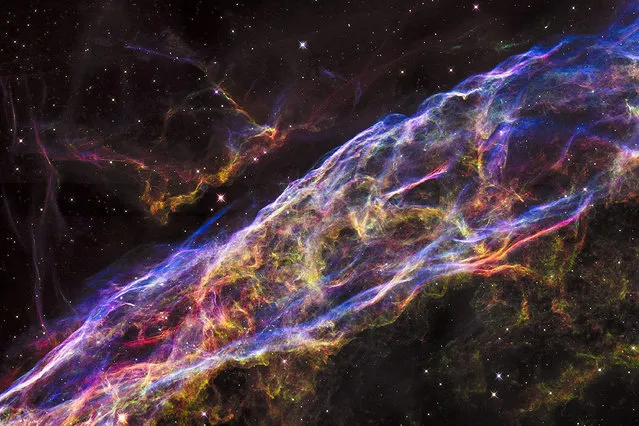
A small section of the expanding remains of the Veil Nebula, a massive star that exploded about 8,000 years ago. The entire nebula is 110 light-years across, covering six full moons on the sky as seen from Earth, and resides about 2,100 light-years away in the constellation Cygnus, the Swan. (Photo by Reuters/NASA/ESA/Hubble)

A small section of the expanding remains of the Veil Nebula, a massive star that exploded about 8,000 years ago. The entire nebula is 110 light-years across, covering six full moons on the sky as seen from Earth, and resides about 2,100 light-years away in the constellation Cygnus, the Swan. (Photo by Reuters/NASA/ESA/Hubble)
Details
29 Feb 2016 11:30:00