Loading...
Done
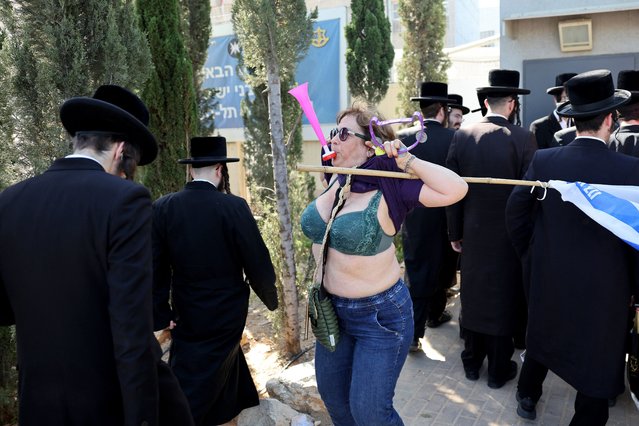
An Israeli protester lifts her T-shirt next to Ultra-Orthodox Jewish men outside an army recruiting office in the town of Kiryat Ono near Tel Aviv on March 5, 2024, during a demonstration against their exemption from serving in the army. Since the October 7 attack by Palestinian militants, the question surrounding whether the insular community, whose members see army service as conflicting with their religious duties, should be obligated to serve has sparked debate and led to protests against their decades-long exemptions. (Photo by Jack Guez/AFP Photo)

An Israeli protester lifts her T-shirt next to Ultra-Orthodox Jewish men outside an army recruiting office in the town of Kiryat Ono near Tel Aviv on March 5, 2024, during a demonstration against their exemption from serving in the army. Since the October 7 attack by Palestinian militants, the question surrounding whether the insular community, whose members see army service as conflicting with their religious duties, should be obligated to serve has sparked debate and led to protests against their decades-long exemptions. (Photo by Jack Guez/AFP Photo)
Details
16 Jul 2025 04:12:00
A child blowing confetti from her hands during a Carnival parade in Cyprus' coastal city of Limassol, Sunday, March 13, 2016. Limassol's long-established parade is Cyprus' biggest and most famous, drawing revelers from across the east Mediterranean island. This year's parade drew huge crowds as people sought lighthearted reprieve from the bailed-out country's recession. The parade marks the start of the 40-day fasting period of Lent in the run-up to the Orthodox Christian Easter. (Photo by Petros Karadjias/AP Photo)

A child blowing confetti from her hands during a Carnival parade in Cyprus' coastal city of Limassol, Sunday, March 13, 2016. Limassol's long-established parade is Cyprus' biggest and most famous, drawing revelers from across the east Mediterranean island. This year's parade drew huge crowds as people sought lighthearted reprieve from the bailed-out country's recession. The parade marks the start of the 40-day fasting period of Lent in the run-up to the Orthodox Christian Easter. (Photo by Petros Karadjias/AP Photo)
Details
14 Mar 2016 10:21:00
Fishermen collect their catch from a net at Dojran Lake, Macedonia, January 4, 2017. (Photo by Ognen Teofilovski/Reuters)

Fishermen collect their catch from a net at Dojran Lake, Macedonia, January 4, 2017. Fish from the lake is a traditional food for locals for orthodox Christmas eve, which falls on January 6. The lake faced sustainability issues during the 1990s due to drought and excessive use of its water but has since recovered after measures were taken to replenish and sustain water levels, according to local media. Dojran Lake is one of the three natural lakes in Macedonia, and also the warmest. It is said it is also the richest lake in fish in Europe. (Photo by Ognen Teofilovski/Reuters)
Details
05 Jan 2017 13:41:00
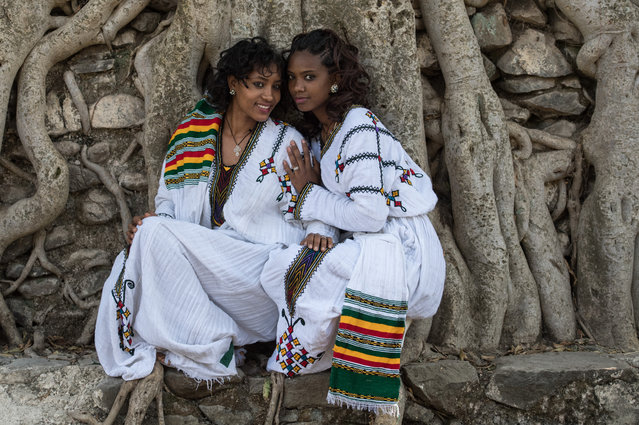
 Women pose for a photograph in traditional Ethiopian dress during the annual Timkat Epiphany celebration on January 19, 2017 in Gondar, Ethiopia. (Photo by Carl Court/Getty Images)

Women pose for a photograph in traditional Ethiopian dress during the annual Timkat Epiphany celebration on January 19, 2017 in Gondar, Ethiopia. Timkat is the Ethiopian Orthodox Christian festival which celebrates the baptism of Jesus in the Jordan river. During the festival, Tabots, or models of the Ark of the Covenant, are taken from churches around Gondar and paraded through the streets to Fasilides Bath. (Photo by Carl Court/Getty Images)
Details
21 Jan 2017 11:29:00


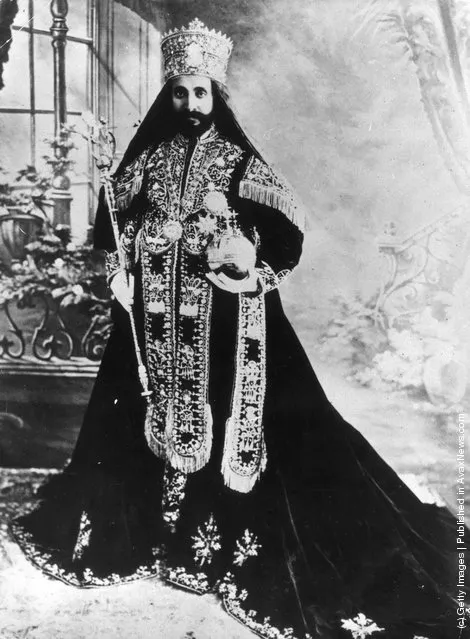
“Haile Selassie I (23 July 1892 – 27 August 1975), born Tafari Makonnen, was Ethiopia's regent from 1916 to 1930 and Emperor of Ethiopia from 1930 to 1974. The heir to a dynasty that traced its origins to the 13th century, and from there by tradition back to King Solomon and Queen Makeda, Empress of Axum, known in the Abrahamic tradition as the Queen of Sheba. Haile Selassie is a defining figure in both Ethiopian and African history.

Haile Selassie is revered as the returned Messiah of the Bible, God incarnate, among the Rastafari movement, the number of followers of which is estimated between 200,000 and 800,000. Begun in Jamaica in the 1930s, the Rastafari movement perceives Haile Selassie as a messianic figure who will lead a future golden age of eternal peace, righteousness, and prosperity. He himself remained an Ethiopian Orthodox Christian throughout his life”. – Wikipedia

Photo: Negusa Negasti, Emperor of Ethiopia Haile Selassie I, known as “Lord of Lords”, “The Conquering Lion of the tribe of Judah”, “Light of the world”, “Elect of God”, in full ceremonial regalia following his coronation. (Photo by Hulton Archive/Getty Images)
Details
21 Jun 2011 11:04:00


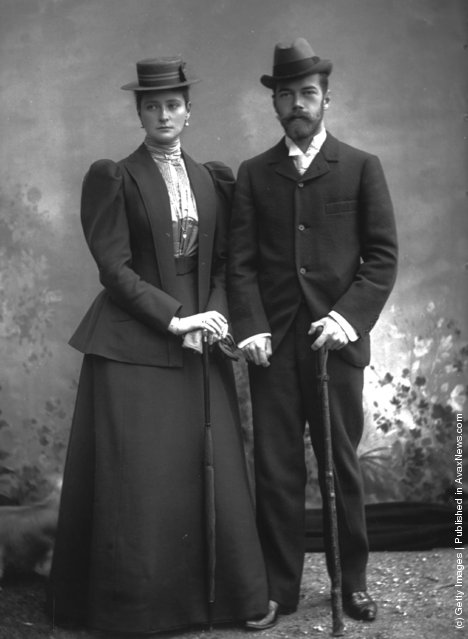
“Nicholas II (Russian: Николай II, Николай Александрович Романов, tr. Nikolay II, Nikolay Alexandrovich Romanov) (18 May [O.S. 6 May] 1868 – 17 July 1918) was the last Emperor of Russia, Grand Prince of Finland, and titular King of Poland. His official title was Nicholas II, Emperor and Autocrat of All the Russias and he is known as Saint Nicholas the Passion-Bearer by the Russian Orthodox Church. Nicholas II, his wife, his son, his four daughters, the family's medical doctor, the Tsar's valet, the Empress' lady-in-waiting and the family's cook were murdered in the same room by the Bolsheviks on the night of 16/17 July 1918”. – Wikipedia

Photo: Tsar Nicholas II (1868–1918) with his wife. (Photo by W. & D. Downey/Getty Images). Circa 1900
Details
12 May 2011 07:26:00
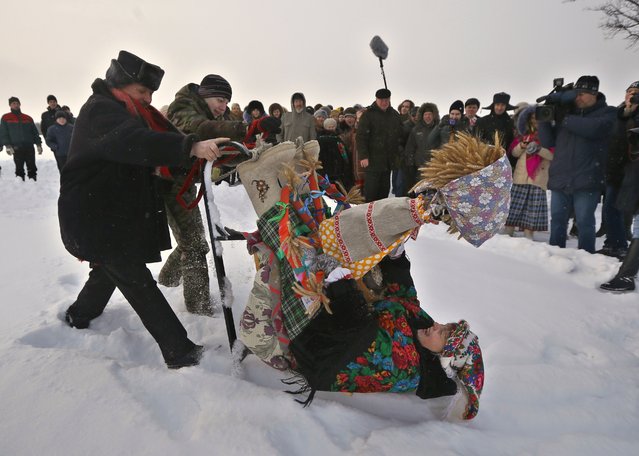
Belarusians wearing national costumes celebrate a Pull the Kolyada Up the Oak rite in the village of Martsiyanauka, some 77 km (48 miles) east of capital Minsk, Belarus, Thursday, January 21, 2016. (Photo by Sergei Grits/AP Photo)

Belarusians wearing national costumes celebrate a Pull the Kolyada Up the Oak rite in the village of Martsiyanauka, some 77 km (48 miles) east of capital Minsk, Belarus, Thursday, January 21, 2016. The merry ancient rite Pull the Kolyada Up the Oak marks the end of Orthodox Christmas celebrations in Belarus. On Jan. 21 a wheel, the so-called Kolyada, would be pulled up an oak or any old tree. The Belarusians believed that the ritual heralds a good harvest, luck and happiness for the entire year. (Photo by Sergei Grits/AP Photo)
Details
22 Jan 2016 10:13:00
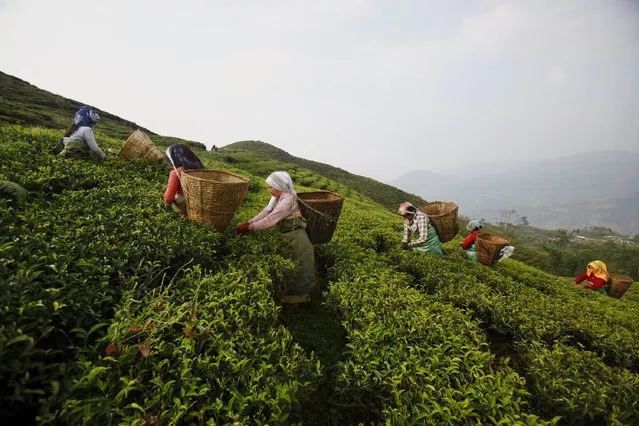
In this Sunday, November 16, 2014 photo, Nepalese women pick tea at a tea garden of Kanyam in Illam district, around 500 kilometers (310 miles) from Katmandu, Nepal. Illam is a hilly district of tea gardens and estates in eastern Nepal's Himalayan region with one of its largest and most productive tea estate being Kanyam estates. (Photo by Niranjan Shrestha/AP Photo)

In this Sunday, November 16, 2014 photo, Nepalese women pick tea at a tea garden of Kanyam in Illam district, around 500 kilometers (310 miles) from Katmandu, Nepal. Illam is a hilly district of tea gardens and estates in eastern Nepal's Himalayan region with one of its largest and most productive tea estate being Kanyam estates. The district produces orthodox tea, hand-processed or machine rolled, which is generally exported to international markets, specially Europe and the United States. Most of the tea pickers here are paid 186 Nepalese Rupees (US $ 2) for 8 hours of work everyday. (Photo by Niranjan Shrestha/AP Photo)
Details
19 Nov 2014 14:28:00