Loading...
Done
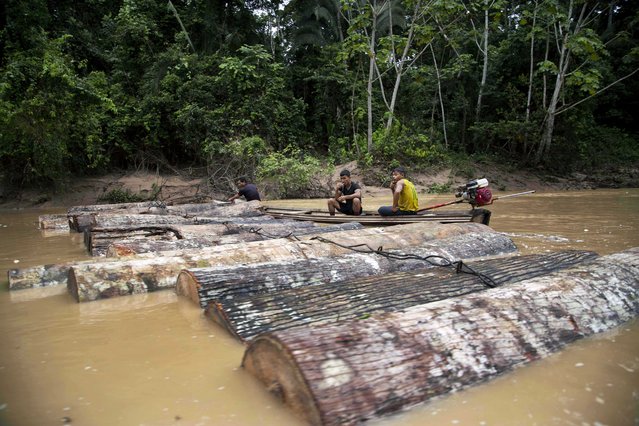
In this March 17, 2015 photo, Ashaninka Indian men, identified by locals as illegal loggers, tie tree trunks together to move them along the Putaya River near the hamlet of Saweto, Peru. Illegal logging persists unabated in this remote Amazon community where four indigenous leaders who resisted it were slain in September. The Putaya River is the waterway that transports felled trees, cut both legally and illegally, to the city of Pucallpa. (Photo by Martin Mejia/AP Photo)

In this March 17, 2015 photo, Ashaninka Indian men, identified by locals as illegal loggers, tie tree trunks together to move them along the Putaya River near the hamlet of Saweto, Peru. Illegal logging persists unabated in this remote Amazon community where four indigenous leaders who resisted it were slain in September. The Putaya River is the waterway that transports felled trees, cut both legally and illegally, to the city of Pucallpa. (Photo by Martin Mejia/AP Photo)
Details
27 Mar 2015 12:40:00
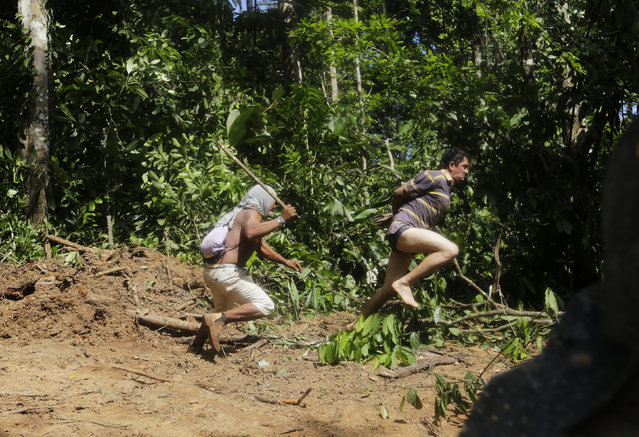
A Ka'apor Indian warrior (L) chases a logger who tried to escape after they captured him during a jungle expedition to search for and expel loggers from the Alto Turiacu Indian territory, near the Centro do Guilherme municipality in the northeast of Maranhao state in the Amazon basin, August 7, 2014. (Photo by Lunae Parracho/Reuters)

A Ka'apor Indian warrior (L) chases a logger who tried to escape after they captured him during a jungle expedition to search for and expel loggers from the Alto Turiacu Indian territory, near the Centro do Guilherme municipality in the northeast of Maranhao state in the Amazon basin, August 7, 2014. Tired of what they say is a lack of sufficient government assistance in keeping loggers off their land, the Ka'apor Indians, who along with four other tribes are the legal inhabitants and caretakers of the territory, have sent their warriors out to expel all loggers they find and set up monitoring camps in the areas that are being illegally exploited. (Photo by Lunae Parracho/Reuters)
Details
05 Sep 2014 11:41:00
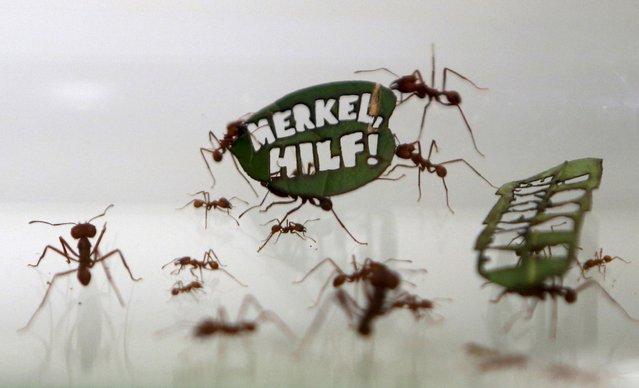
Ants carry a leaf with a slogan reading “Merkel, Help!”, a reference of German Chancellor Angela Merkel, at the zoo in Cologne, Germany August 18, 2015. Some of the zoo's 500,000 leaf-cutting ants carry laser-cut leaves with slogans during a campaign to protect the Amazon rain forest, organised by the German branch of World Wild Fund for Nature (WWF) and Cologne Zoo. Picture taken through the glass of the display case. (Photo by Ina Fassbender/Reuters)

Ants carry a leaf with a slogan reading “Merkel, Help!”, a reference of German Chancellor Angela Merkel, at the zoo in Cologne, Germany August 18, 2015. Some of the zoo's 500,000 leaf-cutting ants carry laser-cut leaves with slogans during a campaign to protect the Amazon rain forest, organised by the German branch of World Wild Fund for Nature (WWF) and Cologne Zoo. Picture taken through the glass of the display case. (Photo by Ina Fassbender/Reuters)
Details
19 Aug 2015 12:14:00


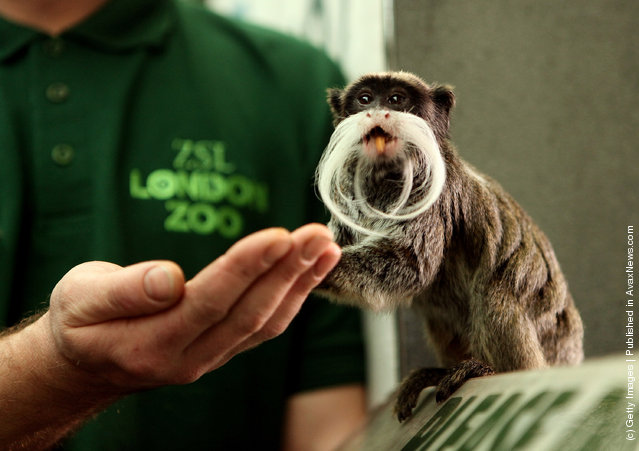
An Emperor Tamarin monkey, native to the Amazon rainforest, experiences its new home in the living rainforest enclosure at ZSL London Zoo on March 25, 2010 in London, England. Entitled “Rainforest Life” the large temperature and humidity controlled bio-dome is home to free-roaming monkeys, sloths, tree anteaters and tropical birds. The exhibit, which is opening in the International Year of Biodiversity, will be open to the public from March 27, 2010. (Photo by Oli Scarff/Getty Images)
Details
19 Apr 2011 11:48:00
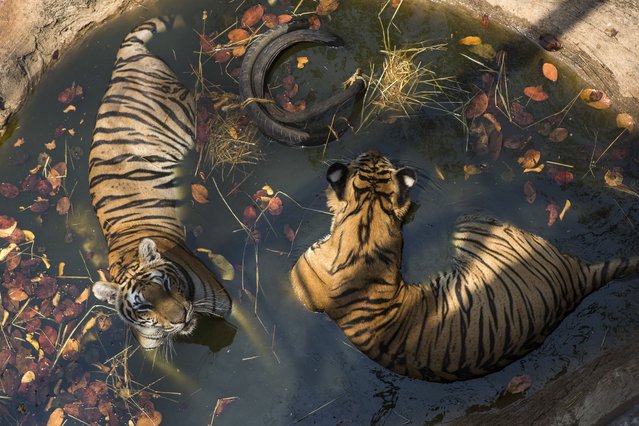
A pair of tigers soak in a shallow pool at Tiger Temple, a Buddhist monastery where paying visitors can interact with young adult tigers, in Kanchanaburi, Thailand, March 16, 2016. The attraction, near the Myanmar border, started collecting the animals 15 years ago when villagers brought an injured tiger cub to the local abbot, who agreed to care for it. Today there are nearly 150 tigers at the monastery. (Photo by Amanda Mustard/The New York Times)

A pair of tigers soak in a shallow pool at Tiger Temple, a Buddhist monastery where paying visitors can interact with young adult tigers, in Kanchanaburi, Thailand, March 16, 2016. The attraction, near the Myanmar border, started collecting the animals 15 years ago when villagers brought an injured tiger cub to the local abbot, who agreed to care for it. Today there are nearly 150 tigers at the monastery. (Photo by Amanda Mustard/The New York Times)
Details
04 May 2016 12:08:00


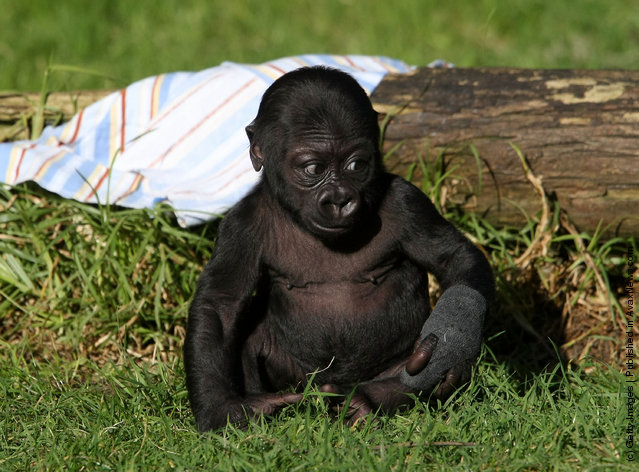
A three month-old baby gorilla named Hasani sits in the grass March 11, 2009 at the San Francisco Zoo in San Francisco, California. The newborn gorilla was given the name Hasani. Hasani's father, a twenty seven year-old gorilla named Oscar Jonsey, picked between five color coded cantaloupes representing the five name finalists to come up with the newborn's name that was submitted by Amanda VerPloeg of Oskaloosa, Iowa. (Photo by Justin Sullivan/Getty Images)
Details
30 Mar 2011 13:46:00
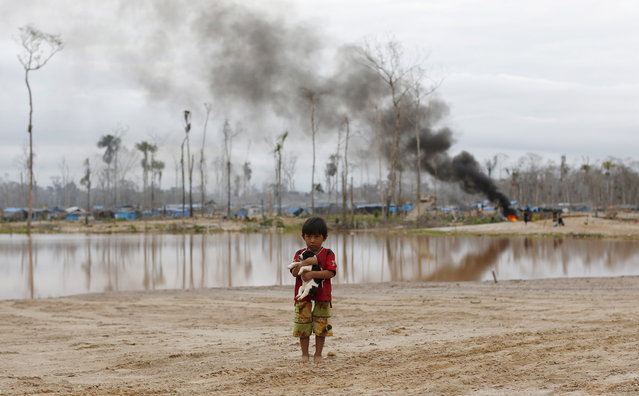
A boy carries a dog as he stands after a Peruvian police operation to destroy illegal gold mining camps in a zone known as Mega 14, in the southern Amazon region of Madre de Dios July 14, 2015. Peruvian police razed dozens of illegal gold mining camps at the edge of an Amazonian nature reserve this week, part of a renewed bid to halt the spread of wildcatting in a remote rainforest region. (Photo by Janine Costa/Reuters)

A boy carries a dog as he stands after a Peruvian police operation to destroy illegal gold mining camps in a zone known as Mega 14, in the southern Amazon region of Madre de Dios July 14, 2015. Peruvian police razed dozens of illegal gold mining camps at the edge of an Amazonian nature reserve this week, part of a renewed bid to halt the spread of wildcatting in a remote rainforest region. (Photo by Janine Costa/Reuters)
Details
18 Jul 2015 12:29:00
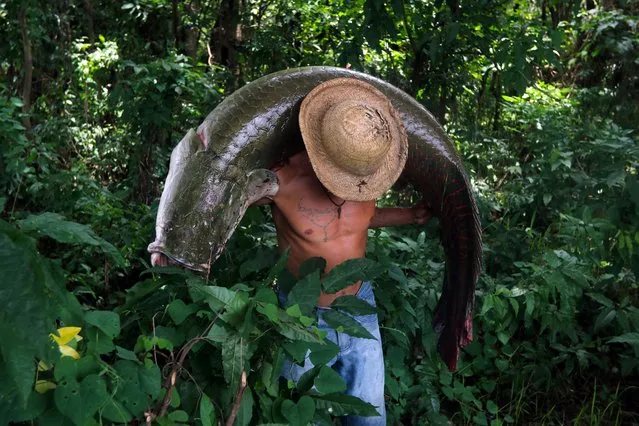
A fisherman carries a large Pirarucu (Arapaima gigas) at the Piagacu-Purus Sustainable Development Reserve in Amazonas state, Brazil, on October 24, 2019. The pirarucu -a giant fish of the Amazon, that had been on the verge of extinction- can measure up to three meters and weigh more than 200 kilos. The soft and tasty white meat fish is nowadays served in renowned restaurants in Rio de Janeiro. (Photo by Ricardo Oliveira/AFP Photo)

A fisherman carries a large Pirarucu (Arapaima gigas) at the Piagacu-Purus Sustainable Development Reserve in Amazonas state, Brazil, on October 24, 2019. The pirarucu -a giant fish of the Amazon, that had been on the verge of extinction- can measure up to three meters and weigh more than 200 kilos. The soft and tasty white meat fish is nowadays served in renowned restaurants in Rio de Janeiro. (Photo by Ricardo Oliveira/AFP Photo)
Details
31 Oct 2019 00:07:00