Loading...
Done
Deadly Insects Hornet

Hornets are insects that are the largest eusocial wasps. Some species can reach up to 5.5 cm (2.2 in) in length. The true hornets make up the genus Vespa and are distinguished from other vespines by the width of the vertex (part of the head behind the eyes), which is proportionally larger in Vespa and by the anteriorly rounded gasters (the section of the abdomen behind the wasp waist). The best known species is the European hornet (Vespa crabro), about 2–3.5 cm in length, widely distributed throughout Europe, Russia, North America and Northeast Asia.
Details
13 Oct 2014 10:17:00


A North Korean soldier looks through a window at Australian Prime Minister Julia Gillard (L) and her partner Tim Mathieson (C) while they visit the United Nations Command Military Armistice Commission (UNCMAC) meeting room at the border village of Panmunjom, between South and North Korea, on April 24, 2011 South Korea. Gillard will visit Japan, the Republic of Korea and China during a bilateral tour of North Asia from April 20-27. (Photo by Jeon Heon-Kyun-pool/Getty Images)
Details
26 Apr 2011 06:48:00
Acid attack survivors wait in the back stage prior to participate in a fashion show titled “Beauty Redefined” organized by ActionAid Bangladesh in Dhaka, Bangladesh, March 7, 2017. (Photo by Mohammad Ponir Hossain/Reuters)

Acid attack survivors wait in the back stage prior to participate in a fashion show titled “Beauty Redefined” organized by ActionAid Bangladesh in Dhaka, Bangladesh, March 7, 2017. Such horrific violence across South Asia is often prompted by insufficient dowries, rejection of advances or land disputes, disfiguring victims for life and ruining their prospects. (Photo by Mohammad Ponir Hossain/Reuters)
Details
10 Mar 2017 00:01:00
Scared of Heights. “Taken from the highest residential building in Asia: the Zenith in Busan. This was taken with official permission (which took me months to get) and safety measures were taken. I had to hang myself over the edge to get this shot. Not for the faint of heart! But when you’re at a height like this, the world below you just seems different. It takes away the fear one would normally have, and gives a sense of peace instead”. (Photo by Albert Dros/NatGeo Cities Travel Photographer of the Year 2017)

Scared of Heights. “Taken from the highest residential building in Asia: the Zenith in Busan. This was taken with official permission (which took me months to get) and safety measures were taken. I had to hang myself over the edge to get this shot. Not for the faint of heart! But when you’re at a height like this, the world below you just seems different. It takes away the fear one would normally have, and gives a sense of peace instead”. (Photo by Albert Dros/NatGeo Cities Travel Photographer of the Year 2017)
Details
03 Jul 2017 08:55:00
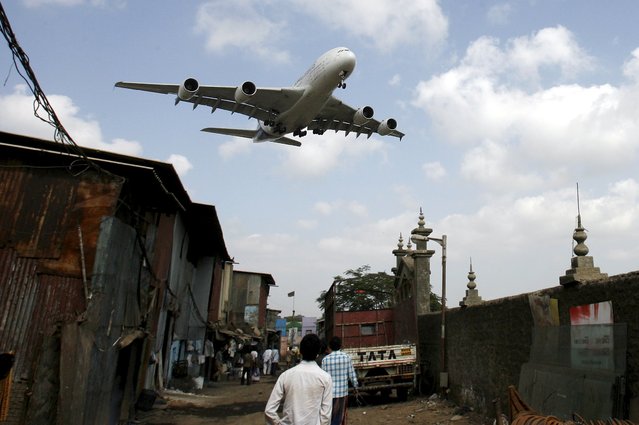
An Airbus A380 aircraft prepares to land at Mumbai airport in this May 8, 2007 file photo. Sentiment at some of Asia's biggest firms deteriorated again in the fourth quarter, falling to a four-year low under the weight of concerns about slowing growth in China, the region's biggest economy, a Thomson Reuters/INSEAD survey showed. (Photo by Arko Datta/Reuters)

An Airbus A380 aircraft prepares to land at Mumbai airport in this May 8, 2007 file photo. Sentiment at some of Asia's biggest firms deteriorated again in the fourth quarter, falling to a four-year low under the weight of concerns about slowing growth in China, the region's biggest economy, a Thomson Reuters/INSEAD survey showed. (Photo by Arko Datta/Reuters)
Details
27 Dec 2015 08:03:00
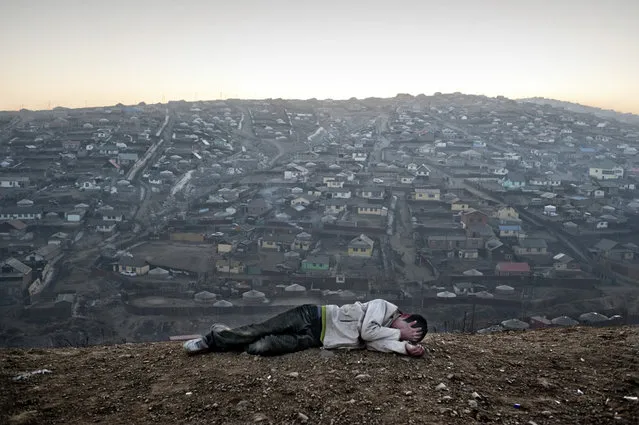
Asia, Mongolia, March 27, 2011. A view of Ulaan Baator over the shoulder of a slumbering drunk. Alcoholism is a huge problem in the city, home to almost half of Mongolia's people. The capital's population has doubled in the past two years, expanding outward in a haphazard sprawl, and many inhabitants live in slums known as the “Gher District”. (Photo by Alessandro Grassani)

“Environmental Migrants: The Last Illusion” by photographer Alessandro Grassani, documents the life of people in Kenya, Mongolia and Bangladesh who migrate to escape environmental stresses to the city of their own countries in hopes for a better life. Here: Asia, Mongolia, March 27, 2011. A view of Ulaan Baator over the shoulder of a slumbering drunk. Alcoholism is a huge problem in the city, home to almost half of Mongolia's people. The capital's population has doubled in the past two years. High levels of unemployment and poverty await herders who abandon rural areas and arrive in the city, illiterate and untrained in any skills necessary for urban jobs. (Photo by Alessandro Grassani)
Details
21 Jul 2015 10:10:00
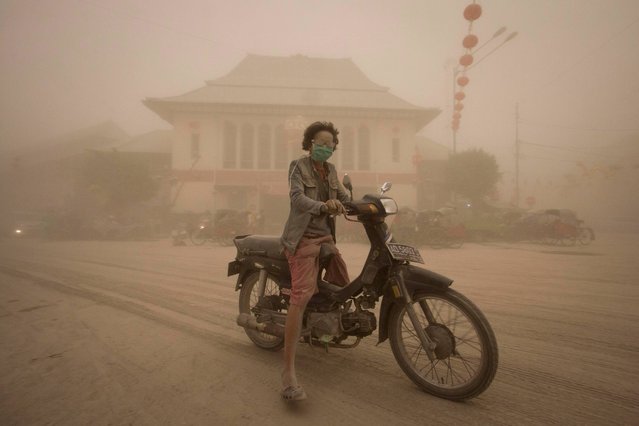
A women rides a motor bike on a street covered with volcanic ash from an eruption of Mount Kelud, in Solo, Indonesia, Friday, February 14, 2014. A major volcanic eruption in Indonesia blasted clouds of ash and debris 18 kilometers (12 miles) into the air on Friday, forcing authorities to close six airports, cancel flights elsewhere in Southeast Asia and evacuate more than 100,000 people from the mountain. (Photo by Hafidz Novalsyah/AP Photo)

A women rides a motor bike on a street covered with volcanic ash from an eruption of Mount Kelud, in Solo, Indonesia, Friday, February 14, 2014. A major volcanic eruption in Indonesia blasted clouds of ash and debris 18 kilometers (12 miles) into the air on Friday, forcing authorities to close six airports, cancel flights elsewhere in Southeast Asia and evacuate more than 100,000 people from the mountain. (Photo by Hafidz Novalsyah/AP Photo)
Details
15 Feb 2014 07:38:00
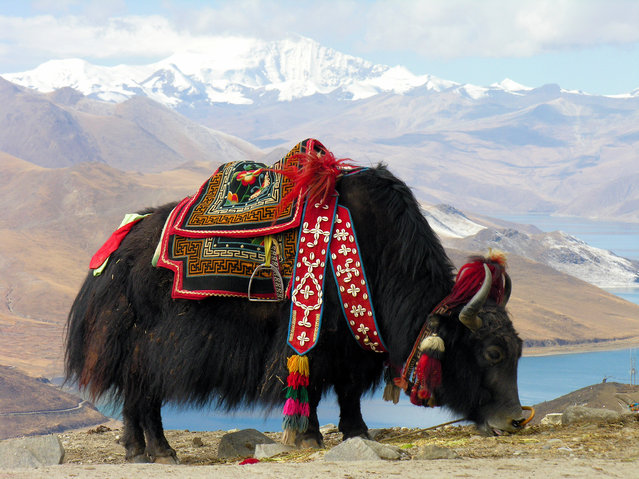
Yak near Yamdrok lake, Tibet. It is a long-haired bovinae found throughout the Himalayan region of south Central Asia, the Tibetan Plateau and as far north as Mongolia and Russia. The Tibetan economy is dominated by subsistence agriculture. Due to limited arable land, the primary occupation of the Tibetan Plateau is raising livestock, such as sheep, cattle, goats, camels, yaks, dzo, and horses. The Tibetan yak is an integral part of Tibetan life. (Photo by Dennis Jarvis)

Yak near Yamdrok lake, Tibet. It is a long-haired bovinae found throughout the Himalayan region of south Central Asia, the Tibetan Plateau and as far north as Mongolia and Russia. The Tibetan economy is dominated by subsistence agriculture. Due to limited arable land, the primary occupation of the Tibetan Plateau is raising livestock, such as sheep, cattle, goats, camels, yaks, dzo, and horses. The Tibetan yak is an integral part of Tibetan life. (Photo by Dennis Jarvis)
Details
10 Jun 2015 10:48:00