Loading...
Done
U.S. Air Force wounded warrior, Capt. Sarah Evans, jumps rope in a gym in San Antonio, Texas. Evans was diagnosed with cancer while deployed to Afghanistan and was medically evacuated back to the United States where her leg was amputated. (Photo by Master Sgt. Jeffrey Allen/U.S. Air Force)

U.S. Air Force wounded warrior, Capt. Sarah Evans, jumps rope in a gym in San Antonio, Texas. Evans was diagnosed with cancer while deployed to Afghanistan and was medically evacuated back to the United States where her leg was amputated. (Photo by Master Sgt. Jeffrey Allen/U.S. Air Force)
Details
26 Mar 2015 11:43:00
A cleric and a woman pray behind a closed door of Masoume shrine in the city of Qom, some 80 miles (125 kilometers) south of the capital Tehran, Iran, Monday, March 16, 2020. On Monday, Iran closed the Masoume shrine, a major pilgrimage site in the city of Qom, the epicenter of the country's new coronavirus outbreak. Authorities were already restricting access and barring pilgrims from kissing or touching the shrine, but it had remained open. (Photo by AP Photo)

A cleric and a woman pray behind a closed door of Masoume shrine in the city of Qom, some 80 miles (125 kilometers) south of the capital Tehran, Iran, Monday, March 16, 2020. On Monday, Iran closed the Masoume shrine, a major pilgrimage site in the city of Qom, the epicenter of the country's new coronavirus outbreak. Authorities were already restricting access and barring pilgrims from kissing or touching the shrine, but it had remained open. (Photo by AP Photo)
Details
23 Mar 2020 00:01:00
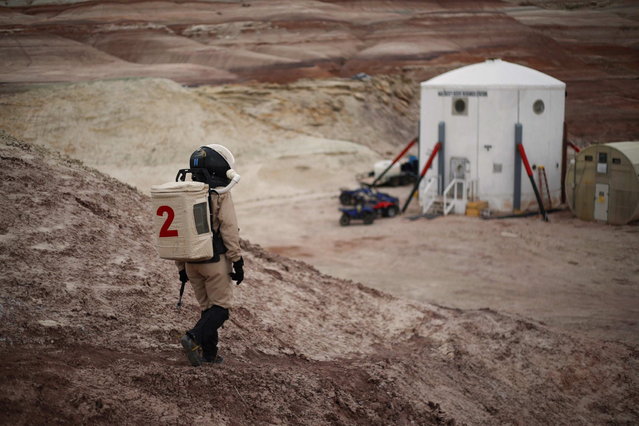
Csilla Orgel, a geologist of Crew 125 EuroMoonMars B mission, makes her way back to the Mars Desert Research Station (MDRS) in the Utah desert March 3, 2013. (Photo by Jim Urquhart/Reuters)

NASA says it could be another 20 years before humans touch down on Mars, but in a sense, the Mars Society has been exploring the red planet for more than a decade – in Utah. Photo: Csilla Orgel, a geologist of Crew 125 EuroMoonMars B mission, makes her way back to the Mars Desert Research Station (MDRS) in the Utah desert March 3, 2013. The MDRS aims to investigate the feasibility of a human exploration of Mars and uses the Utah desert's Mars-like terrain to simulate working conditions on the red planet. Scientists, students and enthusiasts work together developing field tactics and studying the terrain. All outdoor exploration is done wearing simulated spacesuits and carrying air supply packs and crews live together in a small communication base with limited amounts of electricity, food, oxygen and water. Everything needed to survive must be produced, fixed and replaced on site. (Photo by Jim Urquhart/Reuters)
Details
14 Mar 2013 12:11:00
In this photo taken on Saturday, March 9, 2019, a visitor dances in front of a sculpture burning at the Maslenitsa (Shrovetide) festival at the Nikola-Lenivets art park in Nikola-Lenivets village, about 200 kilometers (125 miles) south-west of Moscow, Russia. As part of the celebrations of Maslenitsa (Shrovetide) Holiday in Russian, a folk holiday which heralds the beginning of spring, contemporary artist and park founder Nikolay Polissky built a giant sculpture made of wood and hay which was burnt to ashes during a traditional bonfire. (Photo by Alexander Zemlianichenko Jr./AP Photo)

In this photo taken on Saturday, March 9, 2019, a visitor dances in front of a sculpture burning at the Maslenitsa (Shrovetide) festival at the Nikola-Lenivets art park in Nikola-Lenivets village, about 200 kilometers (125 miles) south-west of Moscow, Russia. As part of the celebrations of Maslenitsa (Shrovetide) Holiday in Russian, a folk holiday which heralds the beginning of spring, contemporary artist and park founder Nikolay Polissky built a giant sculpture made of wood and hay which was burnt to ashes during a traditional bonfire. (Photo by Alexander Zemlianichenko Jr./AP Photo)
Details
27 Jul 2019 00:01:00
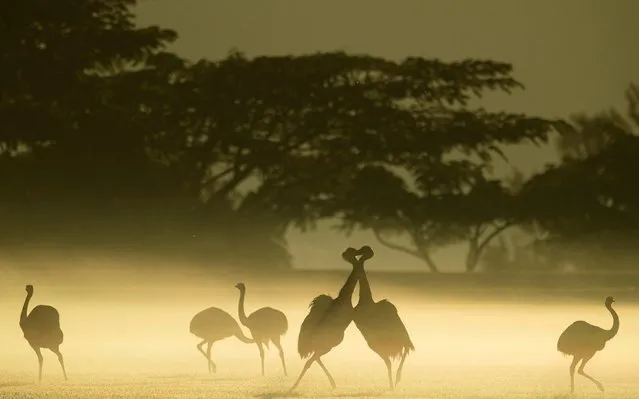
View of a group of ostriches, in the gardens of the Palacio do Alvorada, in Brasilia, Brazil, 02 June 2020. The ostrich is the largest and heaviest bird in the world. When the chicks hatch they are between 25 and 30 cm tall, weighing about 900 grams. (Photo by Joedson Alves/EPA/EFE/Rex Features/Shutterstock)

View of a group of ostriches, in the gardens of the Palacio do Alvorada, in Brasilia, Brazil, 02 June 2020. The ostrich is the largest and heaviest bird in the world. When the chicks hatch they are between 25 and 30 cm tall, weighing about 900 grams. (Photo by Joedson Alves/EPA/EFE/Rex Features/Shutterstock)
Details
08 Jun 2020 00:03:00
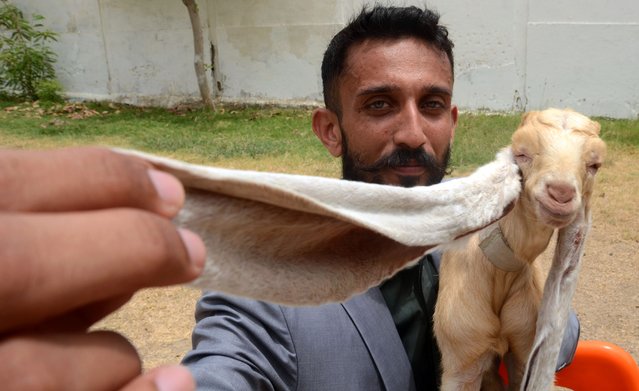
A baby goat named Simba, has the World's longest ears which are 48 cm, is seen with her owner in Karachi, Pakistan on June 16, 2022. (Photo by Yousuf Khan/Anadolu Agency via Getty Images)

A baby goat named Simba, has the World's longest ears which are 48 cm, is seen with her owner in Karachi, Pakistan on June 16, 2022. (Photo by Yousuf Khan/Anadolu Agency via Getty Images)
Details
03 Jul 2022 04:35:00
Guinness World Records declared Afshin Ghaderzadeh 20 years old as world’s shortest man with the height of 65.24 cm in Dubai on December 15, 2022. The Iranian citizen takes the title from previous record-holder Edward Hernandez, from Colombia, who stands at 72cm tall. (Photo by Pawan Singh/The National)

Guinness World Records declared Afshin Ghaderzadeh 20 years old as world’s shortest man with the height of 65.24 cm in Dubai on December 15, 2022. The Iranian citizen takes the title from previous record-holder Edward Hernandez, from Colombia, who stands at 72cm tall. (Photo by Pawan Singh/The National)
Details
17 Dec 2022 00:04:00
Deadly Insects Hornet

Hornets are insects that are the largest eusocial wasps. Some species can reach up to 5.5 cm (2.2 in) in length. The true hornets make up the genus Vespa and are distinguished from other vespines by the width of the vertex (part of the head behind the eyes), which is proportionally larger in Vespa and by the anteriorly rounded gasters (the section of the abdomen behind the wasp waist). The best known species is the European hornet (Vespa crabro), about 2–3.5 cm in length, widely distributed throughout Europe, Russia, North America and Northeast Asia.
Details
13 Oct 2014 10:17:00