Loading...
Done


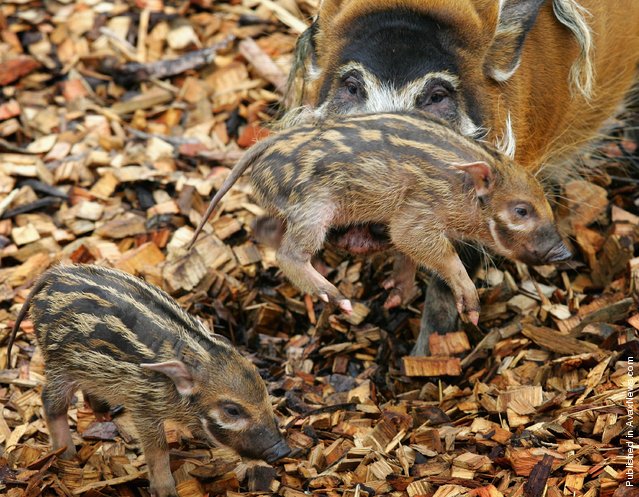
“The Red River Hog (Potamochoerus porcus), also known as the Bush Pig (but not to be confused with P. larvatus, common name “Bushpig”), is a wild member of the pig family living in Africa, with most of its distribution in the Guinean and Congolian forests. It is rarely seen away from rainforests, and generally prefers areas near rivers or swamps.

Red River Hogs eat grass, berries, roots, insects, molluscs, small vertebrates and carrion. They are capable of causing damage to plantations. Red River Hogs typically live in herds of 6-20 members led by a dominant boar. Sows rear 3-6 piglets at a time.”

Photo: Two 17 day old red river hoglet twins forage for food next to their mother Bahiti at London Zoo on August 23, 2007 in London, England. Red River hoglets inhabit the forests and swamps of West and Central Africa. The recent additions to the London Zoo pig pen have been eagerly awaited by zoo keepers. (Photo by Chris Jackson/Getty Images)
Details
18 Mar 2011 15:15:00
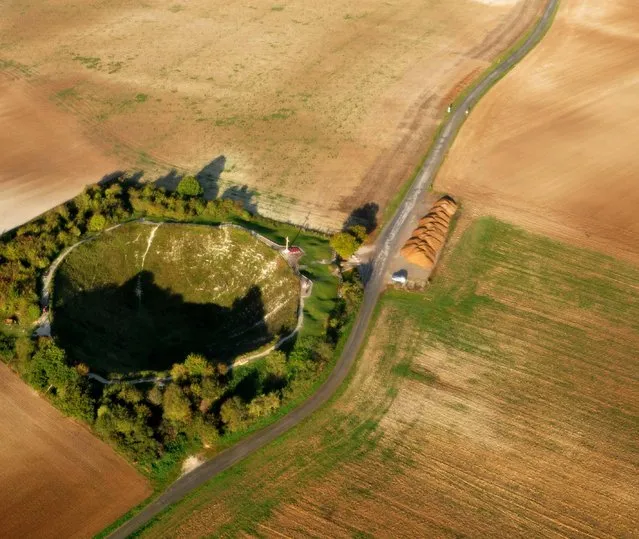
Lochnagar Crater Somme In France

It is amazing how much the humanity can change the face of the earth. Not only can it create huge craters, which look a lot like craters from meteors, they leave a big enough impact that it can be seen from space. Though this crater, caused by a massive explosion on 1 July 1916, looks large, being 90 feet deep and 300 feet across; it is nowhere big enough to be viewed for space. A common misconception is that the Great Wall of China can be seen from space. In reality, however, it is impossible. Not only is it of the same color as the earth near it, it is also not that wide. Deforestation, on the other hand, can be clearly seen from space. Also, at night, all the lights that the large cities produce are also very visible.
Details
17 Nov 2014 12:48:00


“San Diego Comic-Con International, also known as Comic-Con International: San Diego (as given on its website), and commonly known as Comic-Con or the San Diego Comic-Con, was founded as the Golden State Comic Book Convention and later the San Diego Comic Book Convention in 1970 by Shel Dorf and a group of San Diegans. It is traditionally a four-day event (Thursday through Sunday — though a three-hour preview night on Wednesday is open to professionals, exhibitors, and some guests pre-registered for all four days) held during the summer in San Diego, California, United States, at the San Diego Convention Center. Comic-Con is both the name of the annual event and the common name of the organization”. – Wikipedia

Photo: Rannie Rodil and Laya Bella attend Day 1 at Comic-Con 2011 on July 21, 2011 in San Diego, California. (Photo by John Shearer/Getty Images)
Details
24 Jul 2011 14:05:00
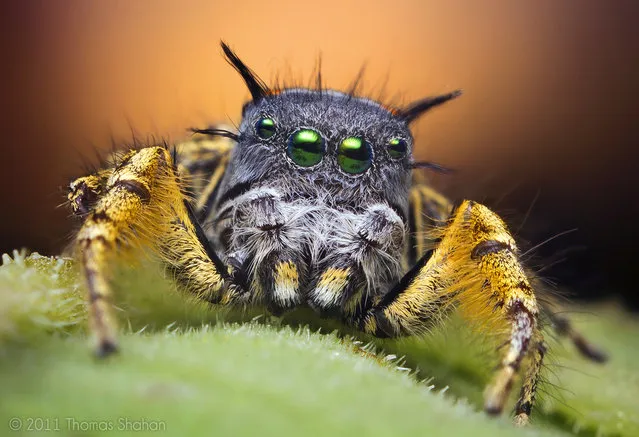
Adult Male Jumping Spider at Sunset – Phidippus mystaceus

“Hey! I'm Thomas Shahan, an artist and macrophotographer from Oklahoma. In my spare time over the past few years, I've been shooting portraiture of local arthropods. Why would I devote countless hours to tramping through forests, fields and the like searching for insects and spiders? Well, despite some common beliefs, arthropods (members of the phylum Arthropoda – insects, spiders, crustaceans...) represent an endlessly varied, wildly beautiful and fascinating bunch of animals with surprisingly personable faces and behavior. Often, all it takes is simply inspecting their lives on a closer level to turn repulsion to reverence”. – Thomas Shahan

Photo: Adult Male Jumping Spider at Sunset – Phidippus mystaceus. (Photo by Thomas Shahan; Source: Flickr)
Details
23 Apr 2012 14:07:00
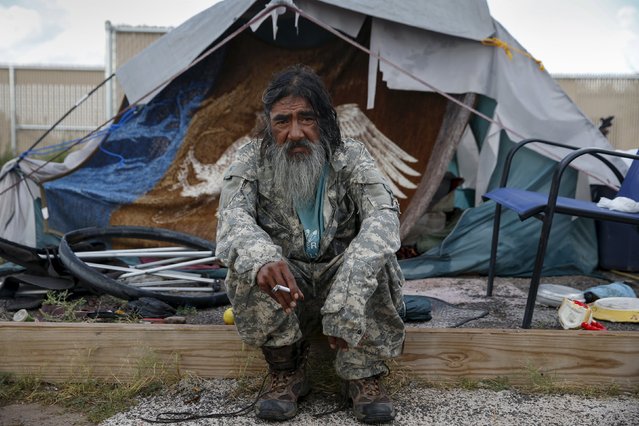
Daniel J. Wabsey, a 58-year-old war veteran, sits outside his tent at Camp Hope in Las Cruces, New Mexico October 6, 2015. “I've been traveling for 35 or 38 years. Getting inside would take a while to get used to. I just want to be able to eat, sleep and be safe. We all get along and understand in Camp Hope. We've all been there. With common sense you can survive out here”, Wabsey said. Camp Hope describe themselves as an “alternative transitional living project for the homeless”. Around 50 people live at the camp. (Photo by Shannon Stapleton/Reuters)

Daniel J. Wabsey, a 58-year-old war veteran, sits outside his tent at Camp Hope in Las Cruces, New Mexico October 6, 2015. “I've been traveling for 35 or 38 years. Getting inside would take a while to get used to. I just want to be able to eat, sleep and be safe. We all get along and understand in Camp Hope. We've all been there. With common sense you can survive out here”, Wabsey said. Camp Hope describe themselves as an “alternative transitional living project for the homeless”. Around 50 people live at the camp. (Photo by Shannon Stapleton/Reuters)
Details
19 Dec 2015 08:05:00
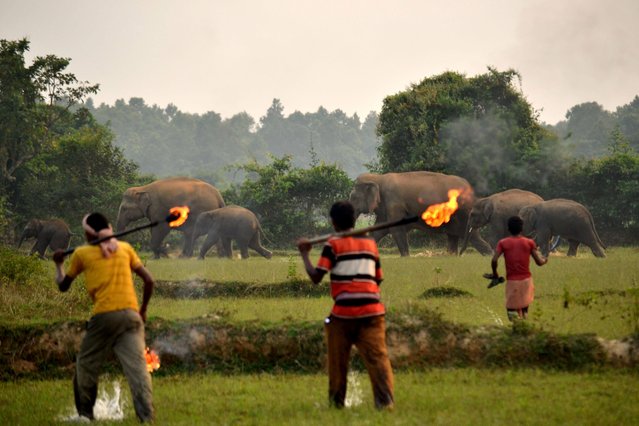
These heartbreaking photo show a confused family of elephants attempting to navigate a railway line built straight through their habitat on October 16, 2012. Taken by Biplab Hazra in Bishnupur, India, the images show the extreme lengths the inhabitants of the town go to to deter elephants from damaging their crops and property. As the images show, villagers often resort to extreme tactics in an effort to drive the elephants out  with one shocking photograph revealing firebombs being launched at a mother and calf as they cross the road. Elephants encroaching out of their habitats is an increasingly common occurrence with deforestation in much of India. (Photo by Biplab Hazra/Caters News Agency)

These heartbreaking photo show a confused family of elephants attempting to navigate a railway line built straight through their habitat on October 16, 2012. Taken by Biplab Hazra in Bishnupur, India, the images show the extreme lengths the inhabitants of the town go to to deter elephants from damaging their crops and property. As the images show, villagers often resort to extreme tactics in an effort to drive the elephants out with one shocking photograph revealing firebombs being launched at a mother and calf as they cross the road. Elephants encroaching out of their habitats is an increasingly common occurrence with deforestation in much of India. (Photo by Biplab Hazra/Caters News Agency)
Details
26 Jan 2019 00:05:00
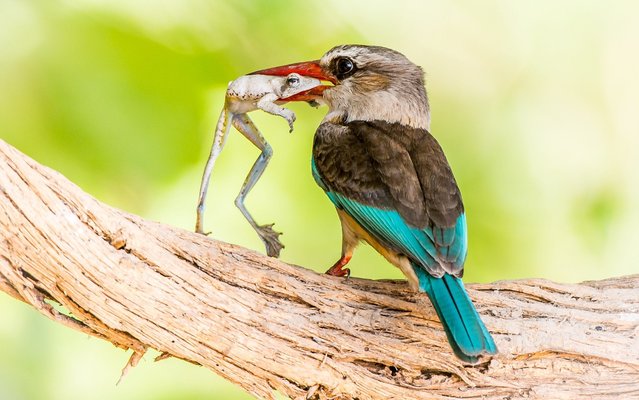
A brown-hooded kingfisher sits on a branch with a freshly caught frog in it's beak. Riaan Marais who took the photo said, “We were doing a boat safari on the Rufiji river in Selous Game Reserve, Tanzania when I spotted the bird with the frog on an overhanging branch on the river bank. It most probably caught the frog in the reeds along the river’s edge as this is where these frogs stay. The kingfisher must have caught the Common Reed Frog just before I took the image, as the frog was still alive, I had a brief moment to take the image before the bird flew off with the frog”. (Photo by Riaan Marais/Solent News and Photo Agency)

A brown-hooded kingfisher sits on a branch with a freshly caught frog in it's beak. Riaan Marais who took the photo said, “We were doing a boat safari on the Rufiji river in Selous Game Reserve, Tanzania when I spotted the bird with the frog on an overhanging branch on the river bank. It most probably caught the frog in the reeds along the river’s edge as this is where these frogs stay. The kingfisher must have caught the Common Reed Frog just before I took the image, as the frog was still alive, I had a brief moment to take the image before the bird flew off with the frog”. (Photo by Riaan Marais/Solent News and Photo Agency)
Details
10 Jun 2018 00:03:00
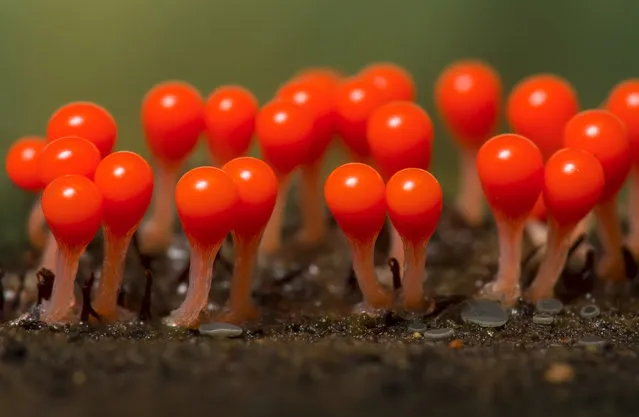
These may look like alien creatures from another planet, but the odd organisms are, in fact, colorful, microscopic life forms found in our forests. The bizarre slime molds, known as mycetozoa or fungus animals, were captured by geologist Valeriya Zvereva. (Photo by Valeriya Zvereva/Caters News)

These may look like alien creatures from another planet, but the odd organisms are, in fact, colorful, microscopic life forms found in our forests. The bizarre slime molds, known as mycetozoa or fungus animals, were captured by geologist Valeriya Zvereva. She spent months documenting the common life forms that are found beneath our feet – but are rarely seen. Incredibly, the organisms can move and hunt for other microscopic life forms on which to feed. Zvereva, who is from Moscow, used a special macro lens to capture the vibrant and up-close shots, which show off the organisms’ unlikely beauty. (Photo by Valeriya Zvereva/Caters News)
Details
20 Apr 2015 13:27:00