Loading...
Done
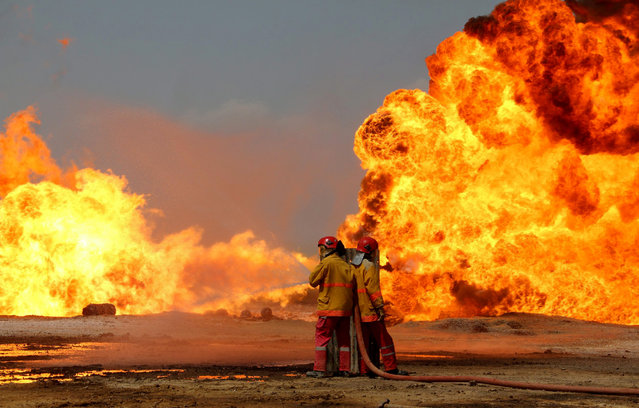
Iraqi firefighters try to stop the fire of burning oil wells in Kirkuk, northern Iraq, 02 June 2016. Two Khabbaz oil field wells in Kirkuk Province, northern Iraq, exploded by suspected insurgents, a security official said. (Photo by EPA/Stringer)

Iraqi firefighters try to stop the fire of burning oil wells in Kirkuk, northern Iraq, 02 June 2016. Two Khabbaz oil field wells in Kirkuk Province, northern Iraq, exploded by suspected insurgents, a security official said. (Photo by EPA/Stringer)
Details
12 Nov 2016 10:42:00
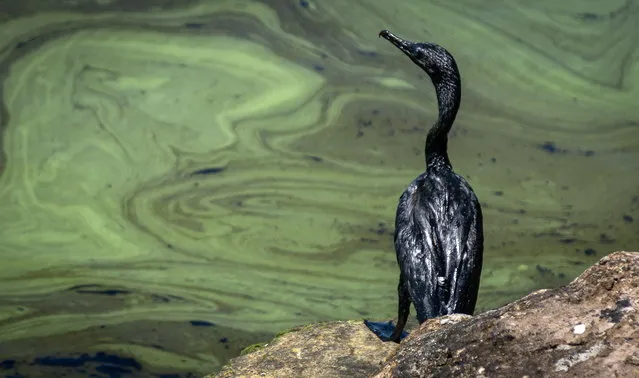
View of an oil-stained bird on the shore of a contaminated lake in Maracaibo, Venezuela on June 22, 2023. The Azul Ambientalistas foundation denounced on 22 June the “state of emergency” in which the Maracaibo Lake, the largest in Venezuela, finds itself, due to oil spills that, it assured, are affecting the lake economy and the health of the people. (Photo by Henry Chirinos/EPA)

View of an oil-stained bird on the shore of a contaminated lake in Maracaibo, Venezuela on June 22, 2023. The Azul Ambientalistas foundation denounced on 22 June the “state of emergency” in which the Maracaibo Lake, the largest in Venezuela, finds itself, due to oil spills that, it assured, are affecting the lake economy and the health of the people. (Photo by Henry Chirinos/EPA)
Details
24 Dec 2023 23:00:00
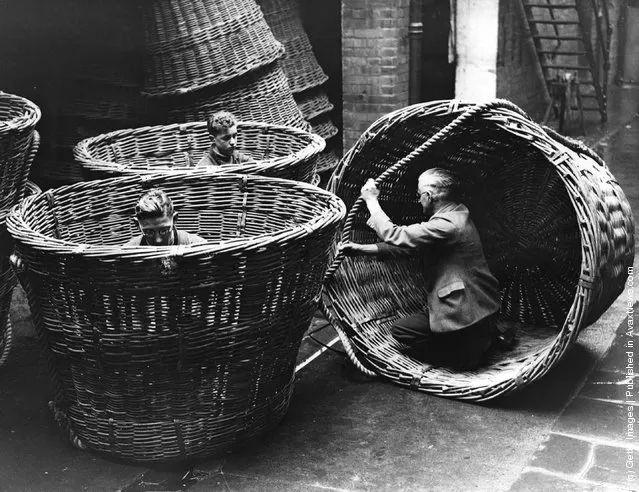
Men at work at the Cardiff Institute, making huge baskets, unique in size and construction, for loading oil cake in South Africa, 1938

Men at work at the Cardiff Institute, making huge baskets, unique in size and construction, for loading oil cake in South Africa. (Photo by Maeers/Getty Images). 1938
Details
05 Dec 2011 13:27:00
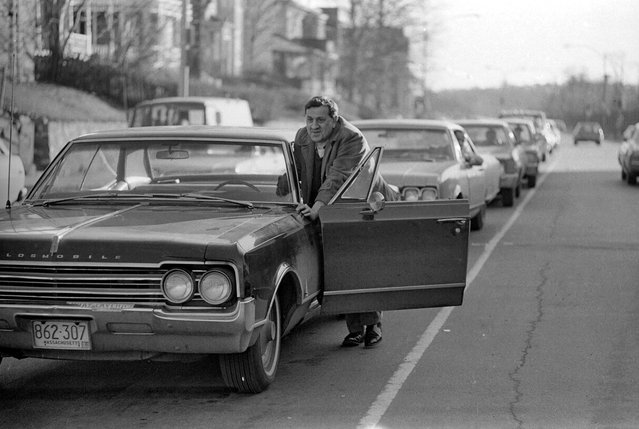
Drivers push cars to gas station during “oil crisis”, Roslindale, Boston, Massachusetts, 1973. (Photo by Spencer Grant/Getty Images)

Drivers push cars to gas station during “oil crisis”, Roslindale, Boston, Massachusetts, 1973. (Photo by Spencer Grant/Getty Images)
Details
18 Nov 2021 08:30:00
A Turkana man and a boy carrying a gun look on as a G3 battle rifle hangs from a structure used to dry fish at a fishing camp on the shores of Lake Turkana, some kilometres from Todonyang near the Kenya-Ethiopia border in northwestern Kenya October 12, 2013. (Photo by Siegfried Modola/Reuters)

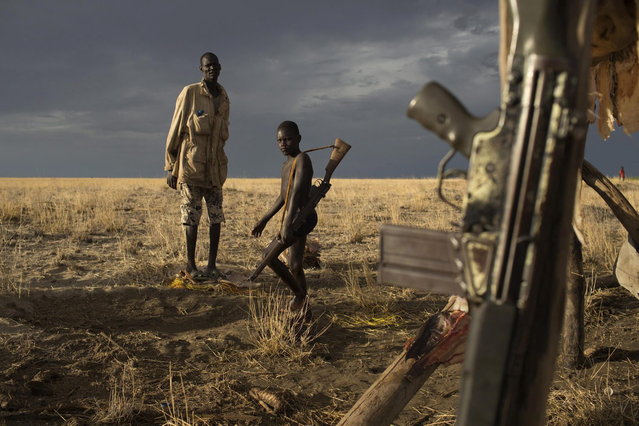
A Turkana man and a boy carrying a gun look on as a G3 battle rifle hangs from a structure used to dry fish at a fishing camp on the shores of Lake Turkana, some kilometres from Todonyang near the Kenya-Ethiopia border in northwestern Kenya October 12, 2013The Turkana are traditionally nomadic pastoralists, but they have seen the pasture that they need to feed their herds suffer from recurring droughts and many have turned to fishing. However, Lake Turkana is overfished, and scarcity of food and pastureland is fuelling long-standing conflict with Ethiopian indigenous Dhaasanac, who have seen grazing grounds squeezed by large-scale government agricultural schemes in southern Ethiopia. The Dhaasanac now venture ever deeper into Kenyan territory in search of fish and grass, clashing with neighbours. Fighting between the communities has a long history, but the conflict has become ever more fatal as automatic weapons from other regional conflicts seep into the area. While the Turkana region is short of basics like grass and ground-water, it contains other resources including oil reserves and massive, newly discovered underground aquifers. (Photo by Siegfried Modola/Reuters)

Details
05 Dec 2013 12:08:00
Spectacular images offering insight into the lives of the Huaorani people in the Ecuadorian Amazon have been revealed showing how they use traditional methods to hunt monkeys for food. The stunning pictures were taken by conservation photographer Pete Oxford from Torquay, Devon in the Ecuadorian Amazon. “The Huaorani Indians are a forest people highly in tune with their environment. Many are now totally acculturated since the 1950s by missionaries”, said Pete. “Today they face radical change to their culture to the proximity of oil exploration within their territory and the Yasuni National Park and Biosphere Reserve, they are vastly changed. Some still live very traditionally and for this shoot, through my Huaorani friend, a direct relative of those photographed he wanted to depict them as close to their original culture as possible. They still largely hunt with blow pipes and spears eating a lot of monkeys and peccaries”. The Huaorani are also known as the Waorani, Waodani or the Waos and are native Amerindians. Their lands are located between the Curaray and Napo rivers and speak the Huaorani language. Pete says that during his visit he was welcomed into the group and hopes that ancient cultures can be saved. Here: The tribe were seen celebrating after a hunter returned to camp with a wild pig. (Photo by Pete Oxford/Mediadrumworld.com)

Spectacular images offering insight into the lives of the Huaorani people in the Ecuadorian Amazon have been revealed showing how they use traditional methods to hunt monkeys for food. The stunning pictures were taken by conservation photographer Pete Oxford from Torquay, Devon in the Ecuadorian Amazon. Here: The tribe were seen celebrating after a hunter returned to camp with a wild pig. (Photo by Pete Oxford/Mediadrumworld.com)
Details
20 Jan 2017 07:58:00
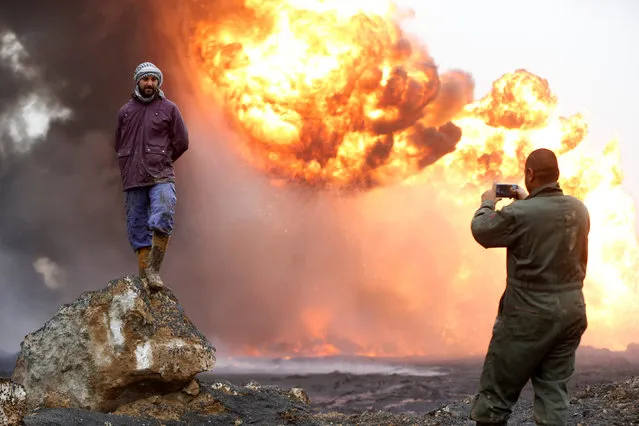
A man takes a photograph of his friend as thick smoke rises from a fire, which broke out at oil wells set ablaze by Islamic State militants before they fled the oil-producing region of Qayyara, Iraq, January 28, 2017. (Photo by Muhammad Hamed/Reuters)

A man takes a photograph of his friend as thick smoke rises from a fire, which broke out at oil wells set ablaze by Islamic State militants before they fled the oil-producing region of Qayyara, Iraq, January 28, 2017. (Photo by Muhammad Hamed/Reuters)
Details
30 Jan 2017 09:55:00
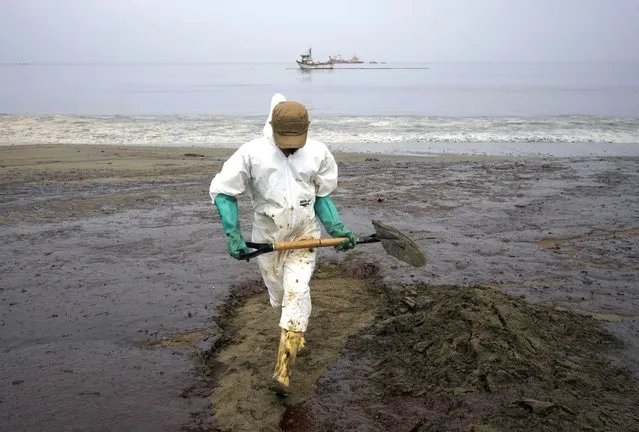
A worker, dressed in a protective suit, cleans Conchitas Beach contaminated by an oil spill, in Ancon, Peru, Thursday, January 20, 2022. The oil spill on the Peruvian coast was caused by the waves from an eruption of an undersea volcano in the South Pacific nation of Tonga. (Photo by Martin Mejia/AP Photo)

A worker, dressed in a protective suit, cleans Conchitas Beach contaminated by an oil spill, in Ancon, Peru, Thursday, January 20, 2022. The oil spill on the Peruvian coast was caused by the waves from an eruption of an undersea volcano in the South Pacific nation of Tonga. (Photo by Martin Mejia/AP Photo)
Details
27 Jan 2022 06:55:00