Loading...
Done
Local residents take part in the celebrations of Kolyada pagan holiday, which over the centuries has merged with Orthodox Christmas festivities and marks the upcoming end of winter, in the village of Noviny, Belarus, January 21, 2017. (Photo by Vasily Fedosenko/Reuters)

Local residents take part in the celebrations of Kolyada pagan holiday, which over the centuries has merged with Orthodox Christmas festivities and marks the upcoming end of winter, in the village of Noviny, Belarus, January 21, 2017. (Photo by Vasily Fedosenko/Reuters)
Details
22 Jan 2017 09:38:00
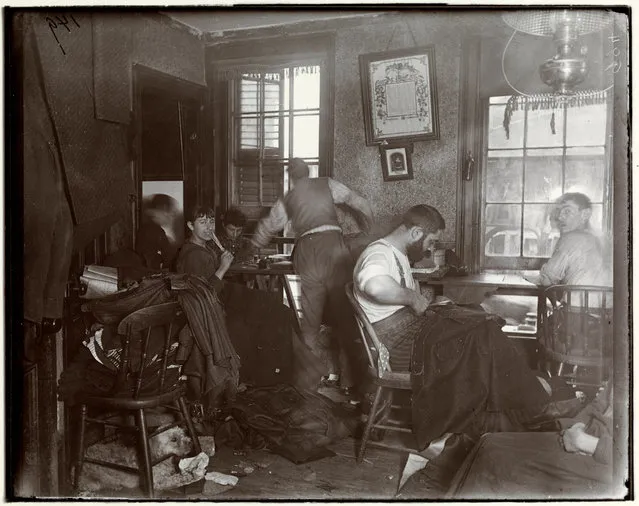
Drastic inequality is by no means new in New York. Jacob A. Riis was called a muckraker after he chose to spotlight the city’s poverty at the turn of the 20th century by photographing it. Here: Sweatshop in Hester Street, 1889-1890. (Photo by Jacob A. Riis/Museum of the City of New York, Gift of Roger William Riis)

Drastic inequality is by no means new in New York. Jacob A. Riis was called a muckraker after he chose to spotlight the city’s poverty at the turn of the 20th century by photographing it. Here: Sweatshop in Hester Street, 1889-1890. (Photo by Jacob A. Riis/Museum of the City of New York, Gift of Roger William Riis)
Details
16 Nov 2015 08:12:00
Cubans swim in a natural swimming pool off the coast of Havana on August 4, 2023. With the current hot summer, Havana residents have rushed to the dilapidated natural pools on the coast of their city, built by wealthy families in the first half of the last century. (Photo by Yamil Lage/AFP Photo)

Cubans swim in a natural swimming pool off the coast of Havana on August 4, 2023. With the current hot summer, Havana residents have rushed to the dilapidated natural pools on the coast of their city, built by wealthy families in the first half of the last century. (Photo by Yamil Lage/AFP Photo)
Details
22 Aug 2023 03:36:00
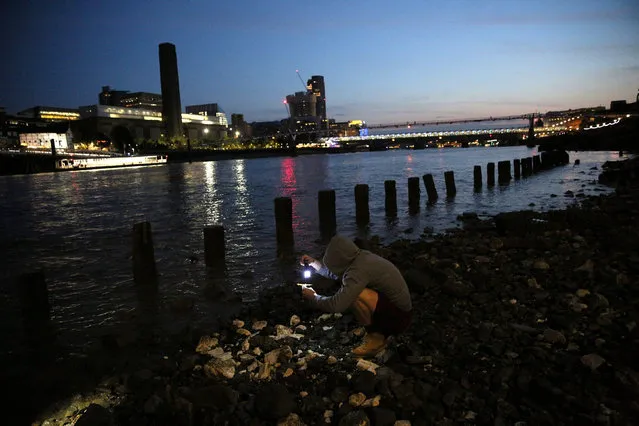
A mudlark uses a torch to look for items on the bank of the River Thames in London, Britain June 06, 2016. Mudlarking is believed to trace its origins to the 18th and 19th century, when scavengers searched the Thames' shores for items to sell. These days, history and archaeology fans are the ones hoping to find old relics such as coins, ceramics, artifacts or everyday items from across centuries. They wait for the low tide and then scour specific areas of exposed shores. "If you're in a field you could be out all day long, with the river you're restricted to about two or three hours," mudlark Nick Stevens said. While many just use the naked eye for their searches, others rely on metal detectors for which a permit from the Port of London Authority is needed. Digging also requires consent. (Photo by Neil Hall/Reuters)

A mudlark uses a torch to look for items on the bank of the River Thames in London, Britain June 06, 2016. Mudlarking is believed to trace its origins to the 18th and 19th century, when scavengers searched the Thames' shores for items to sell. These days, history and archaeology fans are the ones hoping to find old relics such as coins, ceramics, artifacts or everyday items from across centuries. their finds with the Portable Antiquities Scheme. Any item over 300 years old must be recorded. (Photo by Neil Hall/Reuters)
Details
27 Aug 2016 10:43:00
Girls dressed up in traditional Egyptian clothes from the early 20th century pose for a picture before they get their photos taken on the historical Al-Moez street of Islamic Cairo, Egypt, January 17, 2016. (Photo by Asmaa Waguih/Reuters)

Girls dressed up in traditional Egyptian clothes from the early 20th century pose for a picture before they get their photos taken on the historical Al-Moez street of Islamic Cairo, Egypt, January 17, 2016. (Photo by Asmaa Waguih/Reuters)
Details
20 Feb 2016 10:25:00
A woman works at a factory producing clay pots at Phu Lang pottery village in Bac Ninh province, Vietnam, May 14, 2015. The village is part of an old pottery triangle in northern Vietnam which includes Bat Trang and Tho Ha, and has been producing pottery since the 13th century, according to local media. (Photo by Reuters/Kham)

A woman works at a factory producing clay pots at Phu Lang pottery village in Bac Ninh province, Vietnam, May 14, 2015. The village is part of an old pottery triangle in northern Vietnam which includes Bat Trang and Tho Ha, and has been producing pottery since the 13th century, according to local media. (Photo by Reuters/Kham)
Details
15 May 2015 10:46:00
An aerial view taken with a drone shows the autumnally colored Fuerst-Pueckler-Park near Cottbus, eastern Germany, Saturday, October 29, 2016. The park, composed with great sensitivity in the 19th century by Prince Hermann von Pueckler-Muskau, is considered as one of the last great German landscape gardens. (Photo by Patrick Pleul/DPA via AP Photo)

An aerial view taken with a drone shows the autumnally colored Fuerst-Pueckler-Park near Cottbus, eastern Germany, Saturday, October 29, 2016. The park, composed with great sensitivity in the 19th century by Prince Hermann von Pueckler-Muskau, is considered as one of the last great German landscape gardens. (Photo by Patrick Pleul/DPA via AP Photo)
Details
18 Jan 2017 08:01:00
In this photo taken Sunday, October 5, 2014, a library official shows a 13th-century German prayer book containing the earliest evidence of the Yiddish language, at Israel's National Library in Jerusalem. (Photo by Sebastian Scheiner/AP Photo)

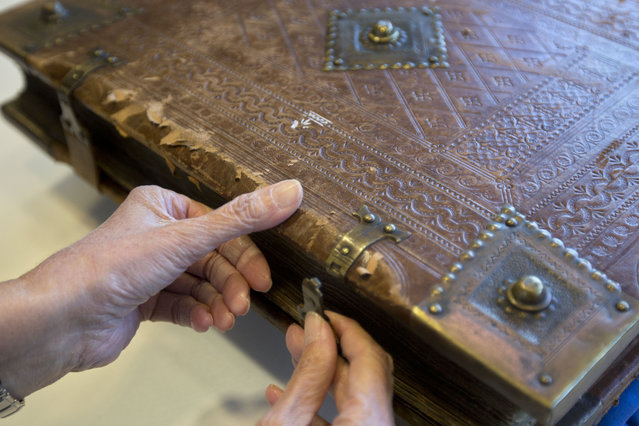
In this photo taken Sunday, October 5, 2014, a library official shows a 13th-century German prayer book containing the earliest evidence of the Yiddish language, at Israel's National Library in Jerusalem. This week, Israel's National Library gave The Associated Press a rare peek at a selection of rare historical manuscripts in its collection. (Photo by Sebastian Scheiner/AP Photo)
Details
09 Oct 2014 12:38:00