Loading...
Done
The spinning vortex of Saturn's north polar storm resembles a deep red rose of giant proportions surrounded by green foliage in this false-color image from NASA's Cassini spacecraft. (Photo by NASA/JPL-Caltech/SSI)

NASA's Cassini spacecraft has provided scientists the first close-up, visible-light views of a behemoth hurricane swirling around Saturn's north pole. In high-resolution pictures and video, scientists see the hurricane's eye is about 1,250 miles (2,000 kilometers) wide, 20 times larger than the average hurricane eye on Earth. Thin, bright clouds at the outer edge of the hurricane are traveling 330 mph(150 meters per second). The hurricane swirls inside a large, mysterious, six-sided weather pattern known as the hexagon. Photo: The spinning vortex of Saturn's north polar storm resembles a deep red rose of giant proportions surrounded by green foliage in this false-color image from NASA's Cassini spacecraft. (Photo by NASA/JPL-Caltech/SSI)
Details
31 May 2015 09:11:00
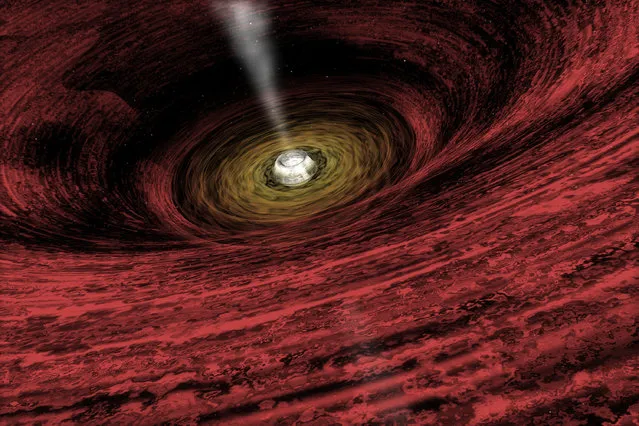
An artist's impression of a growing supermassive black hole located in the early Universe is seen in this NASA handout illustration released on June 15, 2011. Using the deepest X-ray image ever taken, astronomers found the first direct evidence that massive black holes were common in the early universe. This discovery from NASA's Chandra X-Ray Observatory shows that very young black holes grew more aggressively than previously thought, in tandem with the growth of their host galaxies. (Photo by Reuters/NASA/Chandra X-Ray Observatory/A.Hobart)

An artist's impression of a growing supermassive black hole located in the early Universe is seen in this NASA handout illustration released on June 15, 2011. Using the deepest X-ray image ever taken, astronomers found the first direct evidence that massive black holes were common in the early universe. This discovery from NASA's Chandra X-Ray Observatory shows that very young black holes grew more aggressively than previously thought, in tandem with the growth of their host galaxies. (Photo by Reuters/NASA/Chandra X-Ray Observatory/A.Hobart)
Details
11 Feb 2016 12:57:00
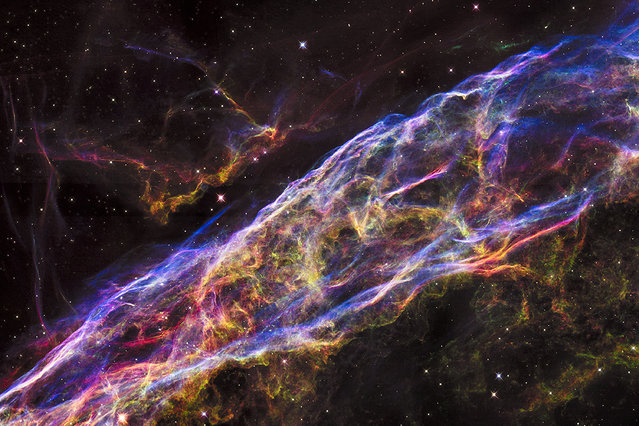
A small section of the expanding remains of the Veil Nebula, a massive star that exploded about 8,000 years ago. The entire nebula is 110 light-years across, covering six full moons on the sky as seen from Earth, and resides about 2,100 light-years away in the constellation Cygnus, the Swan. Image taken by NASA's Hubble Space Telescope. Released September 24, 2015. (Photo by Reuters/NASA/ESA/Hubble Heritage Team)

A small section of the expanding remains of the Veil Nebula, a massive star that exploded about 8,000 years ago. The entire nebula is 110 light-years across, covering six full moons on the sky as seen from Earth, and resides about 2,100 light-years away in the constellation Cygnus, the Swan. Image taken by NASA's Hubble Space Telescope. Released September 24, 2015. (Photo by Reuters/NASA/ESA/Hubble Heritage Team)
Details
10 Dec 2015 08:01:00
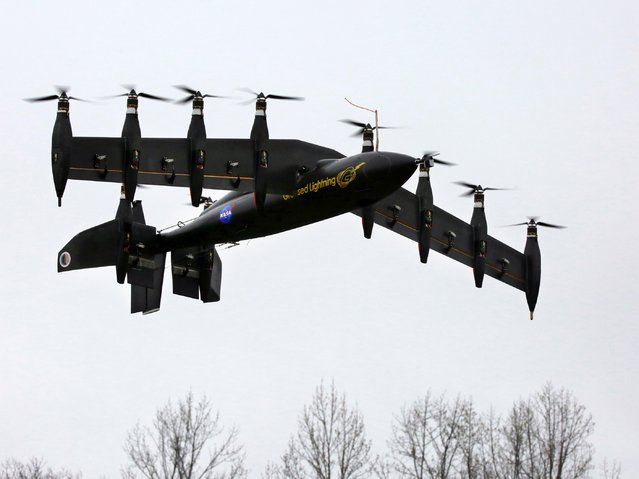
A prototype battery-powered plane, called Greased Lightning or GL-10 is pictured flying at NASA's Langley Research Center in this undated handout photo obtained by Reuters May 1, 2015. The plane, which has 10 engines and can take off like a helicopter and fly efficiently like an aircraft, is currently in the design and testing phase. (Photo by Reuters/NASA)

A prototype battery-powered plane, called Greased Lightning or GL-10 is pictured flying at NASA's Langley Research Center in this undated handout photo obtained by Reuters May 1, 2015. The plane, which has 10 engines and can take off like a helicopter and fly efficiently like an aircraft, is currently in the design and testing phase. (Photo by Reuters/NASA)
Details
02 May 2015 14:56:00


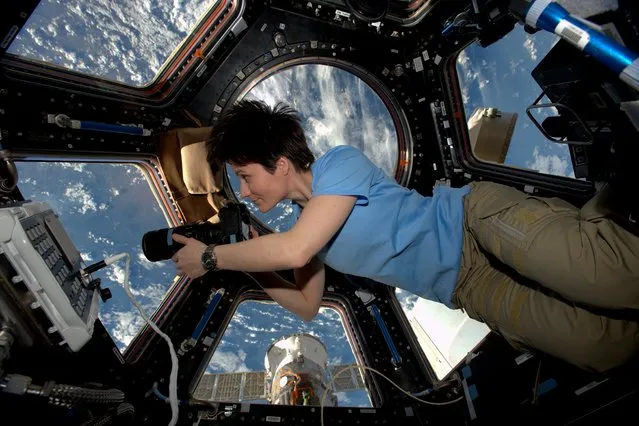
In this handout image provided by the European Space Agency (ESA) and NASA, the International Space Station and the docked space shuttle Endeavour orbit Earth during Endeavour's final sortie on May 23, 2011 in Space. Italian astronaut Paolo Nespoli captured the first-ever images of an orbiter docked to the International Space Station from the viewpoint of a departing vessel as he returned to Earth in a Soyuz capsule. (Photo by Paolo Nespoli - ESA/NASA via Getty Images)
Details
09 Jun 2011 11:28:00
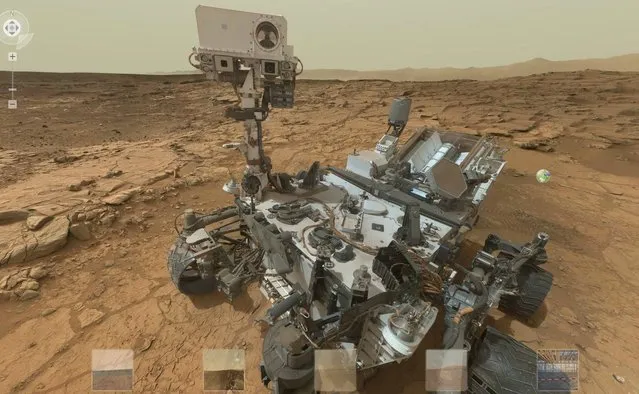
Mars Panorama (Photo by NASA/JPL-Caltech/MSSS/Andrew Bodrov)

360Cities PRO member Andrew Bodrov has just published another stunning panorama stitched from images taken by the Curiosity Rover on Mars. Photo: “Mars Panorama – Curiosity Rover: Martian Solar Day 177” (Photo by NASA/JPL-Caltech/MSSS/Andrew Bodrov)
Details
16 Feb 2013 09:58:00
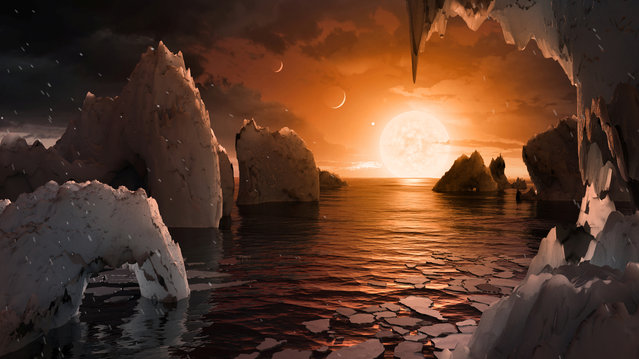
The possible surface of TRAPPIST-1f, one of seven newly discovered planets in the TRAPPIST-1 system that scientists using the Spitzer Space Telescope and ground based telescopes have discovered. (Photo by Reuters/NASA/JPL-Caltech)

The possible surface of TRAPPIST-1f, one of seven newly discovered planets in the TRAPPIST-1 system that scientists using the Spitzer Space Telescope and ground based telescopes have discovered. (Photo by Reuters/NASA/JPL-Caltech)
Details
07 Mar 2017 00:02:00
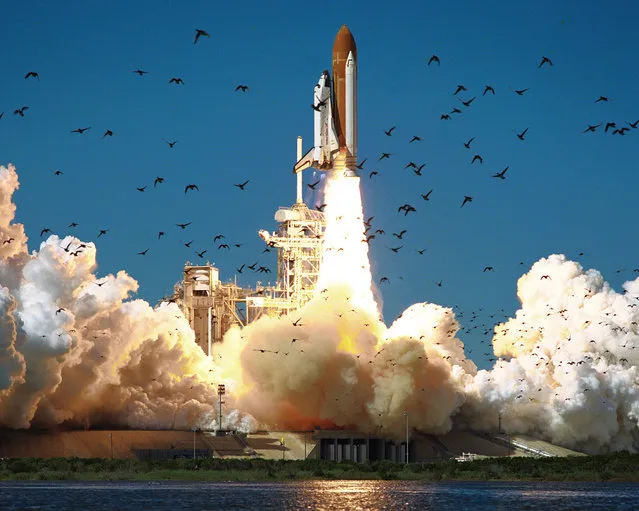
A wide-angle view shows the ascent of the shuttle Challenger on January 28, 1986. In the seconds after ignition, the rocket engines' hot blast began the process of destruction. (Photo by NASA)

A wide-angle view shows the ascent of the shuttle Challenger on January 28, 1986. In the seconds after ignition, the rocket engines' hot blast began the process of destruction. (Photo by NASA)
Details
28 Jan 2016 12:28:00