Loading...
Done
Participants learn how to survive in the wild, including tips on how to make it through a zombie invastion at a Zombie First Responder course in Sandy, Oregon

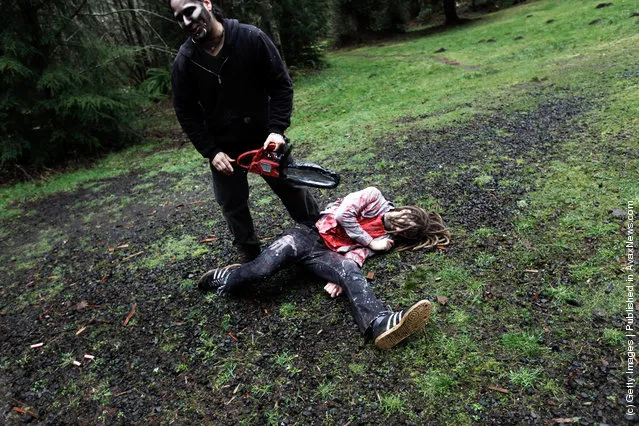
Participants learn how to survive in the wild, including tips on how to make it through a zombie invastion at a “Zombie First Responder” course March 11, 2012 in Sandy, Oregon. In an intensive 2-day curriculum participants train in everything from wilderness and urban survival, nerf or nerd weaponry, stealth and evasion, and proper zombie “disposal”. (Photo by Natalie Behring/Getty Images)
Details
12 Mar 2012 10:38:00
The Shwedagon Pagoda

The Shwedagon Pagoda officially titled Shwedagon Zedi Daw, also known in English as the Great Dagon Pagoda and the Golden Pagoda, is a 99 metres (325 ft)[citation needed] gilded pagoda and stupa located in Yangon, Burma. The pagoda lies to the west of Kandawgyi Lake, on Singuttara Hill, thus dominating the skyline of the city. It is the most sacred Buddhist pagoda for the Burmese with relics of the past four Buddhas enshrined within: the staff of Kakusandha, the water filter of Koṇāgamana, a piece of the robe of Kassapa and eight strands of hair from Gautama, the historical Buddha. Uppatasanti Pagoda is an exact replica of Shwedagon Pagoda in Naypyidaw, the new capital of Burma.
Details
19 Aug 2013 14:37:00
A truck transporting 20 tons of fish lost its load after crashing on a road near Liepen, eastern Germany on April 20, 2018. (Photo by Stefan Sauer/AFP Photo/DPA)

A truck transporting 20 tons of fish lost its load after crashing on a road near Liepen, eastern Germany on April 20, 2018. (Photo by Stefan Sauer/AFP Photo/DPA)
Details
22 Apr 2018 05:26:00
Members of the Colombian Military forces pray for members of the military that have lost their lives and peace in the country at the Military Engineers School in Bogota, Colombia on October 14, 2021. (Photo by Juancho Torres/Anadolu Agency via Getty Images)

Members of the Colombian Military forces pray for members of the military that have lost their lives and peace in the country at the Military Engineers School in Bogota, Colombia on October 14, 2021. (Photo by Juancho Torres/Anadolu Agency via Getty Images)
Details
16 Oct 2021 09:16:00
In this November 7, 2016 photo, “El Menor”, a member of “Los Cainos” self-defense group formed by the Marval fishing family, holds a homemade gun before starting a night patrol to help protect fishermen from pirate attacks in Punta de Araya, Sucre state, Venezuela. Pirates are terrorizing the coastal state of Sucre, once home to the world's fourth-largest tuna fleet and a thriving fishing industry. (Photo by Rodrigo Abd/AP Photo)

In this November 7, 2016 photo, “El Menor”, a member of “Los Cainos” self-defense group formed by the Marval fishing family, holds a homemade gun before starting a night patrol to help protect fishermen from pirate attacks in Punta de Araya, Sucre state, Venezuela. Pirates are terrorizing the coastal state of Sucre, once home to the world's fourth-largest tuna fleet and a thriving fishing industry. (Photo by Rodrigo Abd/AP Photo)
Details
09 Dec 2016 11:46:00
A Police officer checks a man wearing a carnival costume in Venice, Italy, Sunday, January 31, 2016. Carnival-goers in Venice are being asked by police to momentarily lift their masks as part of new anti-terrorism measures for the annual festivities. Police are also examining backpacks and bags and using metal-detecting wands before revelers are allowed into St. Mark's Square, the heart of the Venetian carnival. (Photo by Luigi Costantini/AP Photo)

A Police officer checks a man wearing a carnival costume in Venice, Italy, Sunday, January 31, 2016. Carnival-goers in Venice are being asked by police to momentarily lift their masks as part of new anti-terrorism measures for the annual festivities. Police are also examining backpacks and bags and using metal-detecting wands before revelers are allowed into St. Mark's Square, the heart of the Venetian carnival. (Photo by Luigi Costantini/AP Photo)
Details
01 Feb 2016 12:59:00
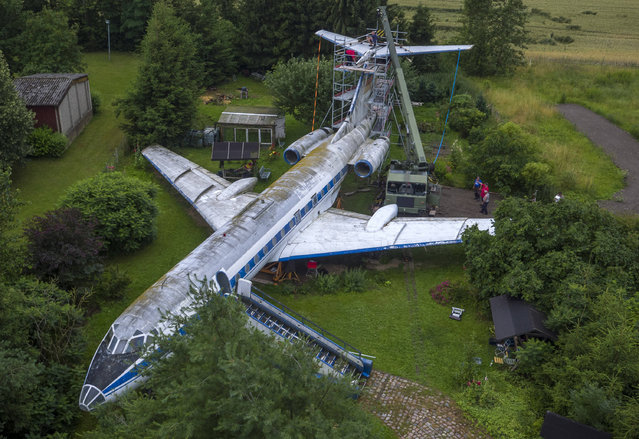
Cottbus Aviation Museum specialists prepare a Soviet Tupolev 134 A passenger plane for dismantlement in Gruenz, Germany, 10 July 2017. The team is preparing the 29 ton plane for transport from a garden in Gruenz to the Aviation Museum in Cottbus. The plane' s owner acquired it in 1991 and transported it with nine tractors and numerous helpers to his vegetable garden where he planned to open a cafe. The plane, formerly used by the East German Stasi for anti- terror operations training, is 30 metres long. (Photo by Jens Büttner/Zentralbild/DPA)

Cottbus Aviation Museum specialists prepare a Soviet Tupolev 134 A passenger plane for dismantlement in Gruenz, Germany, 10 July 2017. The team is preparing the 29 ton plane for transport from a garden in Gruenz to the Aviation Museum in Cottbus. The plane' s owner acquired it in 1991 and transported it with nine tractors and numerous helpers to his vegetable garden where he planned to open a cafe. The plane, formerly used by the East German Stasi for anti- terror operations training, is 30 metres long. (Photo by Jens Büttner/Zentralbild/DPA)
Details
12 Jul 2017 07:50:00
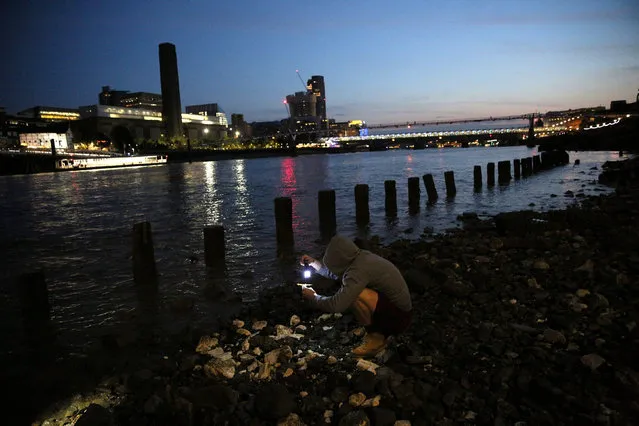
A mudlark uses a torch to look for items on the bank of the River Thames in London, Britain June 06, 2016. Mudlarking is believed to trace its origins to the 18th and 19th century, when scavengers searched the Thames' shores for items to sell. These days, history and archaeology fans are the ones hoping to find old relics such as coins, ceramics, artifacts or everyday items from across centuries. They wait for the low tide and then scour specific areas of exposed shores. "If you're in a field you could be out all day long, with the river you're restricted to about two or three hours," mudlark Nick Stevens said. While many just use the naked eye for their searches, others rely on metal detectors for which a permit from the Port of London Authority is needed. Digging also requires consent. (Photo by Neil Hall/Reuters)

A mudlark uses a torch to look for items on the bank of the River Thames in London, Britain June 06, 2016. Mudlarking is believed to trace its origins to the 18th and 19th century, when scavengers searched the Thames' shores for items to sell. These days, history and archaeology fans are the ones hoping to find old relics such as coins, ceramics, artifacts or everyday items from across centuries. their finds with the Portable Antiquities Scheme. Any item over 300 years old must be recorded. (Photo by Neil Hall/Reuters)
Details
27 Aug 2016 10:43:00