Loading...
Done
Animalistic Tendencies By Zarnala

Zarnala is a female illustrator with a knack for anthropomorphic illustration, combining human and animal elements to create something altogether new. Unlike other forms of anthropomorphic art one can find out there though, her work always retains a tasteful, professional edge similar to the feel I get from comics like Juanjo Garnido's take on Blacksad. With an awesome watercolor themed approach to all her illustration work and her use of graphic shapes to frame her characters, at times it gives her art a strangely retro look that reminds one of the works of Norman Rockwell and JC Leyendecker. Check out more of her work after the break!
Details
11 Dec 2013 11:08:00
Body Painter By Emma Fay

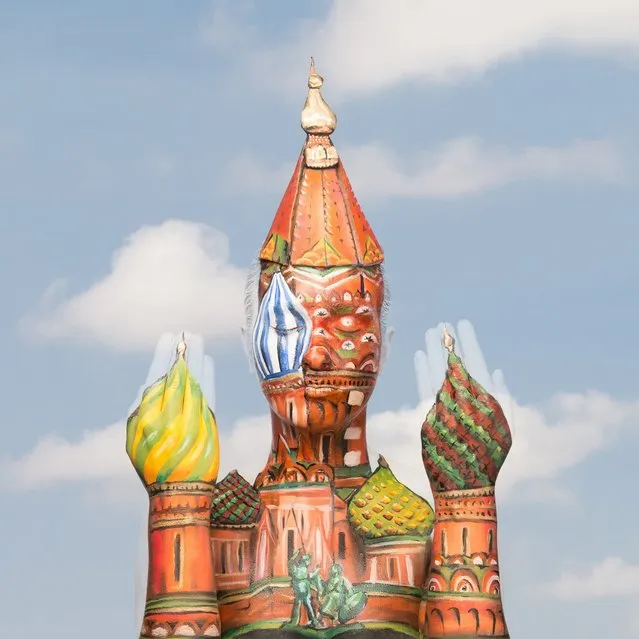
There is something frightening and at the same time appealing in the living sculptures of 27-year-old British artist Emma Fay. Body art in conjunction with the flexibility of acrobats and fantasy of the artist using water-based paints, a brush and sponge, is transformed into a beautiful work of art. It is not immediately possible to make out the human body in the picture. First you look at the landscape and suddenly begin to distinguish someone’s arm, or neck. Or you look into the eyes of an amazing bull, and it turns out that it is perfectly folded back. Lovely people, temples are and wonderful people-insects are.
Details
10 Jan 2016 08:02:00
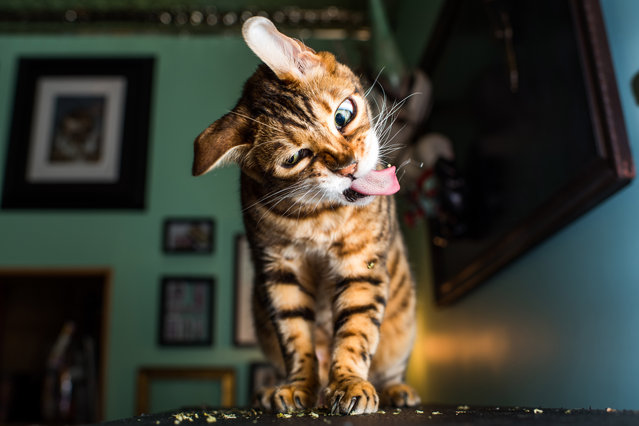
Using his friend’s cat as a muse and supplying several variations of catnip – an herb that can causes cats to enter a state of bliss for up to two hours – the neuroscience graduate captured some laugh-out-loud results. (Photo by Andrew Marttila/Caters News Agency)

Full-time feline photographer Andrew Marttila from Washington, D.C., captured blissful expressions of various cats on catnip, which he used to compile a book, “Cats on Catnip”. The photographer dedicated his time to capturing the euphoric expressions of kitties high on catnip – and the results are absolutely hilarious. (Photo by Andrew Marttila/Caters News Agency)
Details
04 Jul 2018 00:03:00
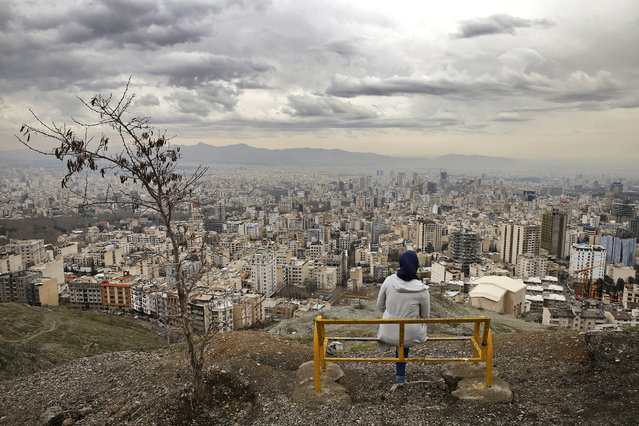
A woman spends her time outdoors to observe the ancient festival of Sizdeh Bedar, an annual public picnic day on the 13th day of the Iranian new year, at the Tochal mountainous area northern Tehran, Iran, Sunday, April, 2, 2017. Sizdeh Bedar, which comes from the Farsi words for “thirteen” and “day out”, is a legacy from Iran's pre-Islamic past that hard-liners in the Islamic Republic never managed to erase from calendars. (Photo by Ebrahim Noroozi/AP Photo)

A woman spends her time outdoors to observe the ancient festival of Sizdeh Bedar, an annual public picnic day on the 13th day of the Iranian new year, at the Tochal mountainous area northern Tehran, Iran, Sunday, April, 2, 2017. Sizdeh Bedar, which comes from the Farsi words for “thirteen” and “day out”, is a legacy from Iran's pre-Islamic past that hard-liners in the Islamic Republic never managed to erase from calendars. (Photo by Ebrahim Noroozi/AP Photo)
Details
21 Apr 2017 07:38:00
A riot policeman watches as a police vehicle burns in Braamfontein, Johannesburg, South Africa, Tuesday, October 25, 2016. Rioters in South Africa set a police vehicle on fire Tuesday and stoned vehicles near a Johannesburg university that has been the scene of sometimes violent protests by students demanding free education. The violence broke out in streets near the University of the Witwatersrand at around the same time that student protesters met and marched off the campus, South African media reported. (Photo by Yeshiel Panchia/AP Photo)

A riot policeman watches as a police vehicle burns in Braamfontein, Johannesburg, South Africa, Tuesday, October 25, 2016. Rioters in South Africa set a police vehicle on fire Tuesday and stoned vehicles near a Johannesburg university that has been the scene of sometimes violent protests by students demanding free education. The violence broke out in streets near the University of the Witwatersrand at around the same time that student protesters met and marched off the campus, South African media reported. (Photo by Yeshiel Panchia/AP Photo)
Details
26 Oct 2016 11:01:00
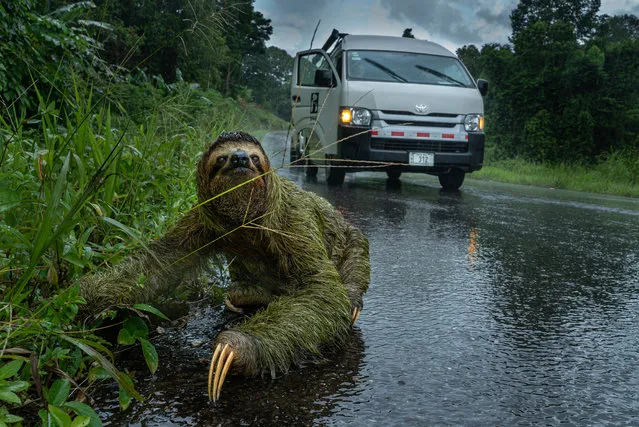
People and Nature category winner: Why did the sloth cross the road? by Andrew Whitworth (Osa Conservation and University of Glasgow), taken in Osa Peninsula, Costa Rica. “I was driving out from the Osa Peninsula, located on the southern Pacific coast of Costa Rica on a dark, stormy day. This female three-toed sloth (Bradypus variegatus) had luckily just about made it across the road, and the drivers of the Toyota on this occasion had spotted her in good time”. (Photo by Andrew Whitworth/2019 British Ecological Society Photography Competition)

People and Nature category winner: Why did the sloth cross the road? by Andrew Whitworth (Osa Conservation and University of Glasgow), taken in Osa Peninsula, Costa Rica. “I was driving out from the Osa Peninsula, located on the southern Pacific coast of Costa Rica on a dark, stormy day. This female three-toed sloth (Bradypus variegatus) had luckily just about made it across the road, and the drivers of the Toyota on this occasion had spotted her in good time”. (Photo by Andrew Whitworth/2019 British Ecological Society Photography Competition)
Details
30 Nov 2019 00:05:00
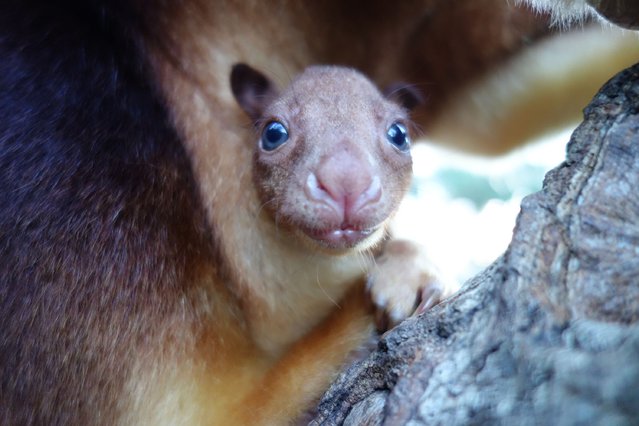
In this handout image provided by Taronga Zoo, an unnamed baby Goodfellows Tree Kangaroo joey is seen in it's mothers pouch on March 10, 2014 in Sydney, Australia. Taronga Zoo is celebrating the successful birth of its first Goodfellows Tree Kangaroo joey in more than 20 years. Zookeepers have only just begun seeing her peeking out from first-time mother, Qwikilas, pouch after she was born in September last year. (Photo by Taronga Zoo via Getty Images)

In this handout image provided by Taronga Zoo, an unnamed baby Goodfellows Tree Kangaroo joey is seen in it's mothers pouch on March 10, 2014 in Sydney, Australia. Taronga Zoo is celebrating the successful birth of its first Goodfellows Tree Kangaroo joey in more than 20 years. Zookeepers have only just begun seeing her peeking out from first-time mother, Qwikilas, pouch after she was born in September last year. (Photo by Taronga Zoo via Getty Images)
Details
19 Mar 2014 06:08:00
While the lido was described as bringing “modernism to the masses” on the British coast it was just the latest example of a trend that had been developing since Victorian times – transforming seaside towns into resorts for leisure and entertainment. In the latter half of the nineteenth century, the fashion was for local authorities to build great piers stretching from the promenade out into the sea

While the lido was described as bringing “modernism to the masses” on the British coast it was just the latest example of a trend that had been developing since Victorian times – transforming seaside towns into resorts for leisure and entertainment. In the latter half of the nineteenth century, the fashion was for local authorities to build great piers stretching from the promenade out into the sea. The Eastbourne Pier, pictured here in May 1931, was erected between 1866 and 1870 to an ingenious design by Eugenius Birch, which saw the structure sitting on special cups allowing the supporting struts to “move” in bad weather. Arranged on the pier's 1,000-foot length were kiosks, a theatre, a ballroom and a camera obscura. 1931. (Photo by Aerofilms Collection via “A History of Britain From Above”)
Details
25 Feb 2014 12:59:00