Loading...
Done
Construction Continues At Ground Zero On One World Trade Center

Construction continues on One World Trade Center (TALLEST BUILDING AT LOWER LEFT) as the memorial footprints of the twin towers are seen (BOTTOM C) on August 12, 2011 in New York City. Upon completion, One World Trade Center will be New York's tallest skyscraper, topping out at a symbolic 1,776 feet, with 3 million square feet of office space. More than 2,700 people were killed when al-Qaeda terrorists hijacked U.S. passenger jets and flew them into the twin towers of the World Trade Center on September 11, 2001. Nearly ten years after the crippling attacks on Lower Manhattan, business, tourism and new construction like One World Trade Center have rejuvenated the formerly devastated cityscape.(Photo by Mario Tama/Getty Images)
Details
14 Aug 2011 13:58:00
The monument of Ilirska Bistrica was designed by Janez Lenassi and built in 1965. It is dedicated to Slovenian soldiers that fell in World War II. (Photo by Jan Kempenaers)

The brutalist war memorials found throughout the former Yugoslavia were weird enough when they were built in the 1960s and 70s. Today, separated by the end of an architectural movement and the disintegration of the country, they seem almost alien. Belgian photographer Jan Kempenaers treats them purely as artistic objects in his book, “Spomenik”, named for the Serb-Croat word for monument. Known for photographing geographical oddities, Kempenaers was captivated by the spomenik after seeing them in an art encyclopedia. After hearing that many had been destroyed or abandoned, he set out to record what was left. (Photo by Jan Kempenaers)
Details
18 Aug 2014 09:07:00
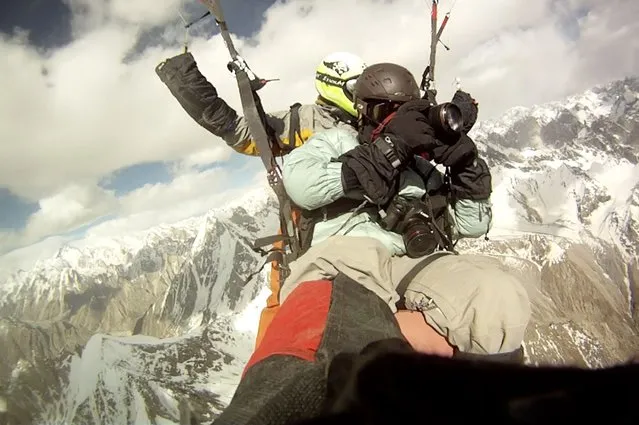
Screenshot of Krystle and Hernan, taken on a foot mounted GoPro. (Photo by Krystle Wright/Caters News)

“Daredevil photographer Krystle Wright suffered a catalogue of injuries after an accident on a shoot in Pakistan. The 26-year-old was left with internal bruising, tendon damage, two fractures, a torn ligament and 10 stitches above her eye following the horrific fall in the Himalayas. Wright took to the air on a dual paraglider and flew at a stomach-churning 18,000 feet to capture the incredible images. But as she neared the end of her trip Wright hit a bolder and blacked out following a bad take-off. The keen photographer, from Queensland, Australia, has travelled the world shooting some of the most awe-inspiring extreme sport stunts”. – Caters News. Photo: Screenshot of Krystle and Hernan, taken on a foot mounted GoPro. (Photo by Krystle Wright/Caters News)
Details
10 Dec 2013 07:45:00
Challenger Bulgarian heavyweight boxer Kubrat Pulev (R) lies in the ring after being knocked down by Ukrainian WBA, WBO, IBO and IBF heavyweight boxing world champion Vladimir Klitschko (L), who celebrates with his brother Vitali (2nd L), as referee Tony Weeks checks on him after their title fight in Hamburg, November 15, 2014. (Photo by Fabian Bimmer/Reuters)

Challenger Bulgarian heavyweight boxer Kubrat Pulev (R) lies in the ring after being knocked down by Ukrainian WBA, WBO, IBO and IBF heavyweight boxing world champion Vladimir Klitschko (L), who celebrates with his brother Vitali (2nd L), as referee Tony Weeks checks on him after their title fight in Hamburg, November 15, 2014. World heavyweight champion Vladimir Klitschko knocked out Bulgarian challenger Kubrat Pulev with a fierce left hook in the fifth round on Saturday to retain his IBF title and end his opponent's unbeaten record. (Photo by Fabian Bimmer/Reuters)
Details
17 Nov 2014 12:34:00
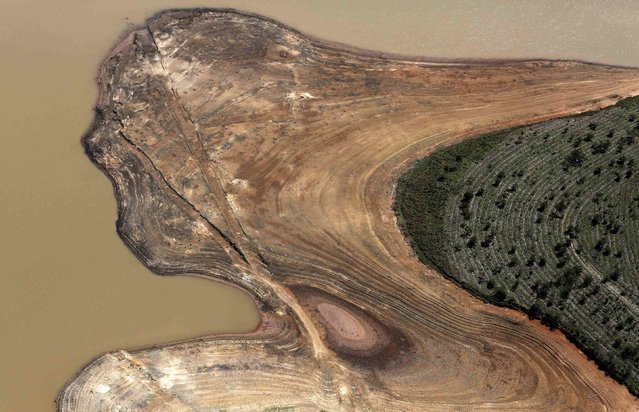
An aerial view of the Atibainha dam, part of the Cantareira reservoir, during a drought in Nazare Paulista, Sao Paulo state November 18, 2014. (Photo by Nacho Doce/Reuters)

An aerial view of the Atibainha dam, part of the Cantareira reservoir, during a drought in Nazare Paulista, Sao Paulo state November 18, 2014. Brazil's worst drought in 80 years has left the Cantareira system, that provides greater Sao Paulo with most of its water, with the lowest water level on record, with daily rationing becoming common in the region's smaller cities, according to the state authorities and the two main reservoirs serving metropolitan Sao Paulo, South America's largest city, could dry out by February if relief does not arrive in the upcoming rainy season. (Photo by Nacho Doce/Reuters)
Details
20 Nov 2014 12:19:00
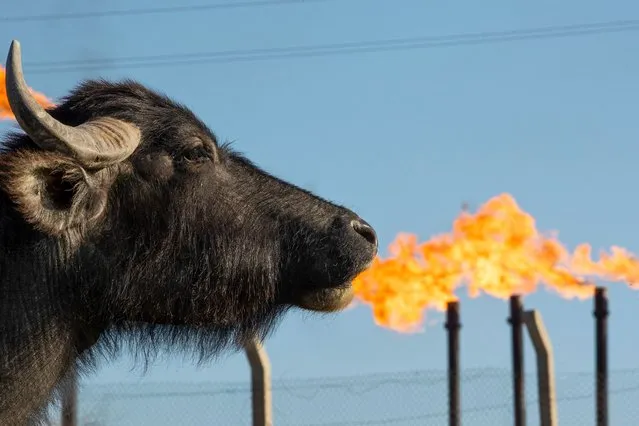
A cow grazes in a field in front of the Nahr Bin Omar oil field and facility near Iraq's southern port city of Basra, on April 4, 2023. (Photo by Hussein Faleh/AFP Photo)

A cow grazes in a field in front of the Nahr Bin Omar oil field and facility near Iraq's southern port city of Basra, on April 4, 2023. (Photo by Hussein Faleh/AFP Photo)
Details
03 May 2023 02:36:00
An aerial view of paddy fields at Debao County on October 16, 2022 in Baise, Guangxi Zhuang Autonomous Region of China. The paddy fields in Baise have entered harvest season. (Photo by VCG/VCG via Getty Images)

An aerial view of paddy fields at Debao County on October 16, 2022 in Baise, Guangxi Zhuang Autonomous Region of China. The paddy fields in Baise have entered harvest season. (Photo by VCG/VCG via Getty Images)
Details
25 Oct 2022 04:31:00
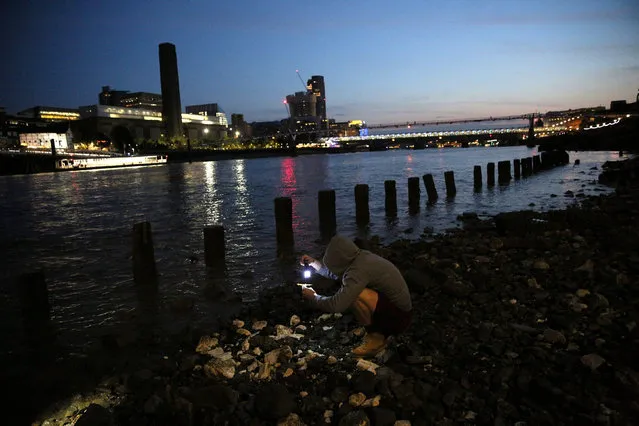
A mudlark uses a torch to look for items on the bank of the River Thames in London, Britain June 06, 2016. Mudlarking is believed to trace its origins to the 18th and 19th century, when scavengers searched the Thames' shores for items to sell. These days, history and archaeology fans are the ones hoping to find old relics such as coins, ceramics, artifacts or everyday items from across centuries. They wait for the low tide and then scour specific areas of exposed shores. "If you're in a field you could be out all day long, with the river you're restricted to about two or three hours," mudlark Nick Stevens said. While many just use the naked eye for their searches, others rely on metal detectors for which a permit from the Port of London Authority is needed. Digging also requires consent. (Photo by Neil Hall/Reuters)

A mudlark uses a torch to look for items on the bank of the River Thames in London, Britain June 06, 2016. Mudlarking is believed to trace its origins to the 18th and 19th century, when scavengers searched the Thames' shores for items to sell. These days, history and archaeology fans are the ones hoping to find old relics such as coins, ceramics, artifacts or everyday items from across centuries. their finds with the Portable Antiquities Scheme. Any item over 300 years old must be recorded. (Photo by Neil Hall/Reuters)
Details
27 Aug 2016 10:43:00