Loading...
Done
Thai office workers walk past armed soldiers standing guard outside the Shinawatra Tower Two in Bangkok, Thailand, 20 May 2014. Thai army Chief Prayuth Chan-ocha early on 20 May 2014, declared martial law giving the military full control to prevent further protest-related violence in the country. (Photo by Narong Sangnak/EPA)

Thai office workers walk past armed soldiers standing guard outside the Shinawatra Tower Two in Bangkok, Thailand, 20 May 2014. Thai army Chief Prayuth Chan-ocha early on 20 May 2014, declared martial law giving the military full control to prevent further protest-related violence in the country. The statement was issued about 3 am on 20 May (2000 GMT), according to local media reports. Prayuth has the authority to declare martial law without the consent of the government, which has had caretaker status since 09 December 2013. Thailand has been wracked by six months of non-stop protests seeking to topple the government. At least 25 people have died in political-related violence and more than 700 injured. (Photo by Narong Sangnak/EPA)
Details
21 May 2014 10:09:00
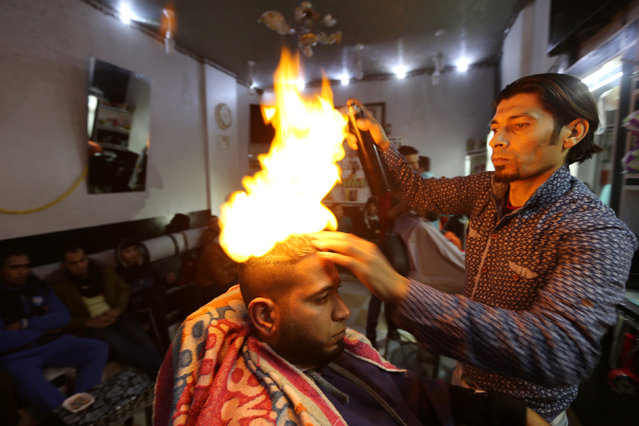
Palestinian barber Ramadan Odwan styles and straightens the hair of a customer with fire at his salon in Rafah, in the southern Gaza Strip February 2, 2017. In Ramadan Odwan's barbershop in Gaza, hair isn't just blow-dried, it's blowtorch-dried. “People have gone crazy about it, many people are curious to go through the experience and they are not afraid”, he told Reuters. “People here love adventures”. Odwan, 37, is not the first stylist in the world to use flame to straighten hair, but his craft is unique in the Gaza Strip. In his salon in the southern Gaza town of Rafah, Odwan applied what he described as a protective liquid coating to a customer's hair – he declined to disclose its contents – before aiming for the head and pressing the button on a small blowtorch. “I control how long I apply fire, I keep it on and off for 10 seconds or 15 seconds. It is completely safe and I have not encountered any accident since I started it two months ago”, Odwan added. Odwan charges 20 shekels ($5.20) for a haircut and fire-straightening. A barber for the past 18 years, he said part of the reason he uses the technique is to show that Palestinian barbers are as “professional as those out there around the world”. (Photo by Ibraheem Abu Mustafa/Reuters)

Palestinian barber Ramadan Odwan styles and straightens the hair of a customer with fire at his salon in Rafah, in the southern Gaza Strip February 2, 2017. In Ramadan Odwan's barbershop in Gaza, hair isn't just blow-dried, it's blowtorch-dried. “People have gone crazy about it, many people are curious to go through the experience and they are not afraid”, he told Reuters. “People here love adventures”. (Photo by Ibraheem Abu Mustafa/Reuters)
Details
11 Feb 2017 00:05:00
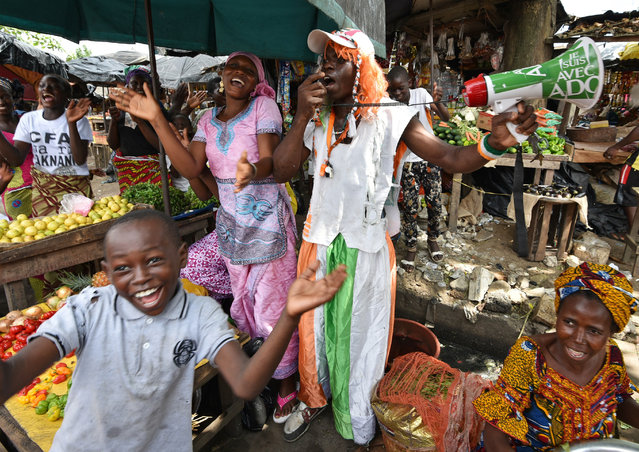
4: Abidjan, Ivory Coast. Latest ranking: 128; Ranking five years ago: 131; Five-year index movement: 3.8%. Here: A supporter of Ivory Coast president Alassane Ouattara campaigns in a market in the city’s Koumassi quarter. (Photo by Sia Kambou/AFP Photo)

A period of relative stability has put the Iranian capital No1 on the list of world cities that have achieved biggest improvements in liveability over the past five years, as calculated by the Economist Intelligence Unit. The “most improved” top 10 contains some unexpected names. So, eg, the fourth place: Abidjan, Ivory Coast. Latest ranking: 128; Ranking five years ago: 131; Five-year index movement: 3.8%. Here: A supporter of Ivory Coast president Alassane Ouattara campaigns in a market in the city’s Koumassi quarter. (Photo by Sia Kambou/AFP Photo)
Details
19 Aug 2016 11:55:00
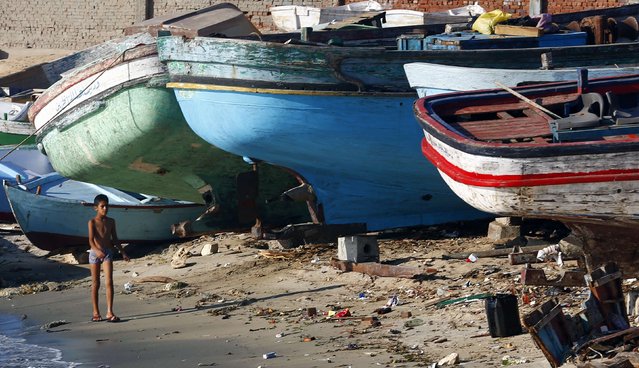
A boy walks past boats docked at the entrance gate of the fishermen's village in the El Max area of the Mediterranean city of Alexandria September 12, 2014.  El Max, where hundreds of boats dart through the canals, has been called the “Venice of Egypt” for its waterways and relaxed atmosphere. Its fishermen, however, worry about how they will make ends meet on meagre earnings they  say are being reduced further by polluted waters that are making fishing more difficult. (Photo by Amr Abdallah Dalsh/Reuters)

A boy walks past boats docked at the entrance gate of the fishermen's village in the El Max area of the Mediterranean city of Alexandria September 12, 2014. El Max, where hundreds of boats dart through the canals, has been called the “Venice of Egypt” for its waterways and relaxed atmosphere. Its fishermen, however, worry about how they will make ends meet on meagre earnings they say are being reduced further by polluted waters that are making fishing more difficult. While the government has tried to fix the state's bloated finances by cutting subsidies and reining in spending, some argue the reforms hurt Egypt's most vulnerable who have long relied on a generous system of fuel and food subsidies to supplement low incomes. (Photo by Amr Abdallah Dalsh/Reuters)
Details
12 Dec 2014 12:42:00
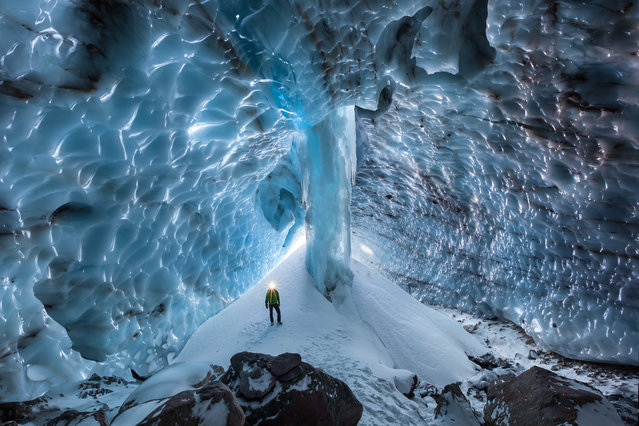
On the western side of Mount Hood lies the longest glacier cave system in the contiguous United States. In 2012, these caves were mapped to a combined length of 7,166.8 feet by cave explorers Brent McGregor and Eddy Cartaya. Currently, the total passage length is hundreds of feet less. Glaciers are frozen rivers; they are always moving and changing. In the past five years, we have seen the caves melt, shrink and collapse in a dramatic way. The caves are formed by water carving away at the ice. (Photo and caption by Josh Hydeman)

On the western side of Mount Hood lies the longest glacier cave system in the contiguous United States. In 2012, these caves were mapped to a combined length of 7,166.8 feet by cave explorers Brent McGregor and Eddy Cartaya. Currently, the total passage length is hundreds of feet less. Glaciers are frozen rivers; they are always moving and changing... (Photo and caption by Josh Hydeman)
Details
22 Mar 2015 11:05:00
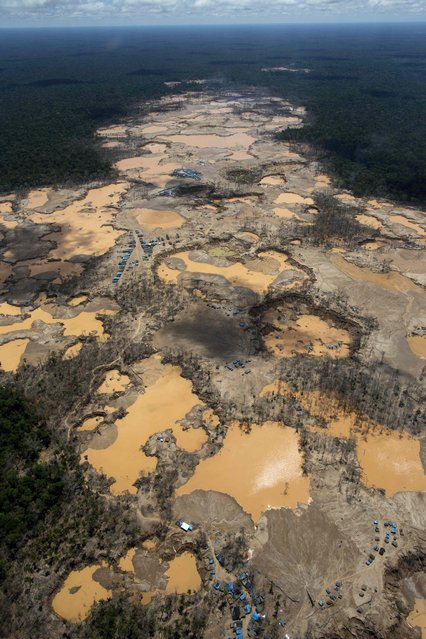
This November 11, 2014 aerial photo, shows a deforested area dotted with blue tarps, marking the area where miners reside, and craters filled with water, caused by illegal gold mining activities, in La Pampa, in Peru's Madre de Dios region. (Photo by Rodrigo Abd/AP Photo)

This November 11, 2014 aerial photo, shows a deforested area dotted with blue tarps, marking the area where miners reside, and craters filled with water, caused by illegal gold mining activities, in La Pampa, in Peru's Madre de Dios region. Less than a month before Peru plays host to global climate talks, the government sent a battalion of police into southeastern jungles to dismantle illegal gold-mining mining camps. Peru's anti-illegal mining czar, retired army Gen. Augusto Soto, marched the men to the wasteland known as La Pampa, where 50,000 hectares of rainforest have been obliterated in the past six years. (Photo by Rodrigo Abd/AP Photo)
Details
21 Nov 2014 12:35:00
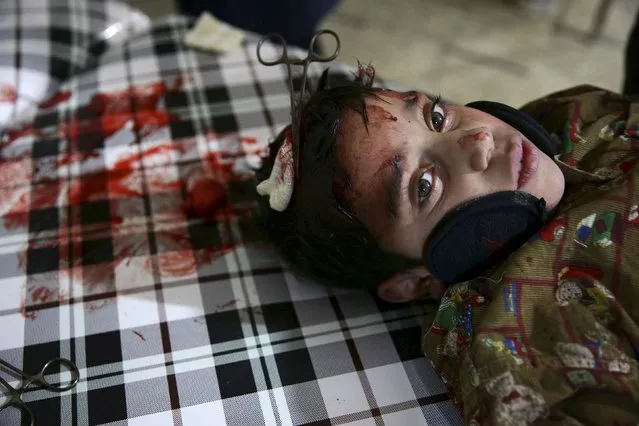
An injured boy who is undergoing surgery, after he was injured in what activists said was an airstrike by forces loyal to Syria's president Bashar al-Assad, rests inside a field hospital in the Douma neighborhood of Damascus, Syria December 5, 2015. (Photo by Bassam Khabieh/Reuters)

An injured boy who is undergoing surgery, after he was injured in what activists said was an airstrike by forces loyal to Syria's president Bashar al-Assad, rests inside a field hospital in the Douma neighborhood of Damascus, Syria December 5, 2015. Douma in Syria, an area controlled by rebels fighting to topple President Bashar al-Assad, has been shelled continuously for the past three years. The injured are taken to basements and shelters transformed into field hospitals run by medical staff who have stayed in the battered neighbourhood of Damascus. (Photo by Bassam Khabieh/Reuters)
Details
19 Dec 2015 08:06:00
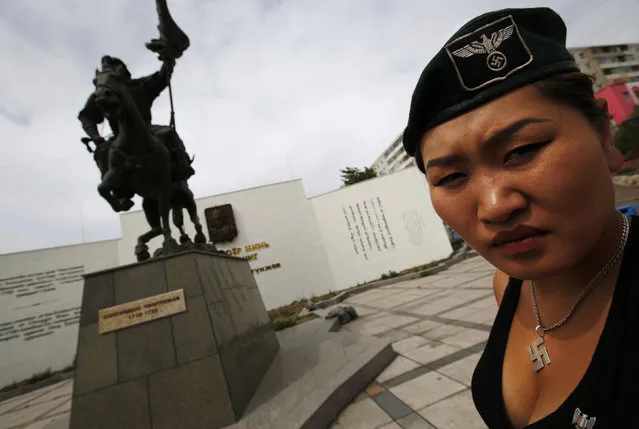
Uranjargal, a leader of the Mongolian neo-Nazi group Tsagaan Khass, stands next to a statue of Chingunjav, a Mongolian national hero, in Ulan Bator June 22, 2013. (Photo by Carlos Barria/Reuters)

Uranjargal, a leader of the Mongolian neo-Nazi group Tsagaan Khass, stands next to a statue of Chingunjav, a Mongolian national hero, in Ulan Bator June 22, 2013. The group has rebranded itself as an environmentalist organisation fighting pollution by foreign-owned mines, seeking legitimacy as it sends Swastika-wearing members to check mining permits. Over the past years, ultra-nationalist groups have expanded in the country and among those garnering attention is Tsagaan Khass, which has recently shifted its focus from activities such as attacks on women it accuses of consorting with foreign men to environmental issues, with the stated goal of protecting Mongolia from foreign mining interests. This ultra-nationalist group was founded in the 1990s and currently has 100-plus members. (Photo by Carlos Barria/Reuters)
Details
09 Jul 2013 07:23:00