Loading...
Done
A woman wearing a kimono performs an uchimizu ritual outside a pachinko game parlor in Tokyo June 30, 2015. The splashing of water onto the hot asphalt in summer is an old Japanese tradition meant to cool down the air as the water evaporates. (Photo by Thomas Peter/Reuters)

A woman wearing a kimono performs an uchimizu ritual outside a pachinko game parlor in Tokyo June 30, 2015. The splashing of water onto the hot asphalt in summer is an old Japanese tradition meant to cool down the air as the water evaporates. (Photo by Thomas Peter/Reuters)
Details
19 Jul 2015 08:36:00
A Nepalese woman pours milk as she offers prayers to the setting Sun on the banks of the Bagmati River during the Chhath Puja festival in Kathmandu, Nepal, Sunday, November 6, 2016. During Chhath, an ancient Hindu festival, rituals are performed to thank the Sun God for sustaining life on earth. (Photo by Niranjan Shrestha/AP Photo)

A Nepalese woman pours milk as she offers prayers to the setting Sun on the banks of the Bagmati River during the Chhath Puja festival in Kathmandu, Nepal, Sunday, November 6, 2016. During Chhath, an ancient Hindu festival, rituals are performed to thank the Sun God for sustaining life on earth. (Photo by Niranjan Shrestha/AP Photo)
Details
08 Nov 2016 11:30:00
Students from St Andrews University are covered in foam as they take part in the traditional “Raisin Weekend” in the Lower College Lawn, at St Andrews in Scotland, Britain October 17, 2016. The weekend, which begins on Sunday, involves rituals for new students, culminating in a foam fight on Monday morning. (Photo by Russell Cheyne/Reuters)

Students from St Andrews University are covered in foam as they take part in the traditional “Raisin Weekend” in the Lower College Lawn, at St Andrews in Scotland, Britain October 17, 2016. The weekend, which begins on Sunday, involves rituals for new students, culminating in a foam fight on Monday morning. (Photo by Russell Cheyne/Reuters)
Details
18 Oct 2016 12:38:00
A woman wearing a traditional Hanbok dress visits the Gyeongbokgung Palace grounds in Seoul on October 23, 2023. A woldae terrace for public rituals and ceremonies in front of Gyeongbok Palace’s Gwanghwamun gate was restored and opened to the public earlier this month, after being removed in 1923, during the 1910-45 Japanese colonial period. (Photo by Anthony Wallace/AFP Photo)

A woman wearing a traditional Hanbok dress visits the Gyeongbokgung Palace grounds in Seoul on October 23, 2023. A woldae terrace for public rituals and ceremonies in front of Gyeongbok Palace’s Gwanghwamun gate was restored and opened to the public earlier this month, after being removed in 1923, during the 1910-45 Japanese colonial period. (Photo by Anthony Wallace/AFP Photo)
Details
06 Nov 2023 05:01:00
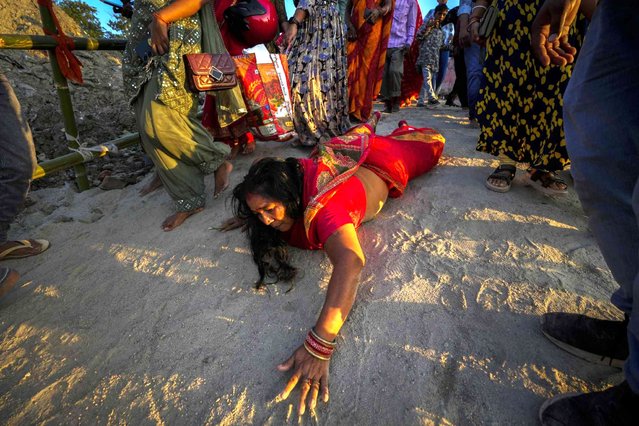
A Hindu devotee moves toward the river Brahmaputra in a prostrate manner to perform rituals during Chhath Puja festival in Guwahati, in the northeastern Indian state of Assam, India, Thursday, November 7, 2024. (Photo by Anupam Nath/AP Photo)

A Hindu devotee moves toward the river Brahmaputra in a prostrate manner to perform rituals during Chhath Puja festival in Guwahati, in the northeastern Indian state of Assam, India, Thursday, November 7, 2024. (Photo by Anupam Nath/AP Photo)
Details
03 Dec 2024 06:08:00
A Gnawa traditional group performs in the city of Essaouira on December 14, 2019, to celebrate the decision of adding the Gnawa culture to UNESCO's list of Intangible Cultural Heritage of Humanity. Gnawa culture, a centuries-old Moroccan practice rooted in music, African rituals and Sufi traditions, was added to UNESCO's list of Intangible Cultural Heritage of Humanity earlier in the week. Gnawa refers to a “set of musical productions, fraternal practices and therapeutic rituals where the secular mixes with the sacred”, according to the nomination submitted by Morocco. Often dressed in colourful outfits, Gnawa musicians play the guenbri, a type of lute with three strings, accompanied by steel castanets called krakebs. (Photo by Fadel Senna/AFP Photo)

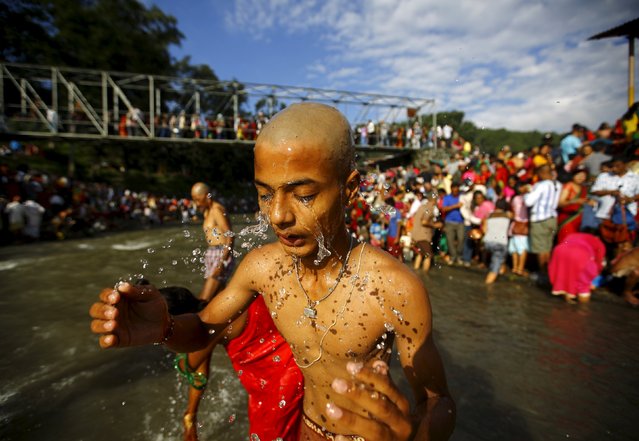
A Gnawa traditional group performs in the city of Essaouira on December 14, 2019, to celebrate the decision of adding the Gnawa culture to UNESCO's list of Intangible Cultural Heritage of Humanity. Gnawa culture, a centuries-old Moroccan practice rooted in music, African rituals and Sufi traditions, was added to UNESCO's list of Intangible Cultural Heritage of Humanity earlier in the week. Gnawa refers to a “set of musical productions, fraternal practices and therapeutic rituals where the secular mixes with the sacred”, according to the nomination submitted by Morocco. Often dressed in colourful outfits, Gnawa musicians play the guenbri, a type of lute with three strings, accompanied by steel castanets called krakebs. (Photo by Fadel Senna/AFP Photo)
Details
18 Dec 2019 00:05:00
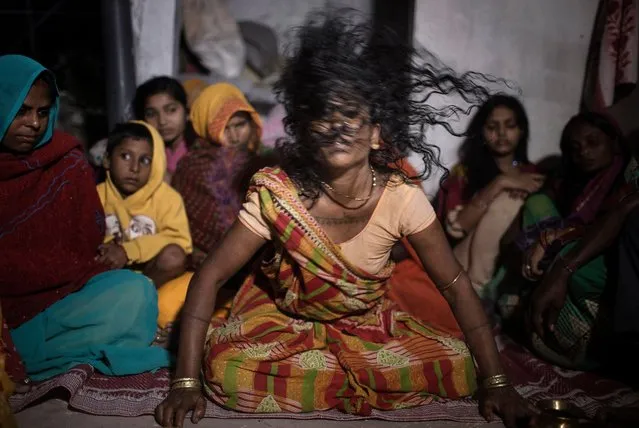
Marani Devi Chaudhary (C), aged 40, performs a ritual in front of shaman Paltan Yadav (unseen) at her home in Rajaur village in Dhanusha district, Nepal, 02 November 2017. The shaman identified Marani Devi to be possessed by their lineage god who was dissatisfied by their worship is thought by the family to have caused them misfortune and is even feared lead to their death. Therefore Marani Devi spent 1,500 USD to perform a healing ritual at the Ghost Festival held at the banks of Kamala River in Dhanusha district two days later. Every family or community has their own sacred god, called 'Kuldevta' in Nepali which means family deity or lineage god. Only family members or people within communities of the same caste can worship to the deity. They have their own rules and regulations of worship which varies from one family and community to another. Being unable to follow the rules and regulations or carry out worship is believed to cause misfortune. (Photo by Narendra Shrestha/EPA/EFE)

Marani Devi Chaudhary (C), aged 40, performs a ritual in front of shaman Paltan Yadav (unseen) at her home in Rajaur village in Dhanusha district, Nepal, 02 November 2017. The shaman identified Marani Devi to be possessed by their lineage god who was dissatisfied by their worship is thought by the family to have caused them misfortune and is even feared lead to their death. (Photo by Narendra Shrestha/EPA/EFE)
Details
17 Nov 2017 06:53:00
Indian groom Prakash Sing (R) and bride Durga Prasad (C) perform marriage rituals at the Lord Shiva temple during the Maha Shivratri festival, in Kolkata, eastern India, 01 March 2022. Maha Shivaratri is celebrated with great devotion and religious fervor by Hindus, in honor of Lord Shiva with ritual bathing of Shivalingams and prayers. Unmarried women observe fast from dawn to dusk and pray to Lord Shiva to give them a good spouse. According to one of the most popular legends, Shivaratri is the wedding day of Lord Shiva and Parvati. (Photo by Piyal Adhikary/EPA/EFE)

Indian groom Prakash Sing (R) and bride Durga Prasad (C) perform marriage rituals at the Lord Shiva temple during the Maha Shivratri festival, in Kolkata, eastern India, 01 March 2022. Maha Shivaratri is celebrated with great devotion and religious fervor by Hindus, in honor of Lord Shiva with ritual bathing of Shivalingams and prayers. Unmarried women observe fast from dawn to dusk and pray to Lord Shiva to give them a good spouse. According to one of the most popular legends, Shivaratri is the wedding day of Lord Shiva and Parvati. (Photo by Piyal Adhikary/EPA/EFE)
Details
15 Mar 2022 05:45:00