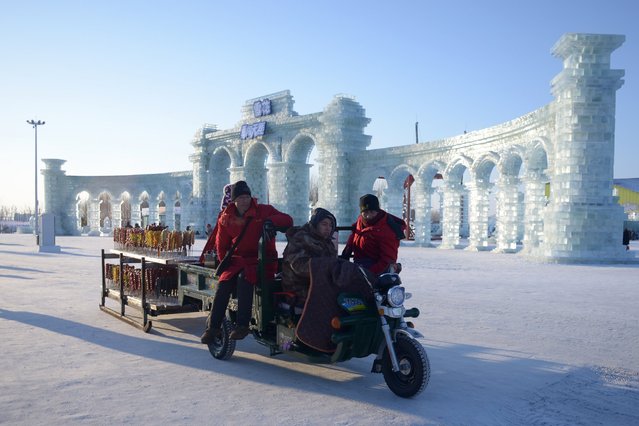
Vendors selling candied haws wait for customers at the Harbin Ice and Snow Festival in Harbin, China, January 4, 2016. The festival is open from Jan. 5 till Feb. 5, 2016, and is aimed at attracting both foreign and local visitors to experience the beauty of the ice and snow. (Photo by Wang Zhao/AFP Photo)
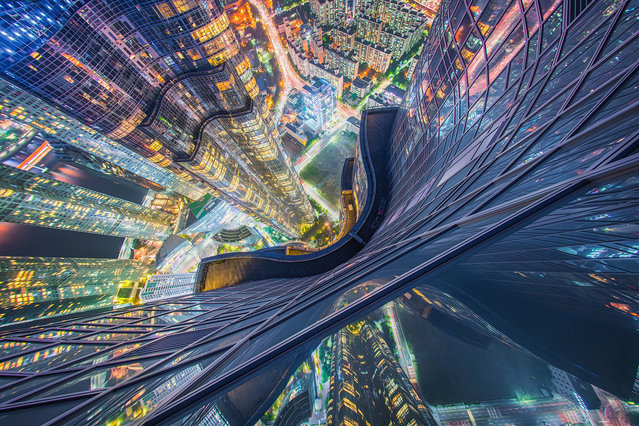
Scared of Heights. “Taken from the highest residential building in Asia: the Zenith in Busan. This was taken with official permission (which took me months to get) and safety measures were taken. I had to hang myself over the edge to get this shot. Not for the faint of heart! But when you’re at a height like this, the world below you just seems different. It takes away the fear one would normally have, and gives a sense of peace instead”. (Photo by Albert Dros/NatGeo Cities Travel Photographer of the Year 2017)
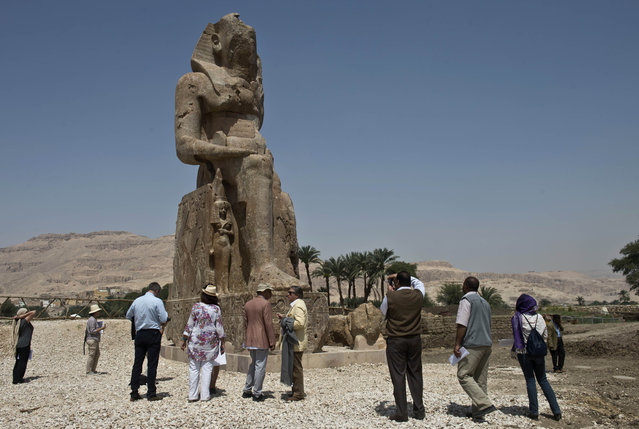
Tourists and journalists stand next to a newly displayed statue of pharaoh Amenhotep III and his wife Tiye (Down) in Egypt's temple city of Luxor on March 23, 2014. Two colossal statues of pharaoh Amenhotep III were unveiled by archaeologists today in their original sites in the funerary temple of the king, on the west bank of the Nile in Luxor, adding to the existing two famous ancient Memnon colossi. (Photo by Khaled Desouki/AFP Photo)
Guiyu, China is known as the “Town of E-waste.” Thousands of its residents depend on processing electronic waste for a living. Guiyu receives its e-waste from China and from abroad, including places like Japan, Europe and America. Under Chinese law, most of the e-waste imported from overseas is illegal.
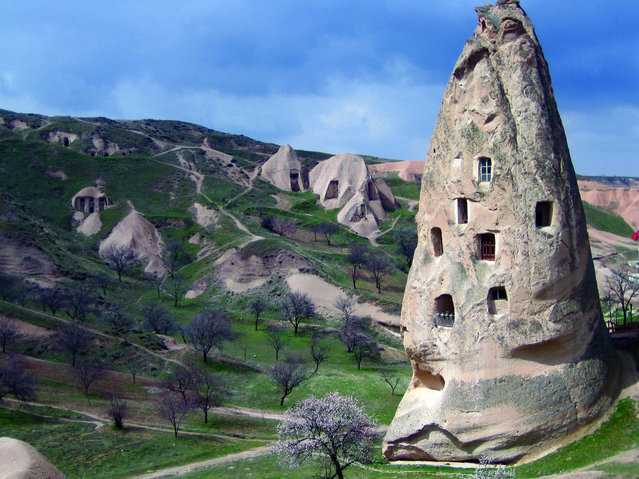
Cappadocia is a historical region in Central Anatolia, largely in Nevşehir Province, in Turkey.
In the time of Herodotus, the Cappadocians were reported as occupying the whole region from Mount Taurus to the vicinity of the Euxine (Black Sea). Cappadocia, in this sense, was bounded in the south by the chain of the Taurus Mountains that separate it from Cilicia, to the east by the upper Euphrates and the Armenian Highland, to the north by Pontus, and to the west by Lycaonia and eastern Galatia.
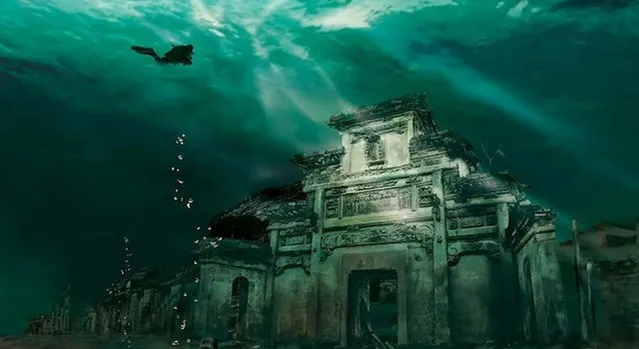
Qiandao Lake (Chinese: 千島湖, lit. Thousand Island Lake), a man-made lake located in Chun'an County, Zhejiang, China, formed after the completion of the Xin'an River hydroelectric station in 1959. 1,078 large islands dot the lake and a few thousand smaller ones are scattered across it. The lake covers an area of 573 km² and has a storage capacity of 17.8 km³. The islands in the lake cover about 86 km²