Loading...
Done
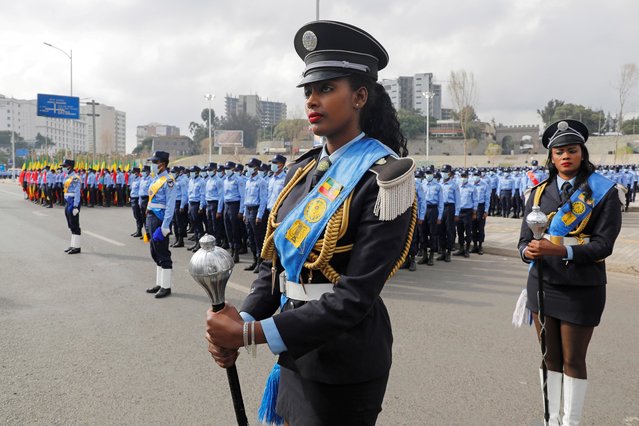
Addis Ababa police officers take part in a parade to display their new uniforms, and their readiness for the upcoming Ethiopian parliamentary and regional elections, in Addis Ababa, Ethiopia, June 19, 2021. (Photo by Baz Ratner/Reuters)

Addis Ababa police officers take part in a parade to display their new uniforms, and their readiness for the upcoming Ethiopian parliamentary and regional elections, in Addis Ababa, Ethiopia, June 19, 2021. (Photo by Baz Ratner/Reuters)
Details
30 Jun 2021 10:34:00
Kamo Mphela, a South African dancer and singer performs Amapiano, a South African musical export that has crossed borders and cultural barriers, reaching as far as Japan, during a music concert in Pretoria, South Africa, July 22, 2022. (Photo by Shafiek Tassiem/Reuters)

Kamo Mphela, a South African dancer and singer performs Amapiano, a South African musical export that has crossed borders and cultural barriers, reaching as far as Japan, during a music concert in Pretoria, South Africa, July 22, 2022. (Photo by Shafiek Tassiem/Reuters)
Details
10 Aug 2022 05:15:00
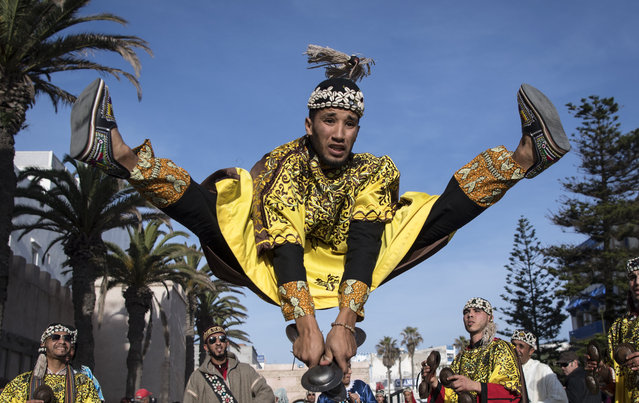
A Gnawa traditional group performs in the city of Essaouira on December 14, 2019, to celebrate the decision of adding the Gnawa culture to UNESCO's list of Intangible Cultural Heritage of Humanity. Gnawa culture, a centuries-old Moroccan practice rooted in music, African rituals and Sufi traditions, was added to UNESCO's list of Intangible Cultural Heritage of Humanity earlier in the week. Gnawa refers to a “set of musical productions, fraternal practices and therapeutic rituals where the secular mixes with the sacred”, according to the nomination submitted by Morocco. Often dressed in colourful outfits, Gnawa musicians play the guenbri, a type of lute with three strings, accompanied by steel castanets called krakebs. (Photo by Fadel Senna/AFP Photo)

A Gnawa traditional group performs in the city of Essaouira on December 14, 2019, to celebrate the decision of adding the Gnawa culture to UNESCO's list of Intangible Cultural Heritage of Humanity. Gnawa culture, a centuries-old Moroccan practice rooted in music, African rituals and Sufi traditions, was added to UNESCO's list of Intangible Cultural Heritage of Humanity earlier in the week. Gnawa refers to a “set of musical productions, fraternal practices and therapeutic rituals where the secular mixes with the sacred”, according to the nomination submitted by Morocco. Often dressed in colourful outfits, Gnawa musicians play the guenbri, a type of lute with three strings, accompanied by steel castanets called krakebs. (Photo by Fadel Senna/AFP Photo)

Details
18 Dec 2019 00:05:00
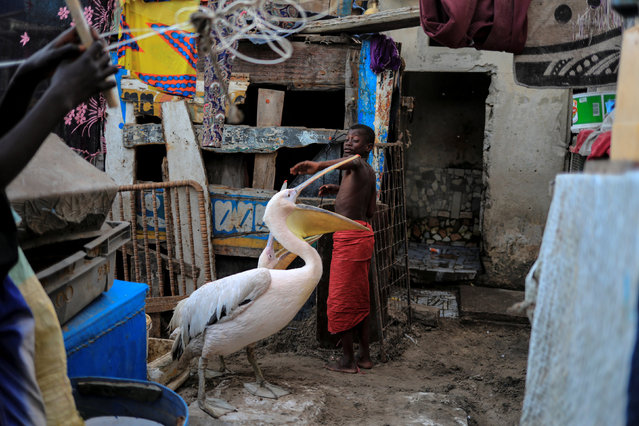
A boy plays with pelicans in Yoff, commune of Dakar, Senegal March 14, 2018. (Photo by Zohra Bensemra/Reuters)

A boy plays with pelicans in Yoff, commune of Dakar, Senegal March 14, 2018. (Photo by Zohra Bensemra/Reuters)
Details
28 Mar 2018 00:01:00
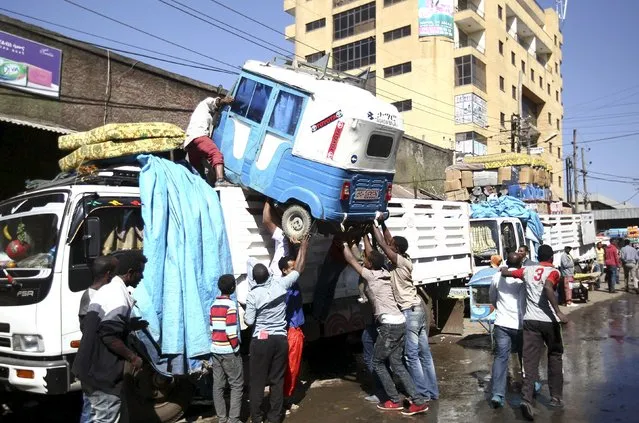
Labourers load a three-wheeled vehicle onto the back of a van at the Mercato market in Addis Ababa October 9, 2015. (Photo by Tiksa Negeri/Reuters)

Labourers load a three-wheeled vehicle onto the back of a van at the Mercato market in Addis Ababa October 9, 2015. Addis Ababa's “Mercato” – Italian for “market” – is reputedly the biggest open-air market in Africa, lying in the west of the capital. (Photo by Tiksa Negeri/Reuters)
Details
20 Dec 2015 08:06:00
Despite the amazing sight, Netal said that seeing the pools came with a downside. “The smell was horrible, and it was difficult to breath”. (Photo by Neta Dekel/Caters News Agency)

These stunning images show the beauty and drama of Mother Nature at work. Captured deep in heart of the Danakil Desert in East Africa, the images show the acid pools near the Erta Ale volcano. Pools of brightly colored acid can be seen amid the dramatic blast of volcanic ash. The photos were taken by Neta Dekel, an Israeli photographer. He the acid pools were one of the most extraordinary sights he had ever seen. (Photo by Neta Dekel/Caters News Agency)
Details
27 Jun 2018 00:03:00
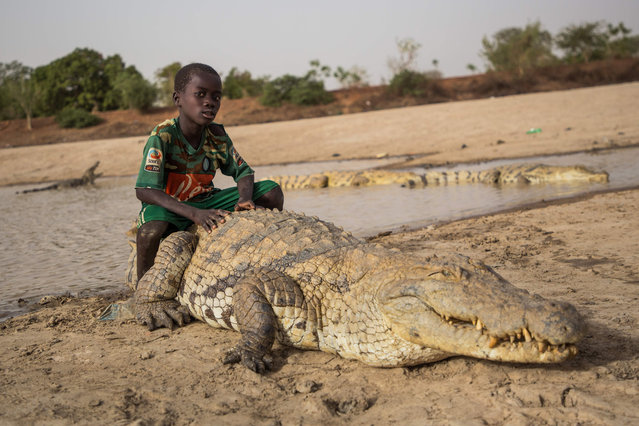
A boy sits on the back of a crocodile on May 19, 2018 at a pond in Bazoule in Burkina Faso, a village which happily shares its local pond with “sacred” crocodiles. Crocodiles may be one of the deadliest hunters in the animal kingdom, but in a small village in Burkina Faso it is not unusual to see someone sitting atop one of the fearsome reptiles. According to local legend, the startling relationship with the predators dates back to at least the 15 th century. The village was in the grip of an agonising drought until the crocodiles led women to a hidden pond where the population could slake their thirst. (Photo by Olympia de Maismont/AFP Photo)

A boy sits on the back of a crocodile on May 19, 2018 at a pond in Bazoule in Burkina Faso, a village which happily shares its local pond with “sacred” crocodiles. Crocodiles may be one of the deadliest hunters in the animal kingdom, but in a small village in Burkina Faso it is not unusual to see someone sitting atop one of the fearsome reptiles. According to local legend, the startling relationship with the predators dates back to at least the 15 th century. The village was in the grip of an agonising drought until the crocodiles led women to a hidden pond where the population could slake their thirst. (Photo by Olympia de Maismont/AFP Photo)
Details
17 Jul 2018 00:01:00
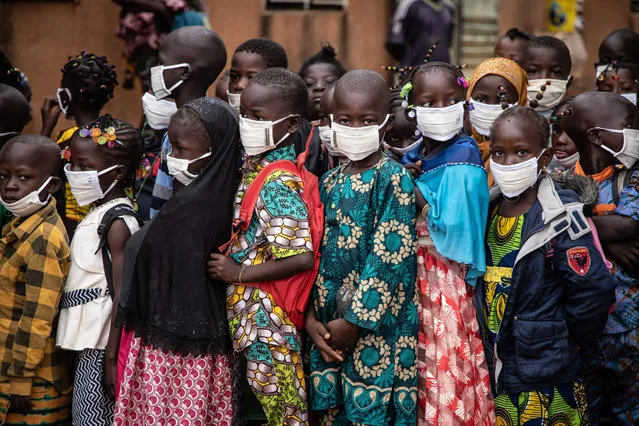
Pupils wearing face masks wait for the opening of their primary school on the first day of the new school year, in Ouagadougou, on October 1, 2020. (Photo by Olympia de Maismont/AFP Photo)

Pupils wearing face masks wait for the opening of their primary school on the first day of the new school year, in Ouagadougou, on October 1, 2020. (Photo by Olympia de Maismont/AFP Photo)
Details
08 Oct 2020 00:01:00