Loading...
Done
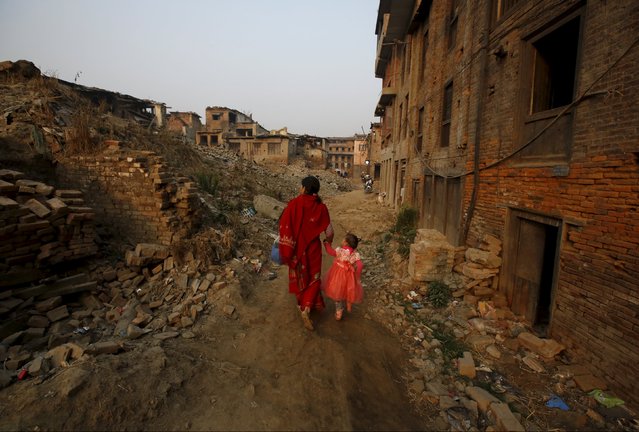
A woman and a child walk past the remains of collapsed houses damaged during the April 2015 earthquake, in Bhaktapur, Nepal March 18, 2016. The two devastating earthquakes that struck Nepal last year killed almost 9,000 people across the country. Inside the Kathmandu Valley almost 2,000 died, and some of the area's most important cultural and heritage sites were completely destroyed. As Kathmandu inhabitants prepare to mark the one-year anniversary of the event, thousands are still displaced and millions are living in temporary shelters. (Photo by Navesh Chitrakar/Reuters)

A woman and a child walk past the remains of collapsed houses damaged during the April 2015 earthquake, in Bhaktapur, Nepal March 18, 2016. The two devastating earthquakes that struck Nepal last year killed almost 9,000 people across the country. Inside the Kathmandu Valley almost 2,000 died, and some of the area's most important cultural and heritage sites were completely destroyed. As Kathmandu inhabitants prepare to mark the one-year anniversary of the event, thousands are still displaced and millions are living in temporary shelters. (Photo by Navesh Chitrakar/Reuters)
Details
25 Apr 2016 09:19:00
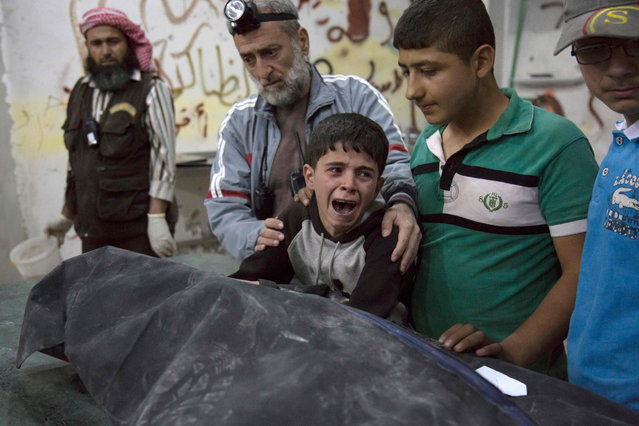
A Syrian boy is comforted as he cries next to the body of a relative who died in a reported airstrike on April 27, 2016 in the rebel-held neighbourhood of al-Soukour in the northern city of Aleppo. (Photo by Karam Al-Masri/AFP Photo)

A Syrian boy is comforted as he cries next to the body of a relative who died in a reported airstrike on April 27, 2016 in the rebel-held neighbourhood of al-Soukour in the northern city of Aleppo. The Syrian army was preparing an offensive to retake the whole of Aleppo, as fighting in the divided second city killed 38 civilians in a new blow for a tattered truce. Nearly 200 people have been killed in Aleppo in the past week as rebels have pounded government-held neighbourhoods with rocket and artillery fire and the regime has hit rebel areas with air raids. (Photo by Karam Al-Masri/AFP Photo)
Details
29 Apr 2016 11:37:00
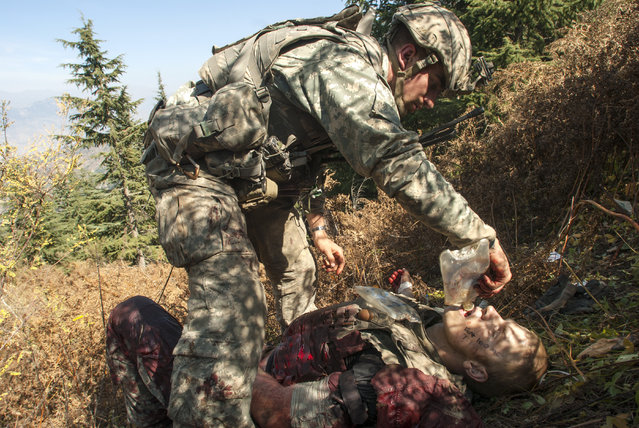
American soldiers with the 173rd Airborne Brigade Battle Company, on a battalion-wide mission in the Korengal Valley, looking for caves, weapons caches and known Taliban leaders, 2007. Tanner Stichter tends to Spc. Carl Vandeberge in the bushes moments after Vandeberge was shot in the stomach during a Taliban ambush, which killed one soldier and wounded two others. (Photo by Lynsey Addario)

American soldiers with the 173rd Airborne Brigade Battle Company, on a battalion-wide mission in the Korengal Valley, looking for caves, weapons caches and known Taliban leaders, 2007. Tanner Stichter tends to Spc. Carl Vandeberge in the bushes moments after Vandeberge was shot in the stomach during a Taliban ambush, which killed one soldier and wounded two others. (Photo by Lynsey Addario)
Details
06 Feb 2015 12:36:00
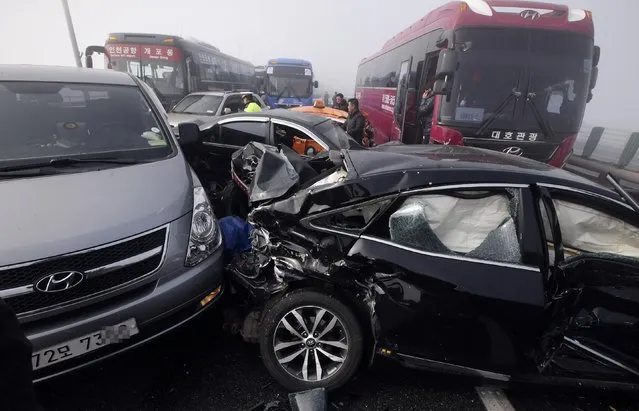
Damaged vehicles sit on Yeongjong Bridge in Incheon, South Korea, Wednesday, February 11, 2015. Two people were killed and at least 42 were injured on Wednesday after a pileup involving about 100 vehicles in foggy weather on the bridge near the Incheon International Airport, South Korean officials said. (Photo by Suh Myung-gon/AP Photo/Yonhap)

Damaged vehicles sit on Yeongjong Bridge in Incheon, South Korea, Wednesday, February 11, 2015. Two people were killed and at least 42 were injured on Wednesday after a pileup involving about 100 vehicles in foggy weather on the bridge near the Incheon International Airport, South Korean officials said. (Photo by Suh Myung-gon/AP Photo/Yonhap)
Details
12 Feb 2015 12:20:00
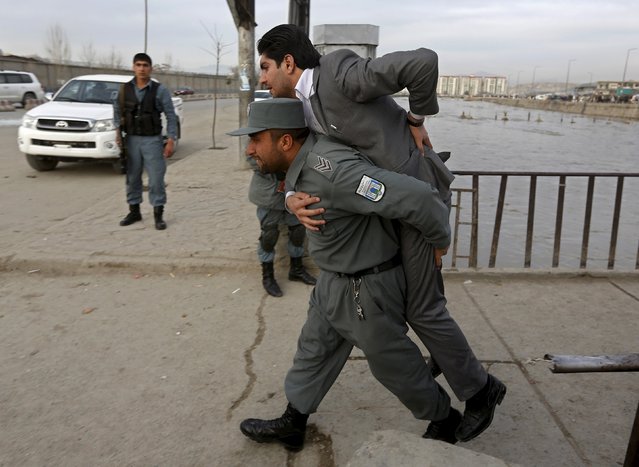
An Afghan policeman carries a wounded man at the site of a suicide attack in Kabul March 25, 2015. Six people were killed and more than 30 injured in the suicide bombing in the Afghan capital on Wednesday that struck close to the presidential palace in the heart of the city, the Interior Ministry said. The suicide bomber had been travelling in a vehicle packed with explosives and it was not immediately clear what the target of the attack had been. (Photo by Omar Sobhani/Reuters)

An Afghan policeman carries a wounded man at the site of a suicide attack in Kabul March 25, 2015. Six people were killed and more than 30 injured in the suicide bombing in the Afghan capital on Wednesday that struck close to the presidential palace in the heart of the city, the Interior Ministry said. The suicide bomber had been travelling in a vehicle packed with explosives and it was not immediately clear what the target of the attack had been. (Photo by Omar Sobhani/Reuters)
Details
26 Mar 2015 12:33:00
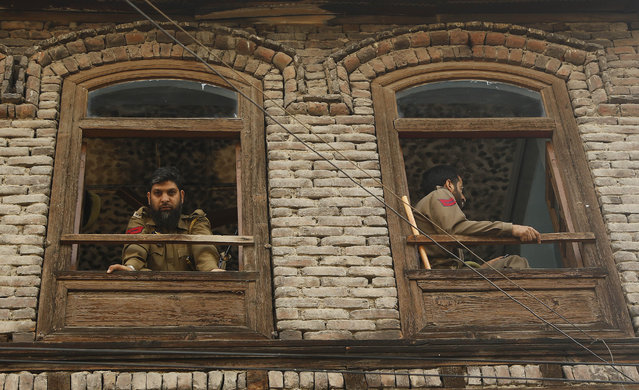
Indian policemen keep guard from the window of a residential house during curfew in Srinagar, Indian controlled Kashmir, Wednesday, July 13, 2016. Curfew imposed in the disputed Himalayan region continues for the fifth consecutive day to suppress anti-India violence following the Friday killing of Burhan Wani, chief of operations of Hizbul Mujahideen, Kashmir's largest rebel group. (Photo by Mukhtar Khan/AP Photo)

Indian policemen keep guard from the window of a residential house during curfew in Srinagar, Indian controlled Kashmir, Wednesday, July 13, 2016. Curfew imposed in the disputed Himalayan region continues for the fifth consecutive day to suppress anti-India violence following the Friday killing of Burhan Wani, chief of operations of Hizbul Mujahideen, Kashmir's largest rebel group. (Photo by Mukhtar Khan/AP Photo)
Details
14 Jul 2016 09:44:00
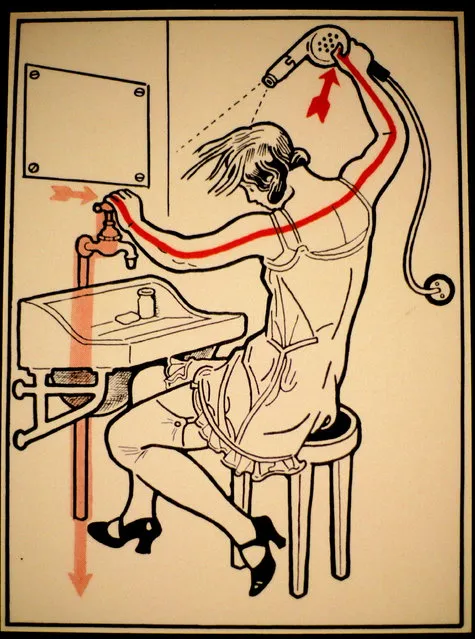
The book “Elektroschutz in 132 Bildern” (Electrical Protection in 132 Pictures) was published in Vienna in the early 1900s by a Viennese physician named Stefan Jellinek (1878-1968, a founder of the Electro-Pathological Museum). The pictures are nice and direct and unambiguous; they teach, graphically, that the surest way to kill yourself with electricity is to form a complete path from source (usually the bright red arrow) to ground (the screened back, pink arrow). Arrowheads provide the path for current flow. (Photo by The Vienna Technical Museum)

The book “Elektroschutz in 132 Bildern” (Electrical Protection in 132 Pictures) was published in Vienna in the early 1900s by a Viennese physician named Stefan Jellinek (1878-1968, a founder of the Electro-Pathological Museum). The pictures are nice and direct and unambiguous; they teach, graphically, that the surest way to kill yourself with electricity is to form a complete path from source (usually the bright red arrow) to ground (the screened back, pink arrow). Arrowheads provide the path for current flow. (Photo by The Vienna Technical Museum)
Details
11 Aug 2014 11:10:00
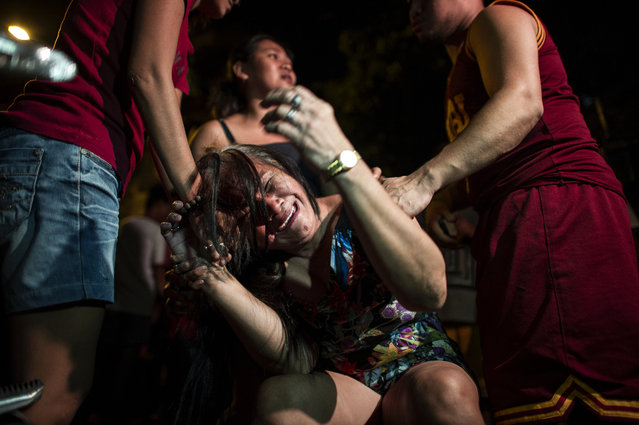
In this picture taken on September 24, 2016, relatives grieve their lost one, an alleged drug user/dealer gunned down by unidentified gunmen in Manila. Philippine President Rodrigo Duterte defended his threat to kill criminals as “perfect” and vowed no let-up in his war on crime, as the death toll surged past 3,700. (Photo by Noel Celis/AFP Photo)

In this picture taken on September 24, 2016, relatives grieve their lost one, an alleged drug user/dealer gunned down by unidentified gunmen in Manila. Philippine President Rodrigo Duterte defended his threat to kill criminals as “perfect” and vowed no let-up in his war on crime, as the death toll surged past 3,700. (Photo by Noel Celis/AFP Photo)
Details
04 Jan 2017 08:00:00