Loading...
Done
A man makes traditional candy “Matang” in preparation for the upcoming Chinese Lunar New Year in Yuqing County, Zunyi, Guizhou Province, China, January 18, 2016. (Photo by Reuters/China Daily)

A man makes traditional candy “Matang” in preparation for the upcoming Chinese Lunar New Year in Yuqing County, Zunyi, Guizhou Province, China, January 18, 2016. (Photo by Reuters/China Daily)
Details
21 Jan 2016 08:06:00
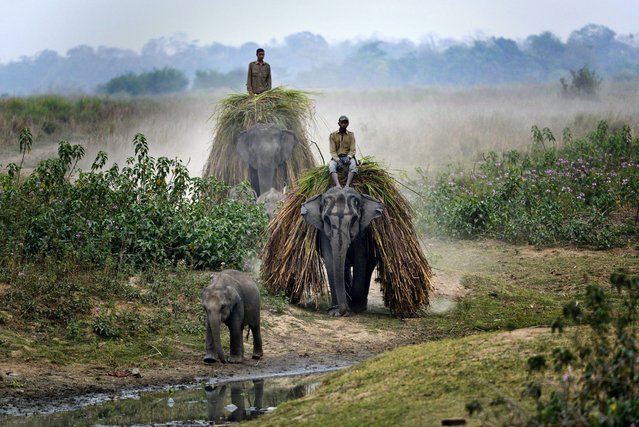
Mahouts return home with their elephants carrying grass to feed them on the eve of the rhino census in Kaziranga National Park in Assam state, India, 24 March 2015. Kaziranga will be closed to visitors for the next two days for a census of the rhinos commencing 25 March, in a previous census in 2013 in the park the population of the Indian rhinos was 2329. (Photo by EPA/Stringer)

Mahouts return home with their elephants carrying grass to feed them on the eve of the rhino census in Kaziranga National Park in Assam state, India, 24 March 2015. Kaziranga will be closed to visitors for the next two days for a census of the rhinos commencing 25 March, in a previous census in 2013 in the park the population of the Indian rhinos was 2329. (Photo by EPA/Stringer)
Details
28 Mar 2015 11:46:00
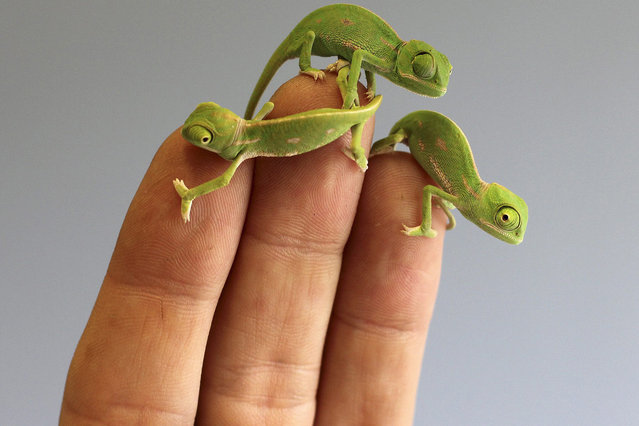
A handout image released by the Taronga Zoo shows Veiled Chameleon hatchlings at Taronga Zoo in Sydney, Australia, 11 March 2015. Taronga has welcomed more than 20 baby chameleons, with the last of three clutches of eggs hatching this week. Veiled Chameleons, or Chamaeleo calyptratus, are native to Saudi Arabia and Yemen and can live up to five years. (Photo by EPA/Taronga Zoo)

A handout image released by the Taronga Zoo shows Veiled Chameleon hatchlings at Taronga Zoo in Sydney, Australia, 11 March 2015. Taronga has welcomed more than 20 baby chameleons, with the last of three clutches of eggs hatching this week. Veiled Chameleons, or Chamaeleo calyptratus, are native to Saudi Arabia and Yemen and can live up to five years. (Photo by EPA/Taronga Zoo)
Details
21 Mar 2015 13:13:00
Emilia Pechinkova, a 24-years-old Bulgarian Pomak (Bulgarian speaking Muslims) bride poses for a photograph following the “gelina” or face painting ceremony carried out by female guests and relatives in preparation for her three-day wedding ceremony in the village of Draginovo, 100 kms southeast of Sofia on April 22, 2016. Bulgaria's Muslim population is one of the highest in the European Union. (Photo by Nikolay Doychinov/AFP Photo)

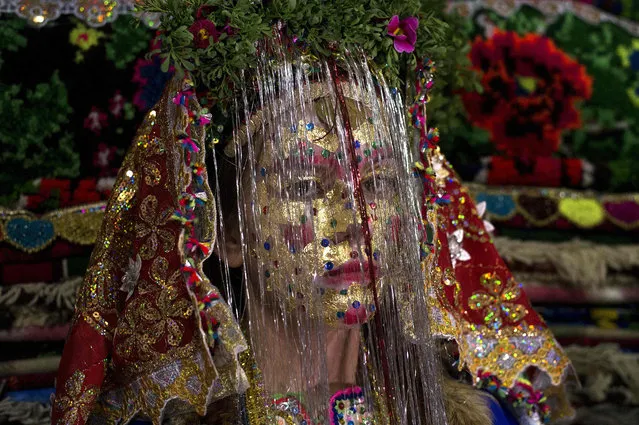
Emilia Pechinkova, a 24-years-old Bulgarian Pomak (Bulgarian speaking Muslims) bride poses for a photograph following the “gelina” or face painting ceremony carried out by female guests and relatives in preparation for her three-day wedding ceremony in the village of Draginovo, 100 kms southeast of Sofia on April 22, 2016. Bulgaria's Muslim population is one of the highest in the European Union. During the Communist regime religious rituals were not tolerated, and Muslims were forced to abandon wearing their traditional wedding outfits. Recently, more young Pomak women want to include traditional wedding customs that were forbidden during the regime, regardless of their secular lifestyles and the high cost of such a wedding. (Photo by Nikolay Doychinov/AFP Photo)

Details
25 Apr 2016 09:55:00
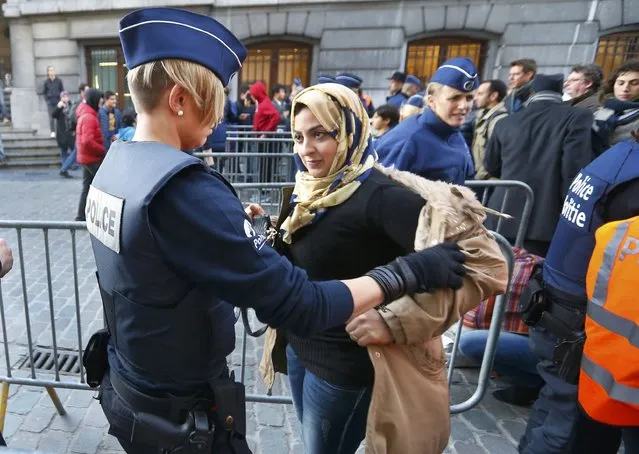
Residents of the Brussels suburb of Molenbeek are searched by police before taking part in a memorial gathering to honour the victims of the recent deadly Paris attacks, in Brussels, Belgium, November 18, 2015. (Photo by Yves Herman/Reuters)

Residents of the Brussels suburb of Molenbeek are searched by police before taking part in a memorial gathering to honour the victims of the recent deadly Paris attacks, in Brussels, Belgium, November 18, 2015. (Photo by Yves Herman/Reuters)
Details
19 Nov 2015 08:07:00
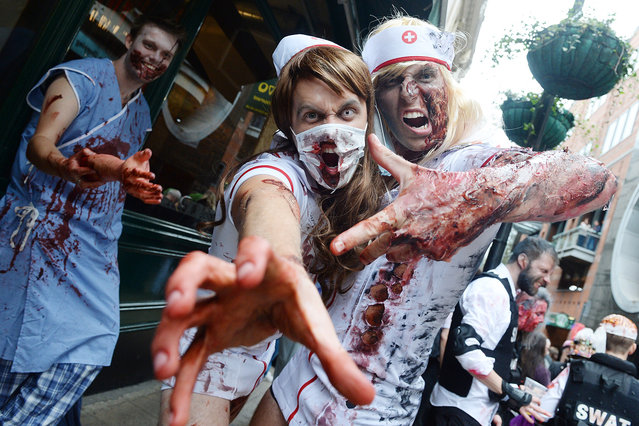
People dressed as zombies participate in a parade for World Zombie Day 2016 in London's West End, Britain on October 9, 2016. (Photo by Splash News and Pictures)

People dressed as zombies participate in a parade for World Zombie Day 2016 in London's West End, Britain on October 9, 2016. (Photo by Splash News and Pictures)
Details
11 Oct 2016 11:28:00
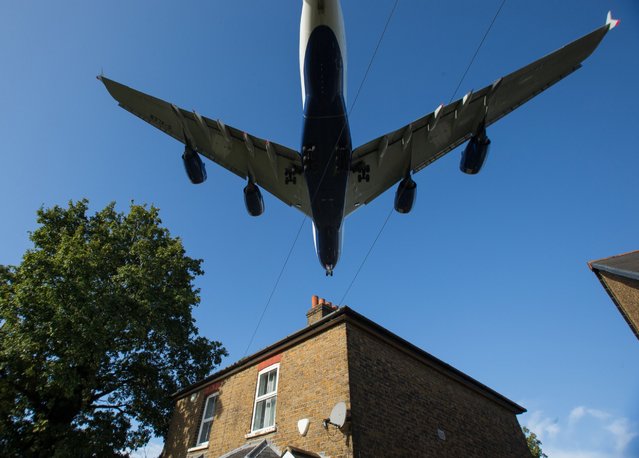
A passenger aircraft passes over a residential house as it prepares to land at London Heathrow Airport in west London on October 17, 2016. Britain's government is considering whether to approve a third runway at Heathrow or expand air capacity in southeast England at another airport such as London Gatwick. (Photo by Daniel Leal-Olivas/AFP Photo)

A passenger aircraft passes over a residential house as it prepares to land at London Heathrow Airport in west London on October 17, 2016. Britain's government is considering whether to approve a third runway at Heathrow or expand air capacity in southeast England at another airport such as London Gatwick. (Photo by Daniel Leal-Olivas/AFP Photo)
Details
18 Oct 2016 12:52:00
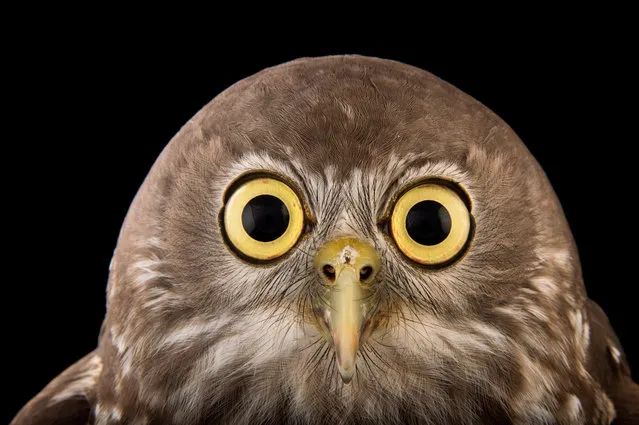
The National Geographic Photo Ark is a travelling exhibition of photographer Joel Sartore’s quest to create a photo archive of biodiversity around the world. So far, Sartore has captured studio portraits of more than 6,000 species – a number that he hopes to double. On 1 July, the ark will open at Melbourne zoo – the first time it has been exhibited in the southern hemisphere. More than 50 portraits will be on display, including many of Australian endangered animals being protected by programs at the zoo itself. These captions have been edited from text supplied by Melbourne zoo. Here: Barking owl. So-named because its call sounds like a barking dog, these birds are native to Australia, Indonesia and Papua New Guinea. In Victoria they are listed as an endangered species, and in 2003 there were estimated to be fewer than 50 breeding pairs. The main threat to the species in Victoria is loss of habitat, especially large trees with hollows in which they can nest and on which many of their prey depend. Apart from a bark, they may utter a chilling scream when they feel threatened. (Photo by Joel Sartore/National Geographic Photo Ark/The Guardian)

The National Geographic Photo Ark is a travelling exhibition of photographer Joel Sartore’s quest to create a photo archive of biodiversity around the world. So far, Sartore has captured studio portraits of more than 6,000 species – a number that he hopes to double. On 1 July, the ark will open at Melbourne zoo – the first time it has been exhibited in the southern hemisphere. More than 50 portraits will be on display, including many of Australian endangered animals being protected by programs at the zoo itself. These captions have been edited from text supplied by Melbourne zoo. Here: Barking owl. (Photo by Joel Sartore/National Geographic Photo Ark/The Guardian)
Details
01 Jul 2017 07:45:00