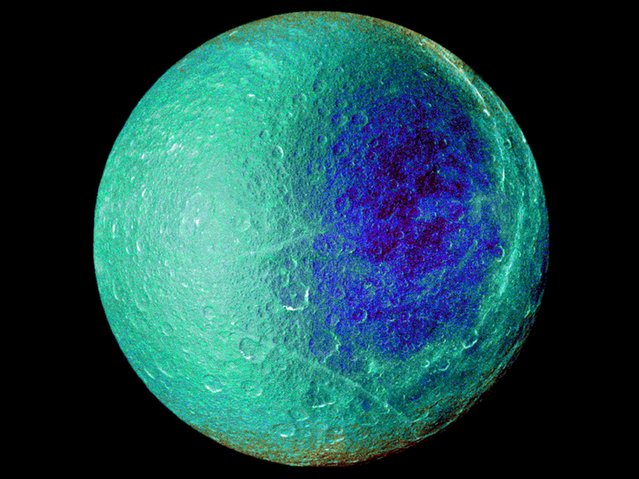
Hemispheric color differences on Saturn's moon Rhea are apparent in this false-color view from NASA's Cassini spacecraft in this March 2, 2010 file photo. (Photo by Reuters/NASA/JPL/SSI)
A 16-foot- ( almost 5 meters ) tall hand sculpture named Quasi stands perched on its fingertips atop the roof of an art gallery in Wellington, New Zealand, Wednesday, October 30, 2024. (Photo by Charlotte Graham-McLay/AP Photo)
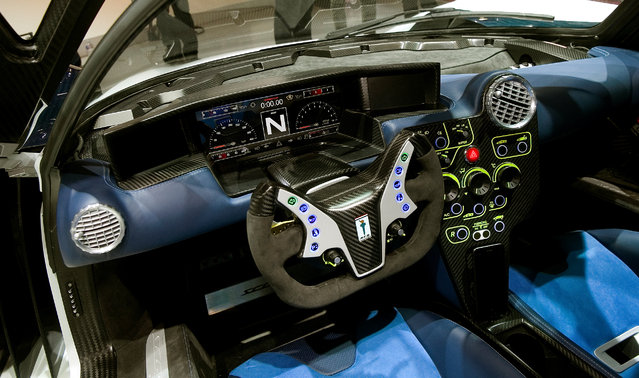
Cockpit of a SCG 0003S racecar is seen during the 87th International Motor Show at Palexpo in Geneva, Switzerland March 8, 2017. (Photo by Arnd Wiegmann/Reuters)
Members of a cheerleading team warm- up during the Russian Cheerleading Championship of students in Moscow on November 20, 2016. (Photo by Natalia Kolesnikova/AFP Photo)
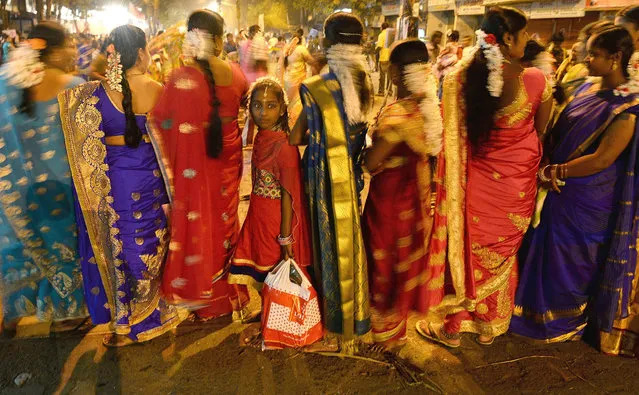
Indian Hindu devotees wait to take part in an event to mark Pongal in Mumbai on January 15, 2016. Pongal, which coincides with the Hindu festival Makara Sankranthi, is a thanksgiving and harvest celebrated throughout India and specifically by those from the Indian state of Tamil Nadu. (Photo by Indranil Mukherjee/AFP Photo)
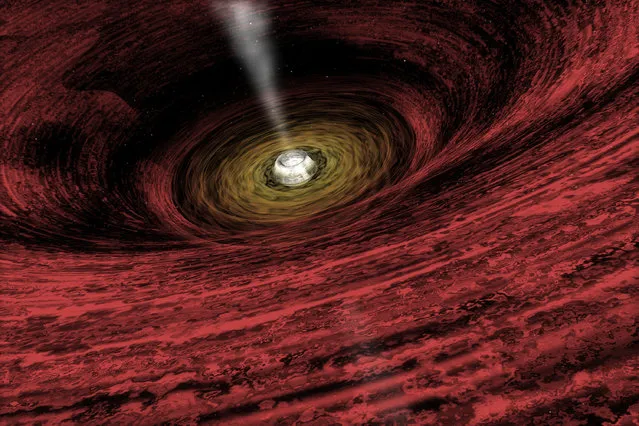
An artist's impression of a growing supermassive black hole located in the early Universe is seen in this NASA handout illustration released on June 15, 2011. Using the deepest X-ray image ever taken, astronomers found the first direct evidence that massive black holes were common in the early universe. This discovery from NASA's Chandra X-Ray Observatory shows that very young black holes grew more aggressively than previously thought, in tandem with the growth of their host galaxies. (Photo by Reuters/NASA/Chandra X-Ray Observatory/A.Hobart)
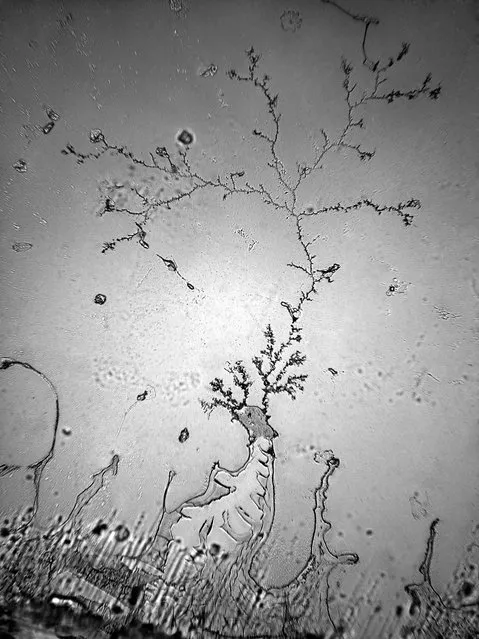
Do tears of joy look the same as ones of woe—or ones from chopping onions? In “The Topography of Tears,” the Los Angeles-based photographer Rose-Lynn Fisher explores the physical terrain of one hundred tears emitted during a range of emotional states and physical reactions. Using a Zeiss microscope with an attached digital camera, she captures the composition of tears enclosed in glass slides, magnified between 10x and 40x. “There are many factors that determine the look of each tear image, including the viscosity of the tear, the chemistry of the weeper, the settings of the microscope, and the way I process the images afterwards,” she says.