Loading...
Done


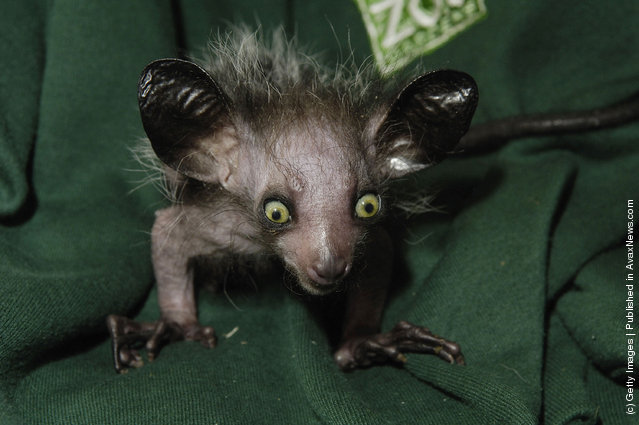
“The aye-aye (Daubentonia madagascariensis) is a lemur, a strepsirrhine primate native to Madagascar that combines rodent-like teeth and a special thin middle finger to fill the same ecological niche as a woodpecker. It is the world's largest nocturnal primate, and is characterized by its unusual method of finding food; it taps on trees to find grubs, then gnaws holes in the wood and inserts its narrow middle finger to pull the grubs out. The only other animal species known to find food in this way is the striped possum. From an ecological point of view the aye-aye fills the niche of a woodpecker as it is capable of penetrating wood to extract the invertebrates within”. – Wikipedia

Photo: In this handout image from Bristol Zoo is seen the first captive bred aye-aye in the UK named “Kintana” (meaning star in Malagasy) April 15, 2005 at Bristol Zoo Gardens, England. The zoo announced today only the second baby aye-aye to be hand-reared in the world (the first was in Jersey Zoo) and has now made his first public appearance since his birth on 11 February 2005. (Photo by Rob Cousins/Bristol Zoo via Getty Images)
Details
13 Apr 2011 13:33:00
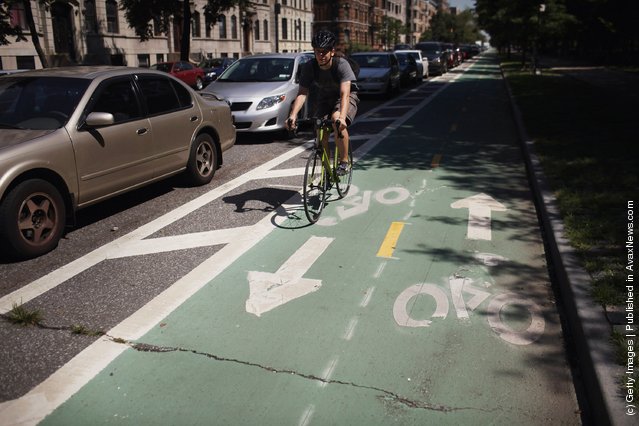
A man rides his bike along a controversial bike lane on Prospect Park West

A man rides his bike along a controversial bike lane on Prospect Park West on August 17, 2011 in the Brooklyn borough of New York City. In what is being viewed as a victory for the Bloomberg administration, a judge on Tuesday dismissed an effort by Brooklyn residents to remove a bicycle lane installed by the city on Prospect Park West. Mayor Michael Bloomberg, along with his transportation commissioner, Janette Sadik-Khan, has attempted to make New York more bicycle and pedestrian friendly with numerous bike and pedestrian lanes around New York City. The effort has angered some in the city who see the lanes as adding to traffic, taking up parking spaces and a danger to pedestrians. (Photo by Spencer Platt/Getty Images)
Details
18 Aug 2011 11:22:00
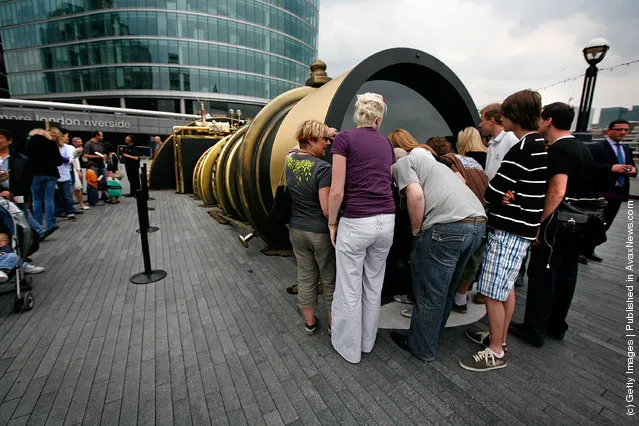
Telectroscope

“The telectroscope (also referred to as “electroscope”) was the first non-working prototype (i.e. conceptual model) of a television or videophone system. The term was used in the 19th century to describe science-based systems of distant seeing. The name and its concept came into being not long after the telephone was patented in 1876, and its original concept evolved from that of remote facsimile reproductions onto paper, into the live viewing of remote images”. – Wikipedia

Photo: Visitors to London wave to people they can see in New York as they peer through the Telectroscope situated by Tower Bridge on May 23, 2008 in London, England. The device named the Telectroscope provides a live visual link up between London and New York, to another Telectroscope by Brooklyn Bridge. (Photo by Cate Gillon/Getty Images)
Details
16 Sep 2011 12:19:00
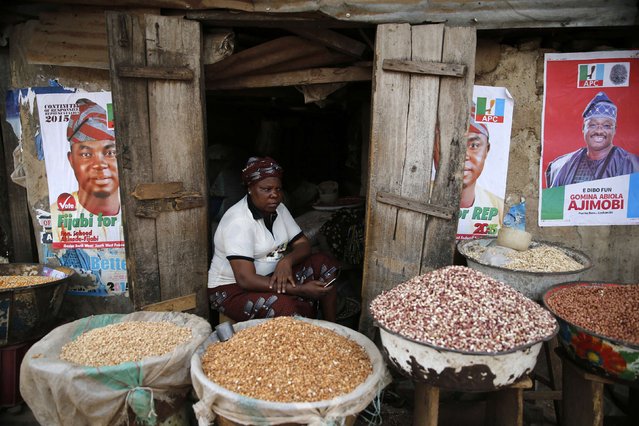
Latefat Alao, 56, a ethnic Yoruba Muslim woman, waits for customers in front of her in Beere market in Ibadan, southwest Nigeria, January 29, 2015. Much of the grain and wheat traders like Alao sell comes from the north and Boko Haram's campaign has negatively affected farmers and food markets. (Photo by Akintunde Akinleye/Reuters)

Latefat Alao, 56, a ethnic Yoruba Muslim woman, waits for customers in front of her in Beere market in Ibadan, southwest Nigeria, January 29, 2015. Much of the grain and wheat traders like Alao sell comes from the north and Boko Haram's campaign has negatively affected farmers and food markets. Reuters photographer Akintunde Akinleye photographed Nigerians and asked them about their views on the elections as well as their hopes and concerns for the country. (Photo by Akintunde Akinleye/Reuters)
Details
12 Feb 2015 12:44:00
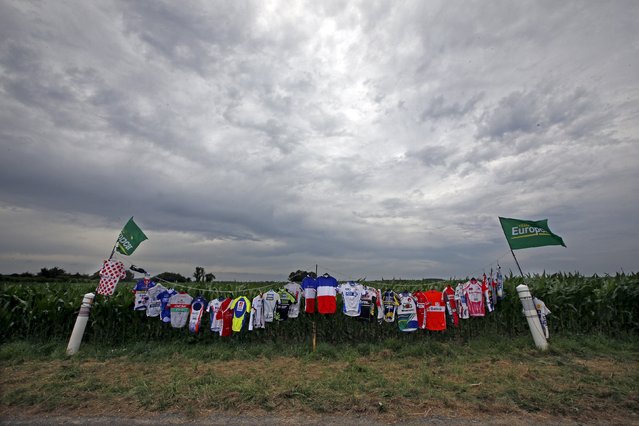
Cycling jerseys, part of a collection belonging to French cycling fan Gerald, hang from a line during the 4th stage of the Tour de France cycling race from Seraing in Belgium to Cambrai in France, July 7, 2015. (Photo by Eric Gaillard/Reuters)

Cycling jerseys, part of a collection belonging to French cycling fan Gerald, hang from a line during the 4th stage of the Tour de France cycling race from Seraing in Belgium to Cambrai in France, July 7, 2015. Photographing the Tour de France cycling race comes with highs and lows: the buzz from capturing just the right image, the tedium of long journeys, the painstaking set-up of equipment, the breath-taking scenery. Reuters photographers have worked not only to capture the thrills and spills on the roads and mountain passes. They have also shot a set of pictures showing their own quirky view from behind the scenes as they travelled through the Netherlands, Belgium and France. (Photo by Eric Gaillard/Reuters)
Details
25 Jul 2015 12:42:00
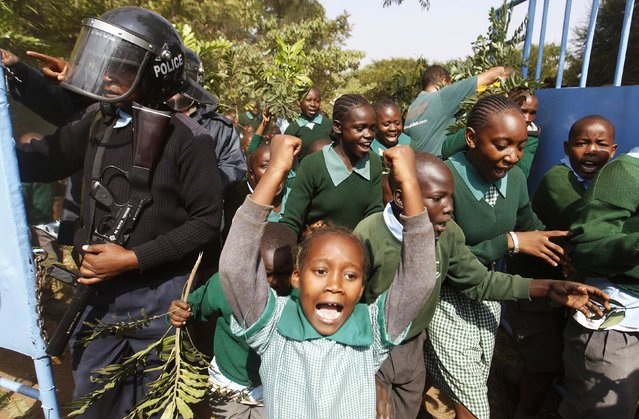
Students from Langata primary school run past riot police as they protest against a perimeter wall illegally erected by a private developer around their school playground in Kenya's capital Nairobi January 19, 2015. (Photo by Thomas Mukoya/Reuters)

Students from Langata primary school run past riot police as they protest against a perimeter wall illegally erected by a private developer around their school playground in Kenya's capital Nairobi January 19, 2015. Riot police used teargas to disperse students at a school in Nairobi as the children protested against the potential loss of their playground. The playground was fenced off in December, during the school holidays, by a prominent developer who also claims ownership of the land. The title to the contested site is said to be in the name of Airport View Housing Limited, according to local media, with plans to use the space to build a parking lot for a hotel. (Photo by Thomas Mukoya/Reuters)
Details
20 Jan 2015 13:04:00
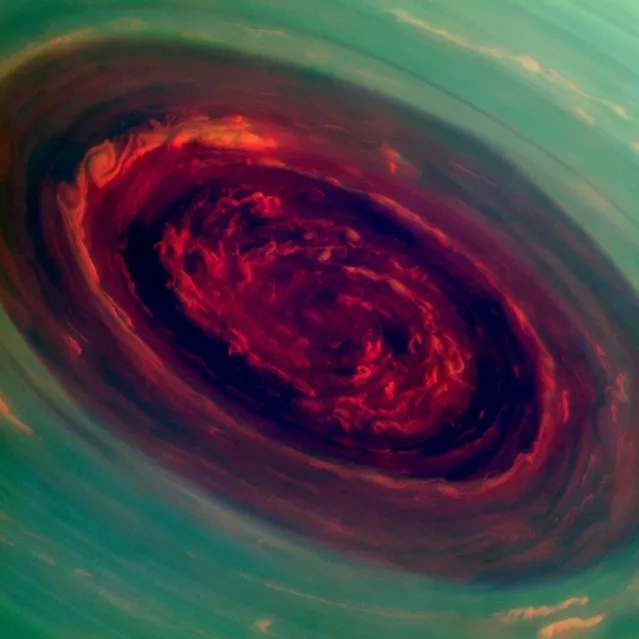
The spinning vortex of Saturn's north polar storm resembles a deep red rose of giant proportions surrounded by green foliage in this false-color image from NASA's Cassini spacecraft. (Photo by NASA/JPL-Caltech/SSI)

NASA's Cassini spacecraft has provided scientists the first close-up, visible-light views of a behemoth hurricane swirling around Saturn's north pole. In high-resolution pictures and video, scientists see the hurricane's eye is about 1,250 miles (2,000 kilometers) wide, 20 times larger than the average hurricane eye on Earth. Thin, bright clouds at the outer edge of the hurricane are traveling 330 mph(150 meters per second). The hurricane swirls inside a large, mysterious, six-sided weather pattern known as the hexagon. Photo: The spinning vortex of Saturn's north polar storm resembles a deep red rose of giant proportions surrounded by green foliage in this false-color image from NASA's Cassini spacecraft. (Photo by NASA/JPL-Caltech/SSI)
Details
31 May 2015 09:11:00
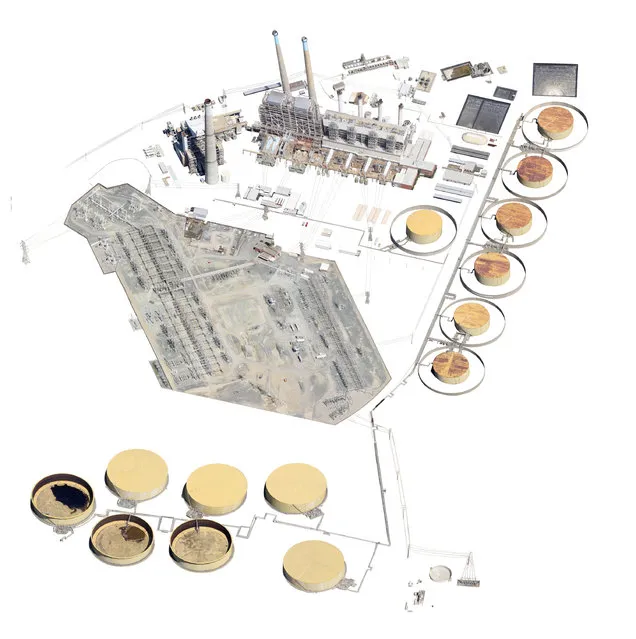
Natural gas plant in Pittsburg, CA (detail of Power Landscape), 2013. (Photo by Jenny Odell)

Jenny Odell repurposes online imagery mostly from Google Maps, but also from YouTube, Craigslist, and other sites. In her “Satellite Collections”, for example, she incorporated aerial views of swimming pools, basketball courts, parking lots, and other recognizable structures, seen from space. Her more recent series, “Satellite Landscapes”, includes painstakingly isolated Google Maps imagery of oil refineries, wastewater treatment plants, solar farms, etc. This work is meant as a reminder of our physically determined and vulnerable existence, since we depend on many of these things for survival and maintenance of our way of life. Photo: Natural gas plant in Pittsburg, CA (detail of Power Landscape), 2013. (Photo by Jenny Odell)
Details
19 Mar 2014 07:28:00