Loading...
Done
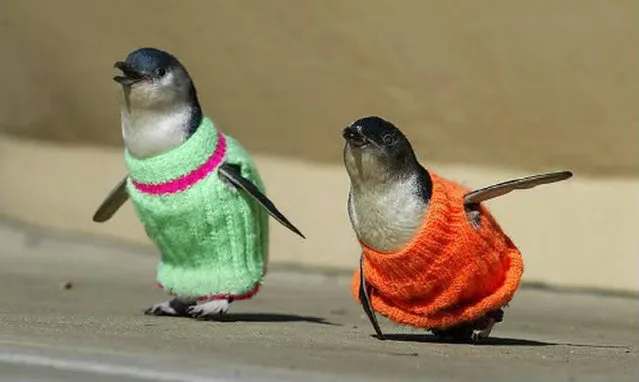
New Zealand Penguins in Need of Sweaters

Penguin sweaters, also known as penguin jumpers, are sweaters which are knitted for penguins that have been caught in oil slicks. When an oil spill affects penguins, they are dressed in knitted sweaters to stop them preening their feathers and to keep them warm, since the spilled oil destroys their natural oils. This also prevents them from poisoning themselves by ingesting the oil. The sweaters are removed and discarded as soon as the penguins can be washed. The original project has been completed, but the knitting pattern is still available on-line, as subsequent oil spills make it necessary. The extra sweaters are kept on behalf of the Wildlife Rescue Team.
Details
31 Oct 2012 13:06:00
The stunning Kamchatka Peninsula, Russia. (Photo by Vladimir Voychuk/Caters News)

These stunning images have captured UFO type clouds forming around world famous volcano. The Kamchatka peninsula contains the volcanoes of Kamchatka, which have been captured in a series of stunning shots by photographer Vladimir Voychuk, 37, from Klin, Russia. It is said that Kamchatka is one of the most picturesque distant corners of huge Russia and attracts hundreds of photographers with its unique nature. Here: The stunning Kamchatka Peninsula, Russia. (Photo by Vladimir Voychuk/Caters News)
Details
13 Oct 2017 06:18:00
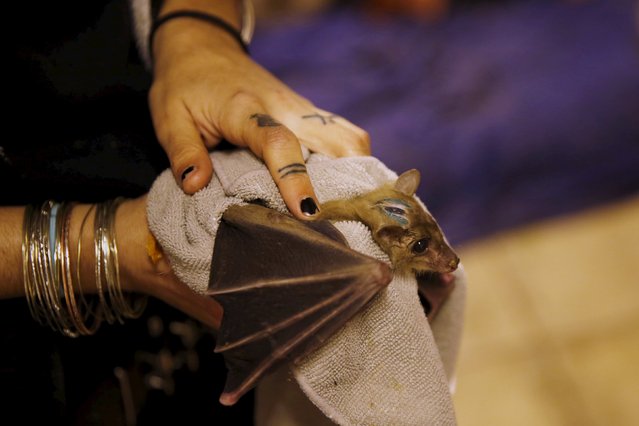
Israeli woman, Nora Lifschitz, 28, holds an injured Egyptian fruit bat at her home in Tel Aviv February 22, 2016. (Photo by Baz Ratner/Reuters)

Israeli woman, Nora Lifschitz, 28, holds an injured Egyptian fruit bat at her home in Tel Aviv February 22, 2016. Lifschitz says that she began caring for injured fruit bats from her home two years ago and now has some 70 of the flying mammals which she plans to release back into nature once they are healthy. (Photo by Baz Ratner/Reuters)
Details
24 Feb 2016 13:10:00
Kale grows at Kajodlingen farm in Gothenburg, Sweden, September 28, 2016. (Photo by Maxim Shemetov/Reuters)

Kale grows at Kajodlingen farm in Gothenburg, Sweden, September 28, 2016. They are doing it on the rooftops, on tower block balconies and even on a disused railway: Swedes have discovered a passion for urban gardening as a way of growing fresh food and getting back in touch with nature. Part of a global movement, an increasing number of Swedish city-dwellers are growing their own in window boxes and allotments or are visiting public gardens built in or on industrial or office spaces. (Photo by Maxim Shemetov/Reuters)
Details
11 Nov 2016 07:58:00
Marcello Di Francesco took third place in the Macro category for this picture of an Emperor shrimp (Periclimenes imperator), taken in the waters near Indonesia's Ambon Island

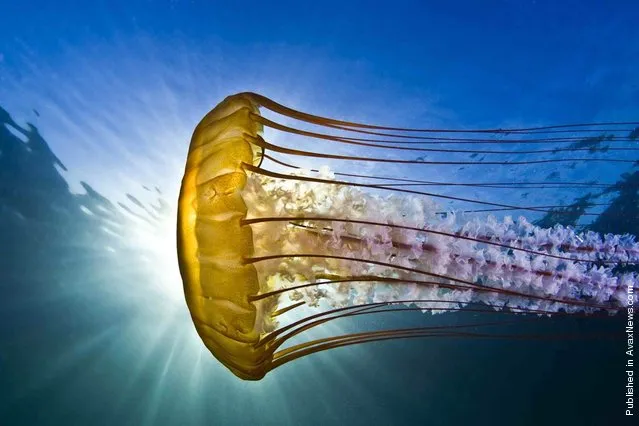
More than 700 underwater images were submitted for the 2012 Annual Underwater Photography Contest, hosted by the University of Miami's Rosenstiel School of Marine & Atmospheric Science. This year, for the first time, the University of Miami set up a “Fan Favorite” category for its underwater photo competition. Internet users could vote for their favorite among five pictures. Todd Aki's photo of a jellyfish took the prize, snaring 599 of the 1,221 votes cast. (Photo by Todd Aki)
Details
22 Apr 2012 12:47:00
“The Hero”. (Christophe Kiciak)

“I started photography in June 2009. At the time, I was searching for a way to express both the rigorous scientist and the creative artist in me. There are few hobbies that let these two approaches work together, so I really was enthusiastic about it: I am now spending all my free time studying various techniques, contemplating others' fantastic work, and of course, making pictures”. – Christophe Kiciak. Photo: “The Hero”. (Photo by Christophe Kiciak)
Details
11 Jan 2013 15:40:00
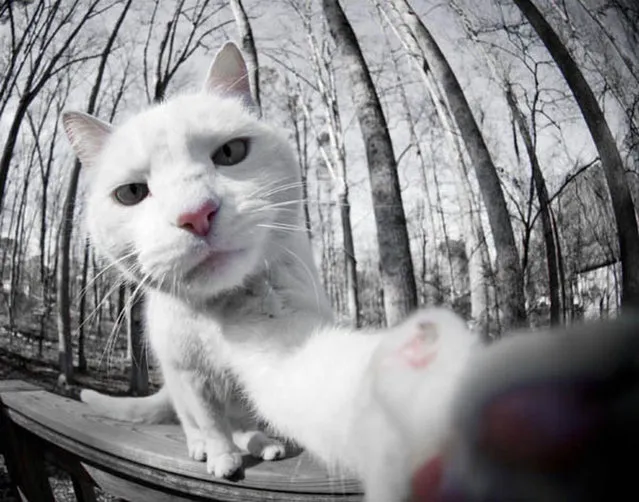
Cats Taking Selfies Part 2

The selfie is the most popular photography trend of the internet today. It's gotten so popular, in fact, that even our beloved feline friends have started to catch on. I dare you to keep the smile off your face for this one!


See also: Cats Taking Selfies Part 1
Details
18 Mar 2014 13:20:00
Porcelain Figurines By Martin Klimas

From a height of three meters, porcelain figurines are dropped on the ground, and the sound they make when they hit trips the shutter release. The result: razor-sharp images of disturbing beauty—temporary sculptures made visible to the human eye by high-speed photography technology. The porcelain statuette bursting into pieces isn't what really captures the attention; the fascination lies in the genesis of a dynamic figure that replaces the static pose. In contrast to the inertness of the intact kitsch figurines Klimas started out with, the photographs of their destruction possess a powerfully narrative character.
Details
21 Apr 2014 12:59:00