Loading...
Done
Plagued by Doubt By Thomas Wightman

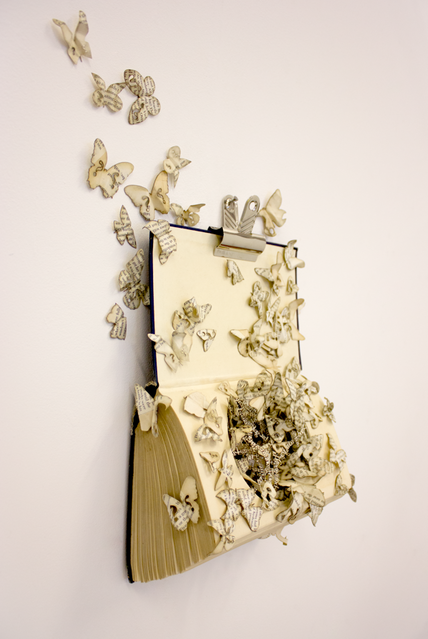
Thoughts. They fly through the broad expenses of our mind, floating gracefully in midair, going into the clouds, and then reemerging once again. Some are quick and furtive, others are grand and majestic. We reflect upon them as they enter our minds, and once they leave, they are usually gone for good. However, some thoughts are different. These thoughts resemble a flock of angry birds or a swarm of hungry moths that invade your mind, slowly eating away at your sanity, strength, and desire to live. Such thoughts often plague that minds of people with Obsessive Compulsive disorder. They completely occupy their time; constantly there; ever-present. With his book sculpture, Thomas Wightman was able to accurately convey the way these thoughts consume the mind, slowly building a nest within it, resisting all attempts to drive them away.

Thomas Wightman


See Also: Derailing My Train of Thought
Details
19 Mar 2015 09:11:00
Lindsey. Then: 11 years old, 6th Grade, in Maumelle, Arkansas.
Now: 32 years old, Nanny/personal assistant residing in Holladay, Utah. (Photo by Awkward Years Project)

“The Awkward Years Project highlights the time in our lives when we felt the most awkward. Some of us had crazy hair, glasses, and/or braces. Some fell victim to the fashion trends of the decade. And some of us struggled even deeper than others realize. This project is a before-and-after transition showing how far the subjects have come and who they turned out to be”. – Awkward Years Project. Photo: Lindsey. Then: 11 years old, 6th Grade, in Maumelle, Arkansas.
Now: 32 years old, Nanny/personal assistant residing in Holladay, Utah. (Photo by Awkward Years Project)
Details
31 Jul 2013 06:41:00
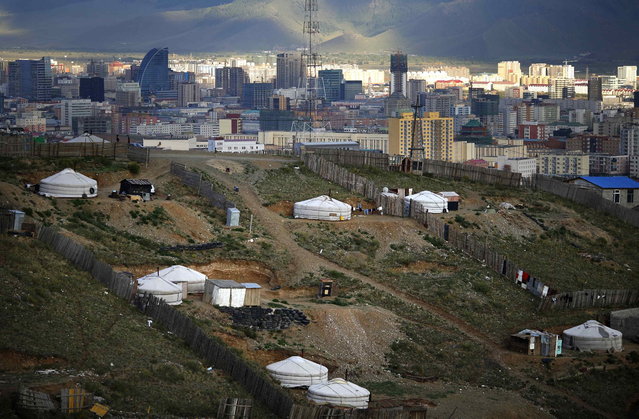
Gers, traditional Mongolian tents, are seen on a hill in an area known as a ger district in Ulan Bator June 26, 2013. (Photo by Carlos Barria/Reuters)

Gers, traditional Mongolian tents, are seen on a hill in an area known as a ger district in Ulan Bator June 26, 2013. Approximately 60 percent of the population of Ulan Bator live in settlements known as ger districts and in many cases residents have limited access to basic services such as water and sanitation. According to a 2010 National Population Center census, every year between thirty and forty thousand people migrate from the countryside to the capital Ulan Bator. Ger districts in the city have been expanding rapidly in recent years. Mongolia is the world's least densely populated country, with 2.8 million people spread across an area around three times the size of France. (Photo by Carlos Barria/Reuters)
Details
11 Aug 2013 11:45:00
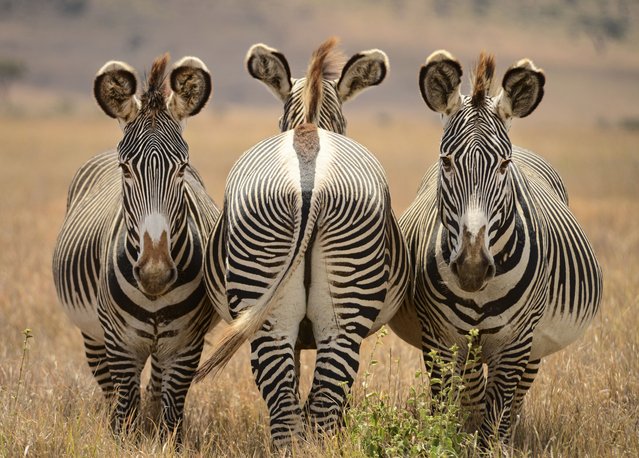
It doesn’t make for the most flattering photoshoot, but there is a reason these zebras at Lewa wildlife conservancy in Kenya in the second decade of August 2025 are stood head to tail: they use their tails to swat flies from each others’ faces. (Photo by Andrew Campbell/Solent News & Photo Agency)

It doesn’t make for the most flattering photoshoot, but there is a reason these zebras at Lewa wildlife conservancy in Kenya in the second decade of August 2025 are stood head to tail: they use their tails to swat flies from each others’ faces. (Photo by Andrew Campbell/Solent News & Photo Agency)
Details
17 Aug 2025 03:01:00
Alluvial Fan, China. A vast alluvial fan blossoms across the desolate landscape between the Kunlun and Altun mountain ranges that form the southern border of the Taklimakan Desert in China’s XinJiang Province. Image taken by the ASTER instrument on NASA’s Terra satellite on May 2nd, 2002. (Photo by NASA/GSFC/USGS EROS Data Center)

Alluvial Fan, China. A vast alluvial fan blossoms across the desolate landscape between the Kunlun and Altun mountain ranges that form the southern border of the Taklimakan Desert in China’s XinJiang Province. Image taken by the ASTER instrument on NASA’s Terra satellite on May 2nd, 2002. (Photo by NASA/GSFC/USGS EROS Data Center)
Details
07 Jan 2013 09:27:00
A waitress wearing a protective mask and gloves to curb the spread of coronavirus disease (COVID-19) serves a drink for a customer at the Koral restaurant in Nusa Dua, Bali, Indonesia on August 9, 2021. (Photo by Fikri Yusuf/Antara Foto via Reuters)

A waitress wearing a protective mask and gloves to curb the spread of coronavirus disease (COVID-19) serves a drink for a customer at the Koral restaurant in Nusa Dua, Bali, Indonesia on August 9, 2021. (Photo by Fikri Yusuf/Antara Foto via Reuters)
Details
21 Aug 2021 09:16:00
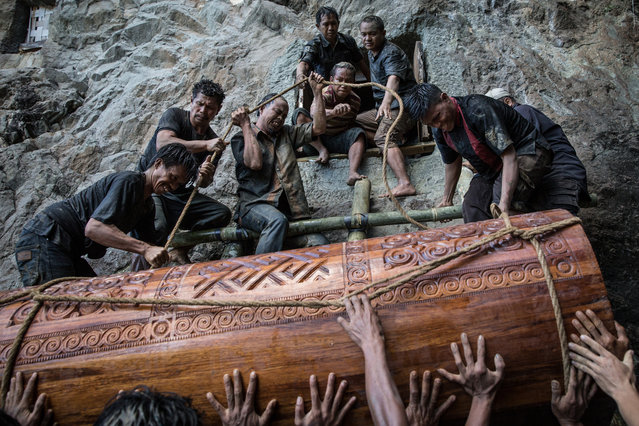
It is said that Torajans are people who “live to die”. For this Indonesian ethnic group, funerals are such extravagant events that they sometimes attract tourists. Families can postpone burials years (and the deceased are considered sick and hosted at home until the funeral) until the family can raise enough money and gather as many relatives as possible. And then it’s a jubilant multiday social event with a parade, dances and animal sacrifices. Agung Parameswara photographed these funerary practices when he traveled to South Sulawesi province, where the Torajans live. But often, their funeral isn’t the last time the dead are seen. In August, crypts are opened, coffins are slid back out and bodies delicately unsheathed. This tender ritual is known as Ma’Nene, which is customarily performed every few years. (Photo by Agung Parameswara/The Washington Post)

It is said that Torajans are people who “live to die”. For this Indonesian ethnic group, funerals are such extravagant events that they sometimes attract tourists. Families can postpone burials years (and the deceased are considered sick and hosted at home until the funeral) until the family can raise enough money and gather as many relatives as possible. And then it’s a jubilant multiday social event with a parade, dances and animal sacrifices. Agung Parameswara photographed these funerary practices when he traveled to South Sulawesi province, where the Torajans live. (Photo by Agung Parameswara/The Washington Post)
Details
06 Oct 2016 09:15:00


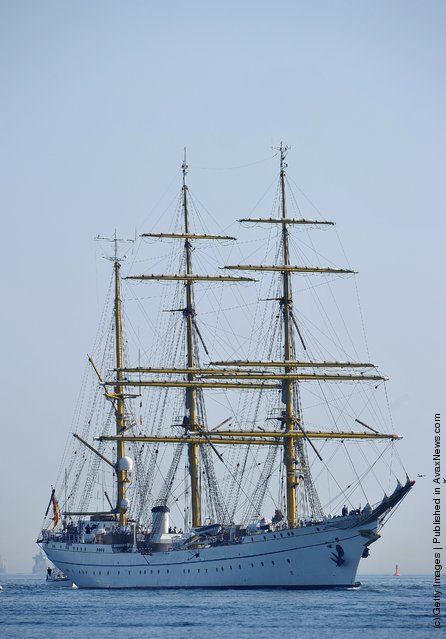
“The Gorch Fock is a tall ship of the German Navy (Deutsche Marine). She is the second ship of that name and a sister ship of the Gorch Fock built in 1933. Both ships are named in honor of the German writer Johann Kinau who wrote under the pseudonym "Gorch Fock" and died in the battle of Jutland/Skagerrak in 1916. The modern-day Gorch Fock was built in 1958 and has since then undertaken 146 cruises (as of October 2006), including one tour around the world in 1988. She is sometimes referred to (unofficially) as the Gorch Fock II to distinguish her from her older sister ship”. – Wikipedia

Photo: The “Gorch Fock” German Navy tall ship sails towards Kiel on May 6, 2011 in Kiel, Germany. The ship returns to Germany following investigations in January while it was in port in Ushuia, Argentina, into allegations of attempted mutiny following the death of a female crew member. German Defense Minister at the time Karl-Theodor zu Guttenberg suspended Captain Norbert Schatz, and though investigators absolved Schatz of wrongdoing, critics charge the investigation was inadequate. The "Gorch Fock" is the German Navy's flagship training vessel. (Photo by Stuart Franklin/Getty Images)
Details
06 May 2011 11:38:00