Loading...
Done
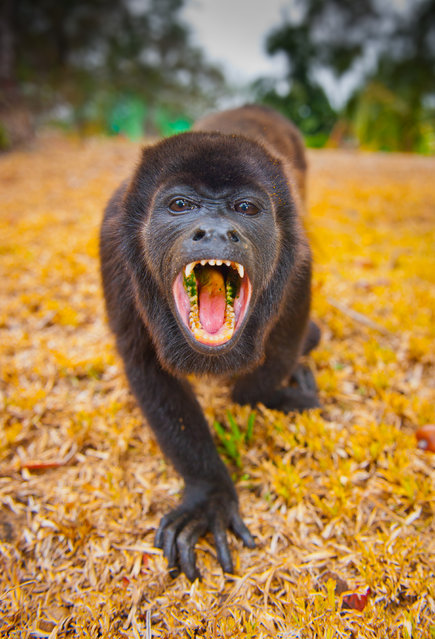
“Attacking Howler Monkey”. Due to a major tropical rainstorm my wife and I were forced to stay overnight in a Howler Monkey Rescue center in Panama. I used the time to explore the area and to take photos of the monkeys. Just after the rain finally stopped, I ran into this monkey that tried to mock attack me. I quickly took a couple of photos before retreating to a (more) safe distance. (Photo and caption by Christian Mueller-Planitz/National Geographic Traveler Photo Contest)

“Attacking Howler Monkey”. Due to a major tropical rainstorm my wife and I were forced to stay overnight in a Howler Monkey Rescue center in Panama. I used the time to explore the area and to take photos of the monkeys. Just after the rain finally stopped, I ran into this monkey that tried to mock attack me. I quickly took a couple of photos before retreating to a (more) safe distance. (Photo and caption by Christian Mueller-Planitz/National Geographic Traveler Photo Contest)

ATTENTION! All pictures are presented in high resolution. To see Hi-Res images – just TWICE click on any picture. In other words, click small picture – opens the BIG picture. Click BIG picture – opens VERY BIG picture.
Details
30 Jun 2013 12:25:00
Pro-Russian activists attack policemen guarding the burned trade union building in the southern Ukrainian city of Odessa on May 3, 2014. More than 30 people were killed in a “criminal” blaze in Ukraine's southern city of Odessa, as violence spread across the country during the bloodiest day since Kiev's Western-backed government took power. (Photo by Anatolii Stepanov/AFP Photo)

Pro-Russian activists attack policemen guarding the burned trade union building in the southern Ukrainian city of Odessa on May 3, 2014. More than 30 people were killed in a “criminal” blaze in Ukraine's southern city of Odessa, as violence spread across the country during the bloodiest day since Kiev's Western-backed government took power. Ukraine's interior ministry said at least 31 people had died in the fire Friday, with local media reporting that pro-Russian militants were believed to have been in the burning building at the time. (Photo by Anatolii Stepanov/AFP Photo)
Details
04 May 2014 09:33:00
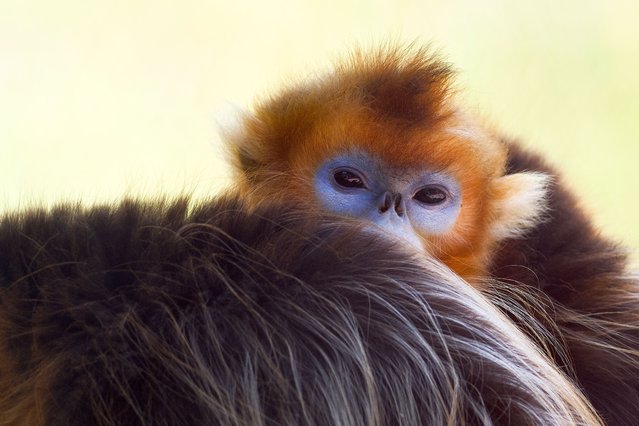
A golden snub-nosed monkeys (Rhinopitheque de Roxelane) looks through its enclosure after quarantine during its presentation at the Beauval Zoopark in Saint-Aignan Central France, on May 7, 2025. ZooParc de Beauval (Loir-et-Cher) welcomed three golden snub-nosed monkeys on April 3, 2025, an endangered species from China, as part of a conservation program, becoming the first zoo outside Asia to house these long-haired, red-furred primates with bluish faces. (Photo by Guillaume Souvant/AFP Photo)

A golden snub-nosed monkeys (Rhinopitheque de Roxelane) looks through its enclosure after quarantine during its presentation at the Beauval Zoopark in Saint-Aignan Central France, on May 7, 2025. ZooParc de Beauval (Loir-et-Cher) welcomed three golden snub-nosed monkeys on April 3, 2025, an endangered species from China, as part of a conservation program, becoming the first zoo outside Asia to house these long-haired, red-furred primates with bluish faces. (Photo by Guillaume Souvant/AFP Photo)
Details
18 May 2025 02:44:00


“The Red River Hog (Potamochoerus porcus), also known as the Bush Pig (but not to be confused with P. larvatus, common name “Bushpig”), is a wild member of the pig family living in Africa, with most of its distribution in the Guinean and Congolian forests. It is rarely seen away from rainforests, and generally prefers areas near rivers or swamps.

Red River Hogs eat grass, berries, roots, insects, molluscs, small vertebrates and carrion. They are capable of causing damage to plantations. Red River Hogs typically live in herds of 6-20 members led by a dominant boar. Sows rear 3-6 piglets at a time.”

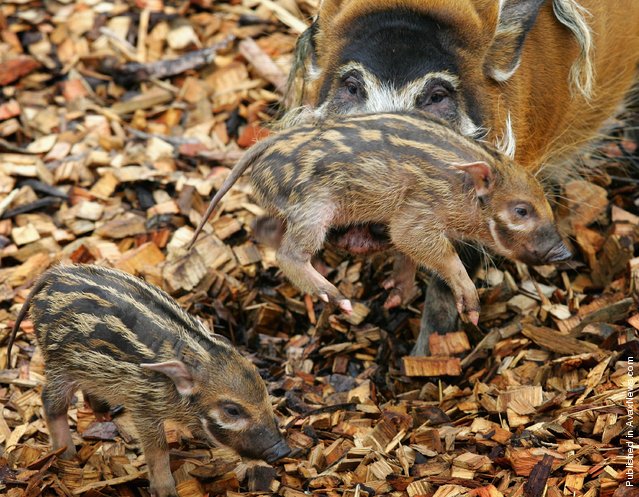
Photo: Two 17 day old red river hoglet twins forage for food next to their mother Bahiti at London Zoo on August 23, 2007 in London, England. Red River hoglets inhabit the forests and swamps of West and Central Africa. The recent additions to the London Zoo pig pen have been eagerly awaited by zoo keepers. (Photo by Chris Jackson/Getty Images)
Details
18 Mar 2011 15:15:00
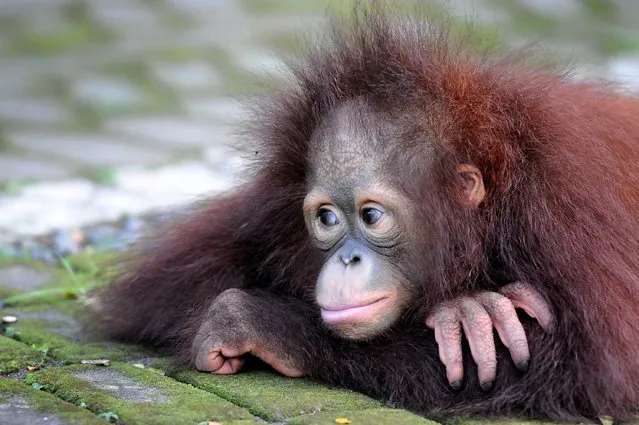
Damai, 3 years old Bornean orang utan plays courtyard at Surabaya Zoo as he prepares to be released into the wild on May 19, 2014 in Surabaya, Indonesia. The two baby orangutans, brothers, were found in Kutai National Park in a critical condition having been abandoned by their mother on May 14, 2014. (Photo by Robertus Pudyanto/Getty Images)

Damai, 3 years old Bornean orang utan plays courtyard at Surabaya Zoo as he prepares to be released into the wild on May 19, 2014 in Surabaya, Indonesia. The two baby orangutans, brothers, were found in Kutai National Park in a critical condition having been abandoned by their mother on May 14, 2014. The Centre for Orangutan Protection (COP) have since been nursing the animals back to health, treating them for malnourishment and 16 wounds predominantly to the feet and hands. (Photo by Robertus Pudyanto/Getty Images)
Details
20 May 2014 10:41:00
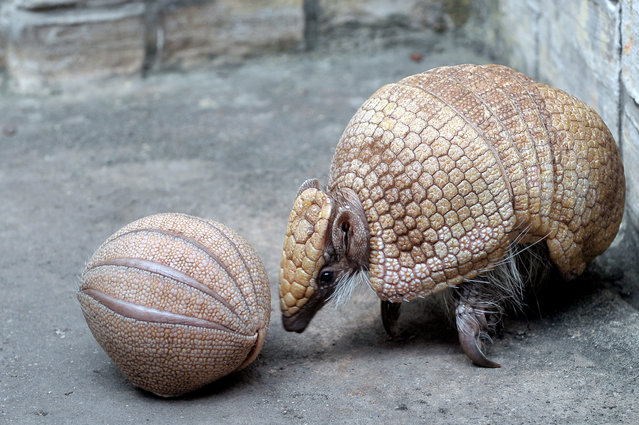
A four-week old southern three-banded armadillo (Tolypeutes matacus) is rolled up into a ball next to its mother in the tropical house of Budapest Zoo in Budapest, Hungary on May 3, 2019. The South American insect-eating mammal and its close relative, the Brasilian three-banded armadillo (Tolypeutes tricinctus) are the only two species of armadillos capable of rolling into a complete ball to defend themselves when feeling threatened. (Photo by Attila Kovács/EPA/EFE)

A four-week old southern three-banded armadillo (Tolypeutes matacus) is rolled up into a ball next to its mother in the tropical house of Budapest Zoo in Budapest, Hungary on May 3, 2019. The South American insect-eating mammal and its close relative, the Brasilian three-banded armadillo (Tolypeutes tricinctus) are the only two species of armadillos capable of rolling into a complete ball to defend themselves when feeling threatened. (Photo by Attila Kovács/EPA/EFE)
Details
05 May 2019 00:03:00


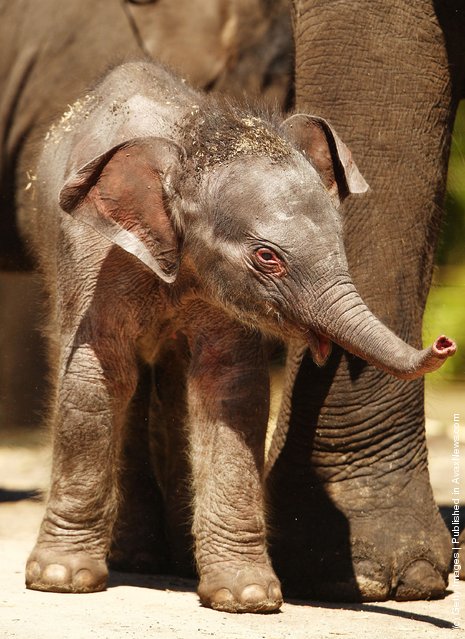
Taronga's first female elephant calf explores the paddock with her mother Pak Boon at Taronga Zoo on November 3, 2010 in Sydney, Australia. The 120kg elephant was born at 1:12am and is Taronga's first female calf and fifth born to The Australian Conservation Management Plan for endangered elephants. The calf will be given a Thai name to reflect the herds' cultural origin. (Photo by Brendon Thorne/Getty Images)
Details
16 Apr 2011 11:01:00
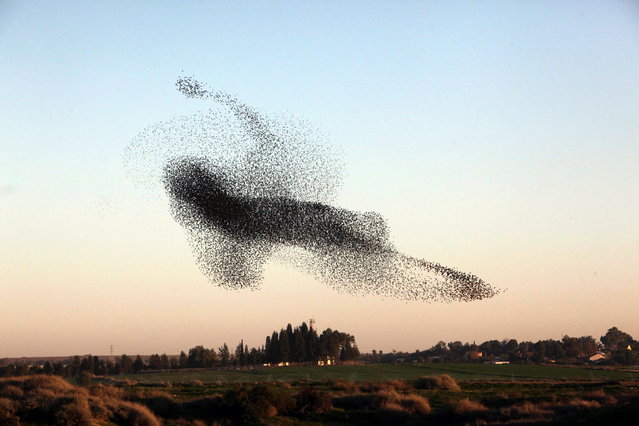
Huge pack of starlings in the sky of the Negev, Israel, on January 21, 2013. Birds are turned in evening twilight before settling to sleep. (Photo by Eliyahu Hershkovitz)

Huge pack of starlings in the sky of the Negev, Israel, on January 21, 2013. Birds are turned in evening twilight before settling to sleep. (Photo by Eliyahu Hershkovitz)
Details
26 Jan 2013 09:21:00