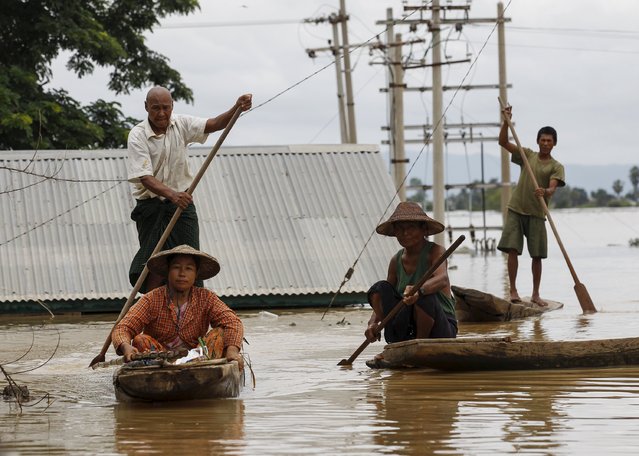
People row their canoes on a flooded street at a village in Kawlin township, Sagaing division, Myanmar, July 21, 2015. Heavy rains caused flooding over 20,000 acres of rice field and in about a hundred villages, killing at least eight people, according to local media. (Photo by Soe Zeya Tun/Reuters)
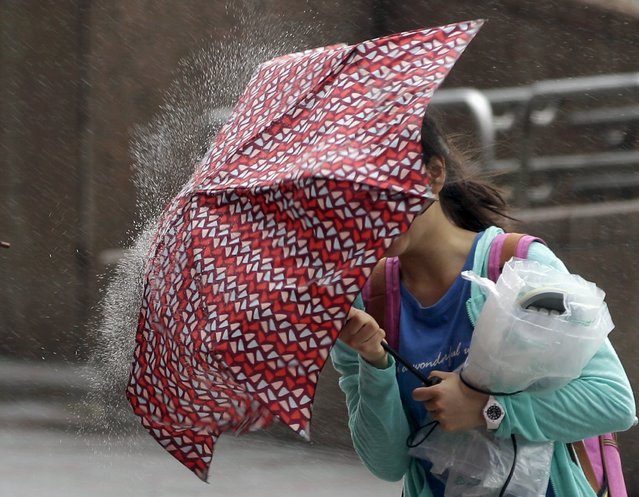
A woman holds her umbrella while walking against strong winds as Typhoon Chan-hom approaches Taiwan, in Taipei, July 10, 2015. (Photo by Pichi Chuang/Reuters)
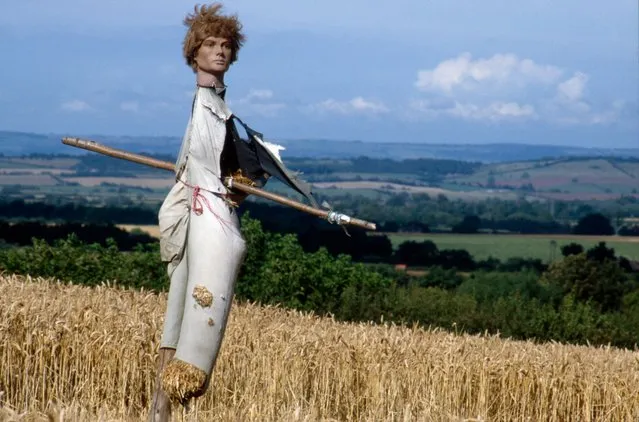
When Colin Garratt went to photograph the traditional sentinels of the British countryside, he found they ranged from the dapper to the downright sinister. “They are not from the anaesthetised world of the craft fair”, says Colin Garratt, “but are the direct descendants of the ancient spectres which have haunted the landscape for centuries”. The Scarecrow Exhibition is at Geddes Gallery, London, from 25 to 30 March. (Photo by Colin Garratt)
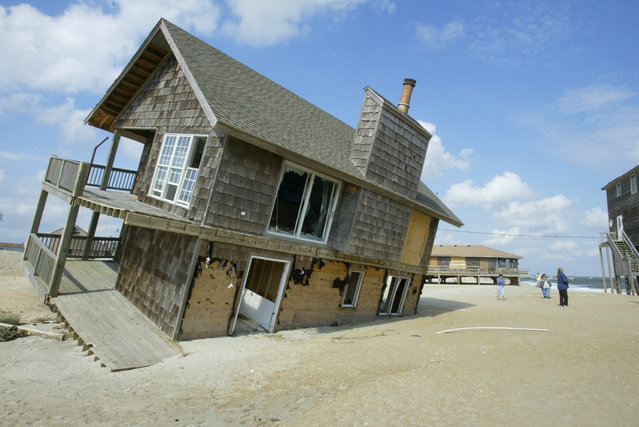
A house that was slammed off its foundation by Hurricane Isabel sits precariously on the beach one month after it hit Rodanthe, North Carolina October 18, 2003. (Photo by Rick Wilking/Reuters)
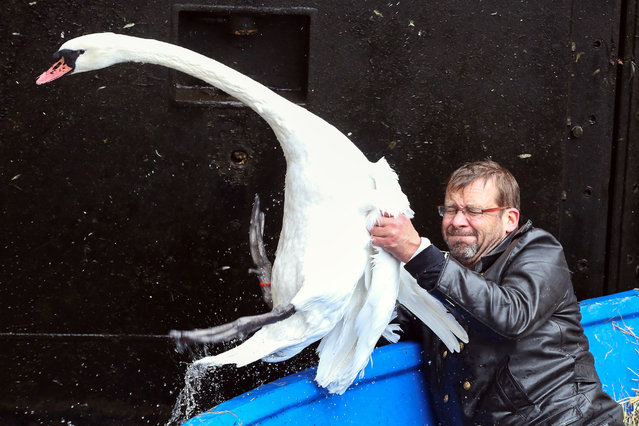
Olaf Niess catches swans on the river Alster near the town hall in Hamburg, Germany, 17 November 2015. The Alster swans are moving to their ice-free winter quarters on the Eppendorf Muehlenteich millpond until spring. (Photo by Bodo Marks/EPA)
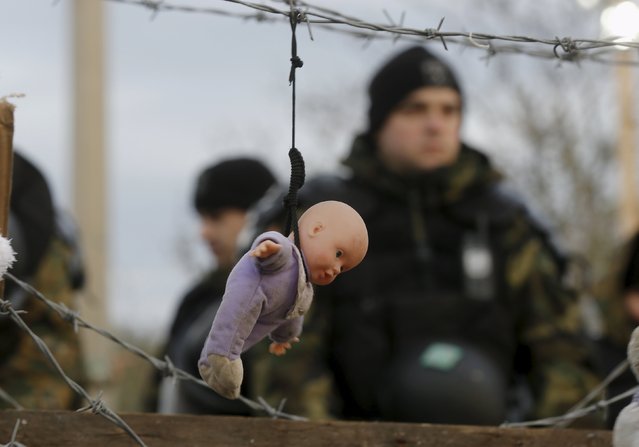
A doll, placed by stranded Iranian migrant protesters, hangs from barbed wire in front of Madedonian police at the Greek-Macedonian border near to the Greek village of Idomeni November 29, 2015. The protesters were demonstrating against what they say is the closure of the border for Iranian migrants. According to the demonstrators, the hanging toys and dolls represent the outcome of being unable to return, if they are sent back to Iran. (Photo by Yannis Behrakis/Reuters)
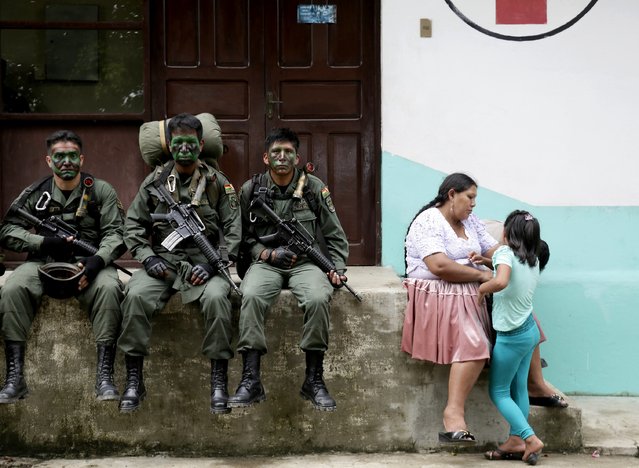
Members of the Bolivian combined forces of army and police rest at their headquarters at the end of their ceremony for the task of fighting against drugs and the eradication of coca leaves in Chimore, east of La Paz, December 10, 2014. The government of Bolivia's President Evo Morales eradicated some 11,000 hectares of illegal coca plants and confiscated nearly 192 tons of drugs in 2014, according to the local media. (Photo by David Mercado/Reuters)