Loading...
Done
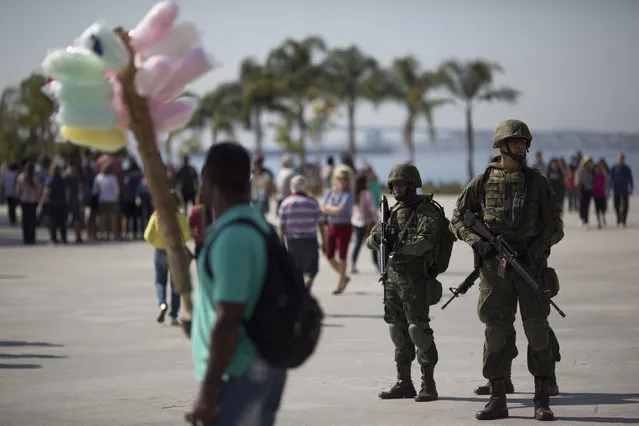
Soldiers stand guard in Maua square where a cotton candy vendor passes by in Rio de Janeiro, Brazil, Saturday, July 9, 2016, as security is deployed to get to know the areas they'll be patrolling during the Olympics. Roughly twice the security contingent at the London Olympics will be deployed during the August games in Rio, which are expected to draw thousands of foreigners to a city where armed muggings, stray bullets and turf wars between heavily armed drug gangs are routine. (Photo by Leo Correa/AP Photo)

Soldiers stand guard in Maua square where a cotton candy vendor passes by in Rio de Janeiro, Brazil, Saturday, July 9, 2016, as security is deployed to get to know the areas they'll be patrolling during the Olympics. Roughly twice the security contingent at the London Olympics will be deployed during the August games in Rio, which are expected to draw thousands of foreigners to a city where armed muggings, stray bullets and turf wars between heavily armed drug gangs are routine. (Photo by Leo Correa/AP Photo)
Details
10 Jul 2016 09:35:00
A view of traditional bolinhos de bacalhau (fried codfish balls) in Rio de Janeiro, Brazil, May 7, 2016. (Photo by Sergio Moraes/Reuters)

If the most popular foods of Rio de Janeiro have one thing in common, it is their informality. You can find fine restaurants in the city, but they do not set Rio apart from other places. What does set it apart, and what invariably brings its residents, known as "Cariocas," together is the unpretentious food they eat in bright, loud, crowded bars and restaurants, on busy street corners, or after a day at the beach. Here: A view of traditional bolinhos de bacalhau (fried codfish balls) in Rio de Janeiro, Brazil, May 7, 2016. (Photo by Sergio Moraes/Reuters)
Details
05 Aug 2016 13:20:00
A woman shouts asking for help during an eviction in Rio de Janeiro, Brazil, Friday, April 11, 2014. Squatters in Rio de Janeiro are clashing with police after a Brazilian court ordered that 5,000 people be evicted from abandoned buildings of a telecommunications company. Officers have used tear gas and stun grenades to try to disperse the families. (Photo by Silvia Izquierdo/AP Photo)

A woman shouts asking for help during an eviction in Rio de Janeiro, Brazil, Friday, April 11, 2014. Squatters in Rio de Janeiro are clashing with police after a Brazilian court ordered that 5,000 people be evicted from abandoned buildings of a telecommunications company. Officers have used tear gas and stun grenades to try to disperse the families. (Photo by Silvia Izquierdo/AP Photo)
Details
13 Apr 2014 07:22:00
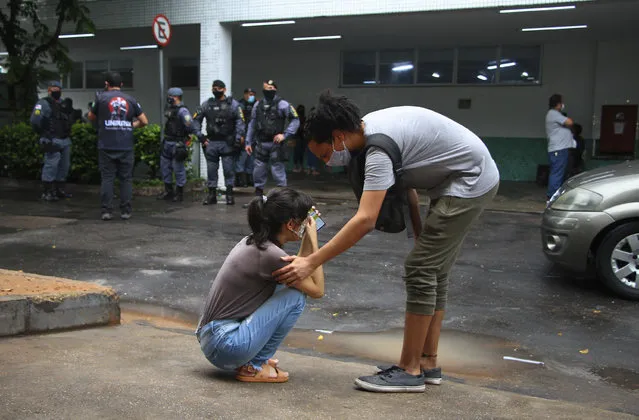
Raissa Floriano whose father is hospitalized with CCOVID-19, cries during a protest amid the new coronavirus pandemic outside the 28 Agosto Hospital, in Manaus, Brazil, Thursday, January 14, 2021. Scores of COVID-19 patients in the Amazon rainforest's biggest city will be transferred out of state as the local health system collapses and dwindling stocks of oxygen tanks begin to falter. (Photo by Edmar Barros/AP Photos)

Raissa Floriano whose father is hospitalized with CCOVID-19, cries during a protest amid the new coronavirus pandemic outside the 28 Agosto Hospital, in Manaus, Brazil, Thursday, January 14, 2021. Scores of COVID-19 patients in the Amazon rainforest's biggest city will be transferred out of state as the local health system collapses and dwindling stocks of oxygen tanks begin to falter. (Photo by Edmar Barros/AP Photos)
Details
16 Jan 2021 00:07:00
France's defender #07 Sakina Karchaoui (L) and France's forward #11 Kadidiatou Diani (R) celebrate their win at the end of the Australia and New Zealand 2023 Women's World Cup Group F football match between France and Brazil at Brisbane Stadium in Brisbane on July 29, 2023. (Photo by Dan Peled/Reuters)

France's defender #07 Sakina Karchaoui (L) and France's forward #11 Kadidiatou Diani (R) celebrate their win at the end of the Australia and New Zealand 2023 Women's World Cup Group F football match between France and Brazil at Brisbane Stadium in Brisbane on July 29, 2023. (Photo by Dan Peled/Reuters)
Details
09 Aug 2023 00:18:00
Queen of drums, Sabrina Sato of Unidos de Vila Isabel samba school during the Champions Parade on the last day of Rio de Janeiro 2022 Carnival at Marques de Sapucai Sambadrome on May 01, 2022 in Rio de Janeiro, Brazil. Rio de Janeiro's iconic carnival returns to the sambodrome after a two year suspension and postponements due to the coronavirus pandemic. (Photo by Wagner Meier/Getty Images)

Queen of drums, Sabrina Sato of Unidos de Vila Isabel samba school during the Champions Parade on the last day of Rio de Janeiro 2022 Carnival at Marques de Sapucai Sambadrome on May 01, 2022 in Rio de Janeiro, Brazil. Rio de Janeiro's iconic carnival returns to the sambodrome after a two year suspension and postponements due to the coronavirus pandemic. (Photo by Wagner Meier/Getty Images)
Details
18 Aug 2023 03:38:00
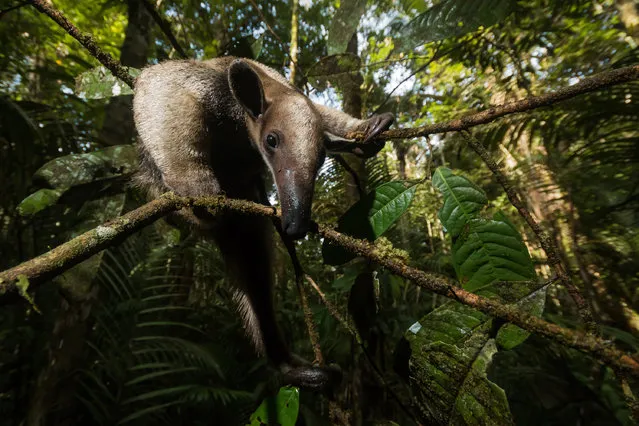
Individuals and populations student winner. Limbing in the Tropics, photographed in Manaus, Brazil. While walking in the Amazon rainforest looking for bat roosts to set up mist nets to capture bats for scientific research, a faint and almost imperceptible noise suddenly caught this photographer’s attention. An anteater was climbing with exceptional ability in a tangled mess of branches and lianas. With an unbelievable calmness, the animal watched the photographer at work and seemed to enjoy being the subject of an impromptu photography session in the most biodiverse ecosystem on Earth. (Photo by Adrià López Baucells/University of Lisbon/British Ecological Society)

Individuals and populations student winner. Limbing in the Tropics, photographed in Manaus, Brazil. While walking in the Amazon rainforest looking for bat roosts to set up mist nets to capture bats for scientific research, a faint and almost imperceptible noise suddenly caught this photographer’s attention. An anteater was climbing with exceptional ability in a tangled mess of branches and lianas. (Photo by Adrià López Baucells/University of Lisbon/British Ecological Society)
Details
05 Dec 2018 00:03:00
Kawakanih Yawalapiti, 9, Upper Xingu region of Mato Grosso, Brazil, 2018: Kawakanih lives with her tribe, the Yawalapiti, in Xingu national park, a preserve in the Amazon basin of Brazil. The Yawalapiti collect seeds to preserve species unique to their ecosystem, which lies between the rain forest and savannah. Kawakanih’s diet is simple, consisting mainly of fish, cassava, porridge, fruit and nuts. “It takes five minutes to catch dinner”, says Kawakanih. “When you’re hungry, you just go to the river with your net”. (Photo by Gregg Segal/The Guardian)

Photographer Gregg Segal travelled the world to document children and the food they eat in a week. Partly inspired by the increasing problems of childhood obesity, he tracked traditional regional diets as yet unaffected by globalisation, and ironically, found that the healthiest diets were often eaten by the least well off. (Photo by Gregg Segal/The Guardian)
Details
03 Jul 2019 00:03:00