Loading...
Done
Semiotic Alpine Escape By Armin Senoner

Armin Senoner conceptualizes class system based semiotic alpine escape all visuals courtesy of armin senoner. From birth, every human is organized through the hierarchical class system. Without regard to personal characteristics in the least, each is donned with a label; lower, middle, or upper. Society at large is innately regulated because by it, the rich do anything to remain at the top, the middle tries to overthrow the rich, and the poor just try to survive. Modern times, though less brutal, is no less restrained by the unspoken rules of social division.
Details
01 Jul 2015 13:22:00
Nasoin Akhter, 15, has her makeup done at a beauty parlor on the day of her wedding to a 32-year-old man, August 20, 2015, in Manikganj, Bangladesh. (Photo by Allison Joyce/Getty Images)

Nasoin Akhter, 15, has her makeup done at a beauty parlor on the day of her wedding to a 32-year-old man, August 20, 2015, in Manikganj, Bangladesh. In June of this year, Human Rights Watch released a damning report about child marriage in Bangladesh. The country has one of the highest rates of child marriage in the world, with 29% of girls marrying before the age of 15, and 65% of girls marrying before they turn 18. (Photo by Allison Joyce/Getty Images)
Details
27 Aug 2015 12:02:00
Gemma, right, and Joanne in their home in Angeles City. (Photo by Hannah Reyes Morales/The Washington Post)

Typhoon Yolanda – also known as Haiyan – struck the central part of the country November 8, 2013, leaving at least 6,300 people dead and over four million displaced. A month after Typhoon Haiyan, the United Nations Population Fund estimates that 5,000 women were subjected to sеxual violence. A study by the Health and Human Rights online publication shows the majority of young girls and women in Manila’s sеx industry come from poverty-stricken areas – such as Leyte, Samar, Cebu and southern Mindanao – and enter trafficking through force, deception, economic desperation and psychological manipulation. (Photo by Hannah Reyes Morales/The Washington Post)
Details
01 May 2017 09:59:00
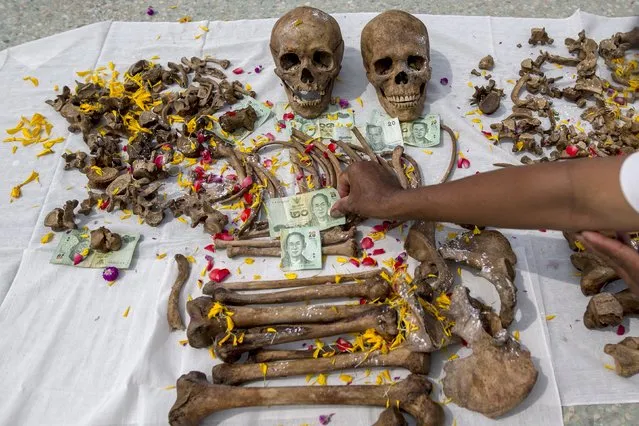
A volunteer puts a banknote on remains for luck during a mass exhumation at Poh Teck Tung Foundation Cemetery in Samut Sakhon province, Thailand November 3, 2015. (Photo by Athit Perawongmetha/Reuters)

A volunteer puts a banknote on remains for luck during a mass exhumation at Poh Teck Tung Foundation Cemetery in Samut Sakhon province, Thailand November 3, 2015. Human remains from 3,890 unclaimed bodies have been dug out of graves to be cleaned and put into storage in a warehouse before being cremated, in order to make room for further unidentified corpses. (Photo by Athit Perawongmetha/Reuters)
Details
06 Nov 2015 08:01:00
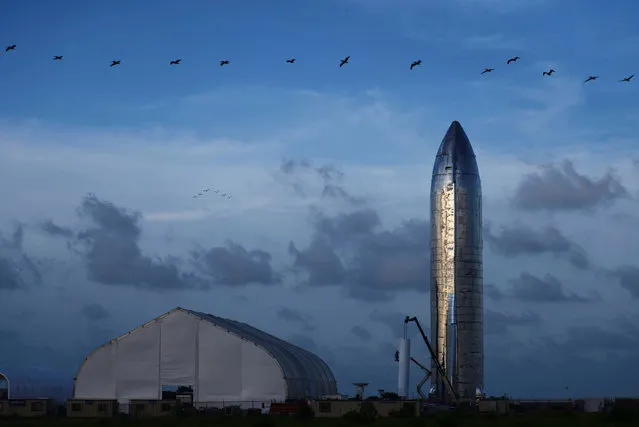
A prototype of SpaceX's Starship spacecraft is seen before SpaceX's Elon Musk gives an update on the company's Mars rocket Starship in Boca Chica, Texas U.S. September 28, 2019. (Photo by Callaghan O'Hare/Reuters)

A prototype of the Space Exploration Technologies Corp. (SpaceX) Starship launch vehicle stands during an event at the SpaceX launch facility in Cameron County, Texas, U.S., on Saturday, September 28, 2019. Elon Musk gave space fans an update Saturday evening on the status of “Starship”, the next-generation vehicle his SpaceX plans to use to eventually take humans to Mars. (Photo by Callaghan O'Hare/Reuters)
Details
30 Sep 2019 00:07:00
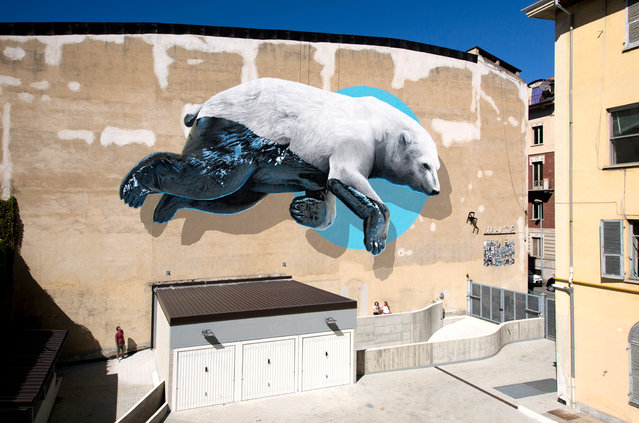
A polar bear whose bottom half is caked in oily black gunk. A whale wrapped in striped fabric: a pseudo straightjacket. These are the messes climate change leaves behind, the things we know are happening but often don’t have the opportunity to see with our own eyes. Swiss street art duo Christian Rebecchi and Pablo Togni, otherwise known as NeverCrew, met in art school when they were 15 and started making work together soon after. As a team, the artists adorn the world with eye-popping and gut-wrenching images depicting the consequences of humanity’s actions on earth. Here: “Black machine” mural painting and installation on the Colosseo theater in Turin, Italy, in September 2015. (Photo by NeverCrew/The Huffington Post)

A polar bear whose bottom half is caked in oily black gunk. A whale wrapped in striped fabric: a pseudo straightjacket. These are the messes climate change leaves behind, the things we know are happening but often don’t have the opportunity to see with our own eyes. Swiss street art duo Christian Rebecchi and Pablo Togni, otherwise known as NeverCrew, met in art school when they were 15 and started making work together soon after. As a team, the artists adorn the world with eye-popping and gut-wrenching images depicting the consequences of humanity’s actions on earth. (Photo by NeverCrew/The Huffington Post)
Details
13 Aug 2016 11:09:00
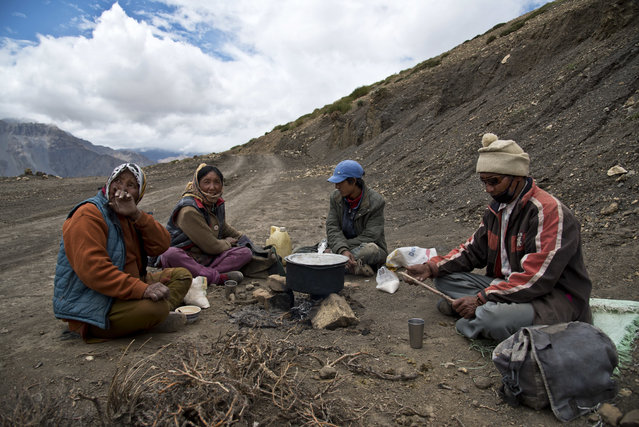
In this August 17, 2016, photo, from left to right, Chhering Chodom, 60, Tashi Yangzom, 50, Lobsang Chhering, 27, and Dorje Tandup, 58, drink milk tea on the side of the road. For centuries, the sleepy valley nestled in the Indian Himalayas remained a hidden Buddhist enclave forbidden to outsiders. Enduring the harsh year-round conditions of the high mountain desert, the people of Spiti Valley lived by a simple communal code – share the Earth's bounty, be hospitable to neighbors, and eschew greed and temptation at all turns. That's all starting to change, for better or worse. Since India began allowing its own citizens as well as outsiders to visit the valley in the early 1990s, tourism and trade have boomed. And the marks of modernization, such as solar panels, asphalt roads and concrete buildings, have begun to appear around some of the villages that dot the remote landscape at altitudes above 4,000 meters (13,000 feet). (Photo by Thomas Cytrynowicz/AP Photo)

In this August 17, 2016, photo, from left to right, Chhering Chodom, 60, Tashi Yangzom, 50, Lobsang Chhering, 27, and Dorje Tandup, 58, drink milk tea on the side of the road. For centuries, the sleepy valley nestled in the Indian Himalayas remained a hidden Buddhist enclave forbidden to outsiders. Enduring the harsh year-round conditions of the high mountain desert, the people of Spiti Valley lived by a simple communal code – share the Earth's bounty, be hospitable to neighbors, and eschew greed and temptation at all turns. That's all starting to change, for better or worse. (Photo by Thomas Cytrynowicz/AP Photo)
Details
15 Sep 2016 09:22:00
Palestinian plain-clothed security officers detain a man during a demonstration in the city of Ramallah in the occupied West Bank, on June 26, 2021, to protest the death of human rights activist Nizar Banat while in the custody of Palestinian Authority (PA) security forces. Thousands of mourners attended on June 25 the funeral of the 43-year-old Banat, a day after he died in custody following his violent arrest by Palestinian security forces, which sparked outrage in the occupied West Bank. He was known for social media videos denouncing alleged corruption within the PA. (Photo by Ahmad Gharabli/AFP Photo)

Palestinian plain-clothed security officers detain a man during a demonstration in the city of Ramallah in the occupied West Bank, on June 26, 2021, to protest the death of human rights activist Nizar Banat while in the custody of Palestinian Authority (PA) security forces. Thousands of mourners attended on June 25 the funeral of the 43-year-old Banat, a day after he died in custody following his violent arrest by Palestinian security forces, which sparked outrage in the occupied West Bank. He was known for social media videos denouncing alleged corruption within the PA. (Photo by Ahmad Gharabli/AFP Photo)
Details
08 Jul 2021 10:22:00