Loading...
Done


Women talk during a Slutwalk march for the right of women to wear what they want without harassment on May 28, 2011 in Melbourne, Australia. The Slutwalk began with a small protest in Toronto, Canada, when women marched against a policeman who claimed he was told women should “avoid dressing like sl*ts in order not to be victimized”. Slutwalks are scheduled for Adeleaide and Sydney as well as other cities in North America and Europe. (Photo by Scott Barbour/Getty Images)
Details
28 May 2011 07:53:00
A female soldier takes part in a training for women at the Tolemaida Military Air Base in Tolemaida, Colombia, on May 16, 2023. The last time the Colombian Army enlisted women in their ranks was in 1993. Now, 30 years on, more than 1,200 women voluntarily joined the military service in the country. (Photo by Raúl Arboleda/AFP Photo)

A female soldier takes part in a training for women at the Tolemaida Military Air Base in Tolemaida, Colombia, on May 16, 2023. The last time the Colombian Army enlisted women in their ranks was in 1993. Now, 30 years on, more than 1,200 women voluntarily joined the military service in the country. (Photo by Raúl Arboleda/AFP Photo)
Details
17 Dec 2023 05:41:00
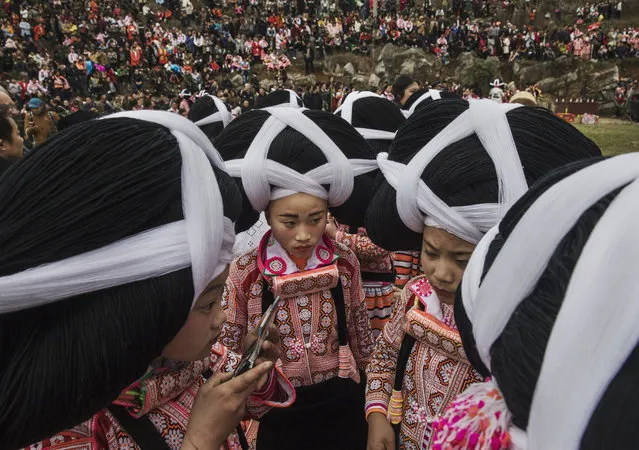
Girls of the Long Horn Miao ethnic minority group wear headdresses as they prepare gather for Tiaohua or Flower Festival as part of the Lunar New Year on February 6, 2017 in Longga village, Guizhou province, southern China. The Long Horn Miao are recognized for their declining practice of wrapping a blend of linen, wool, and the hair of their ancestors around animal horns or a wooden clip to make headdresses. Many young women say they now wear the headdresses only for special occasions and festivals, as the ornaments, which are attached by the horns to their real hair, have proved impractical for modern daily life in a fast changing world. China officially recognizes 56 different ethnic minorities, and statistics show over 7 million Chinese identifying themselves as Miao. But the small Long Horn Miao community counts only around 5000 people living in 12 villages, whose age-old traditions, language, and culture are fading. It is increasingly difficult in a modernizing China, as young people are drawn from remote rural villages to opportunities in bigger cities amongst wide-scale urbanization. Farming and labour remain the mainstays of life for the Long Horn Miao, leaving the area relatively poor in comparison with many parts of China. The government has invested significant amounts into local infrastructure and the tourism industry to try to bolster the local economy. (Photo by Kevin Frayer/Getty Images)

Girls of the Long Horn Miao ethnic minority group wear headdresses as they prepare gather for Tiaohua or Flower Festival as part of the Lunar New Year on February 6, 2017 in Longga village, Guizhou province, southern China. (Photo by Kevin Frayer/Getty Images)
Details
13 Feb 2017 00:01:00


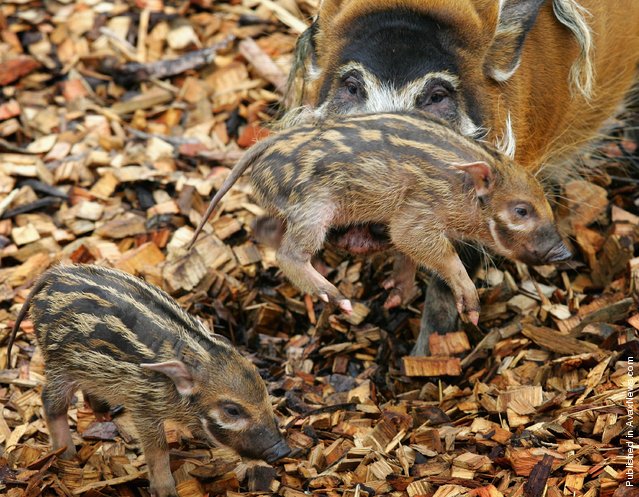
“The Red River Hog (Potamochoerus porcus), also known as the Bush Pig (but not to be confused with P. larvatus, common name “Bushpig”), is a wild member of the pig family living in Africa, with most of its distribution in the Guinean and Congolian forests. It is rarely seen away from rainforests, and generally prefers areas near rivers or swamps.

Red River Hogs eat grass, berries, roots, insects, molluscs, small vertebrates and carrion. They are capable of causing damage to plantations. Red River Hogs typically live in herds of 6-20 members led by a dominant boar. Sows rear 3-6 piglets at a time.”

Photo: Two 17 day old red river hoglet twins forage for food next to their mother Bahiti at London Zoo on August 23, 2007 in London, England. Red River hoglets inhabit the forests and swamps of West and Central Africa. The recent additions to the London Zoo pig pen have been eagerly awaited by zoo keepers. (Photo by Chris Jackson/Getty Images)
Details
18 Mar 2011 15:15:00
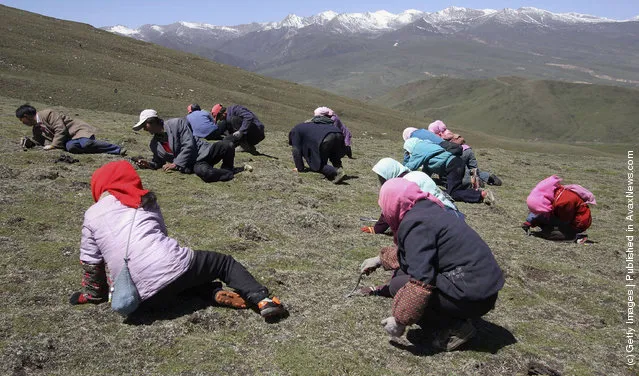
Ophiocordyceps Sinensis A.K.A. Caterpillar Fungus

“There are over 680 documented species of the sac fungus genus Ophiocordyceps, and one of the best known of these is Ophiocordyceps sinensis, colloquially known as caterpillar fungus. The fungus is known in Tibetan as yartsa gunbu or yatsa gunbu. O. sinensis is known in the West as a medicinal mushroom and its use has a long history in Traditional Chinese medicine as well as Traditional Tibetan medicine. The highly valuable fungus-caterpillar combination is hand-collected and is used as an aphrodisiac and as a treatment for a variety of ailments from fatigue to cancer”. – Wikipedia

Photo: Nomads dig for Chinese caterpillar fungus from a mountain May 25, 2007 in Guide County, Hainan Prefecture, Qinghai Province, China. Nomads can earn about 2,000 yuan to 5,000 yuan (about U.S. $260 to $653 ) through their work during the fifty-day Chinese caterpillar fungus gathering season. (Photo by China Photos/Getty Images)
Details
26 Sep 2011 10:47:00
En attendant davoir des balles..... Photo Art by Pierre Beteille

Talented French artist, Pierre Beteille, is skillful in manipulation of portraits (specially his own self portraits) using Photoshop. This is how he describes himself: “I am not a photographer or an artist, I just make images… I shoot very average or even bad photos that I try to improve thanks to Photoshop”…

Photo: “En attendant d'avoir des balles”...., 2007 (Photo by Pierre Beteille)

Details
23 Jul 2012 08:52:00


Dema and Manis, the 26-day-old endangered Sumatran Tiger cubs play together at the “Taman Safari Indonesia” Animal Hospital, on February 26, 2007 in Cisarua, Bogor Regency, West Java, Indonesia. The two Sumatran tiger-cubs recently born at the hospital have been rejected by their mother Cicis, while baby Orangutans, Irma and Nia have also been rejected by their mothers. All babies are being looked after by staff at the Animal Hospital. (Photo by: Dimas Ardian/Getty Images)
Details
24 Apr 2011 12:51:00
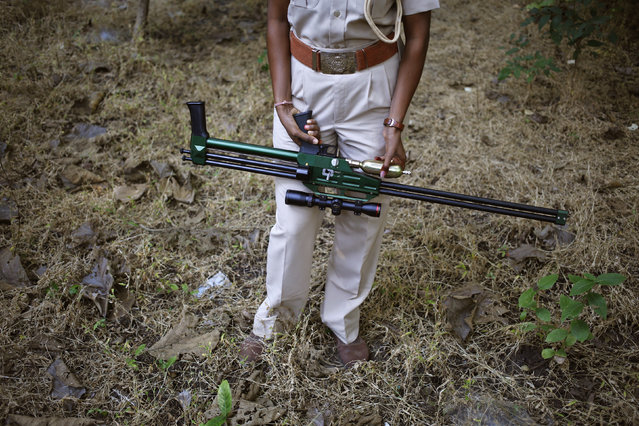
A female forest guard carries a tranquillizer gun in the Gir National Park and Wildlife Sanctuary in Sasan, in Gujarat December 2, 2014. (Photo by Anindito Mukherjee/Reuters)

A female forest guard carries a tranquillizer gun in the Gir National Park and Wildlife Sanctuary in Sasan, in Gujarat December 2, 2014. The sanctuary, which is home to Asiatic lions in India, has an area of 1,412 sq km in which female guards were employed for the first time in India in 2007. The guards fetch a monthly salary of around $148 for working almost 12 hours a day, six days a week, said one of the female guards. (Photo by Anindito Mukherjee/Reuters)
Details
10 Dec 2014 12:37:00