Loading...
Done
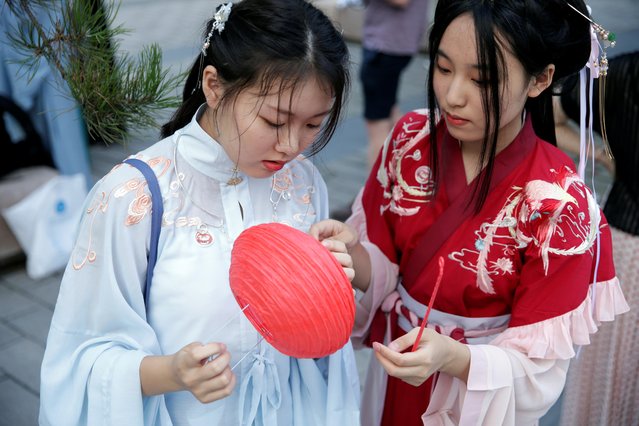
Girls dressed in “Hanfu”, or Han clothing, prepare for an event to mark the traditional Qixi festival, the Chinese equivalent of Valentine's Day, at a park in Beijing, China, August 7, 2019. Chinese for “Han clothing”, “Hanfu” is based on the idea of donning costumes worn in bygone eras by China's dominant Han ethnicity. Some of the most popular styles are from the Ming, Song and Tang dynasties. Hanfu enthusiasts doubled to two million in 2018 from a year earlier, according to a survey by Hanfu Zixun, a popular community account on the Wechat social media platform. (Photo by Jason Lee/Reuters)

Girls dressed in “Hanfu”, or Han clothing, prepare for an event to mark the traditional Qixi festival, the Chinese equivalent of Valentine's Day, at a park in Beijing, China, August 7, 2019. Chinese for “Han clothing”, “Hanfu” is based on the idea of donning costumes worn in bygone eras by China's dominant Han ethnicity. Some of the most popular styles are from the Ming, Song and Tang dynasties. Hanfu enthusiasts doubled to two million in 2018 from a year earlier, according to a survey by Hanfu Zixun, a popular community account on the Wechat social media platform. (Photo by Jason Lee/Reuters)
Details
23 Sep 2019 00:05:00
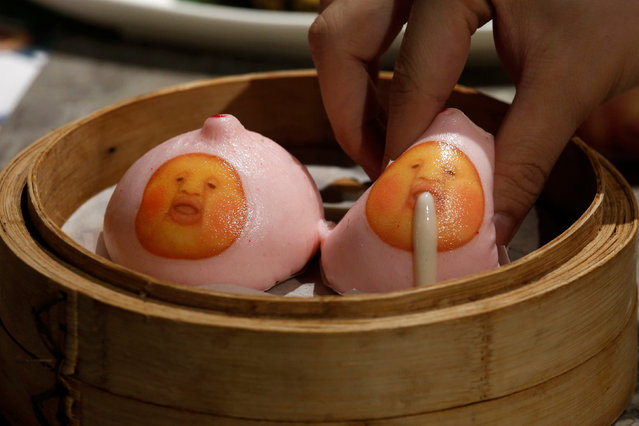
A milk custard bun made to resemble one of the popular Japanese “Kobitos” characters is squeezed during a display for the photographer at Dim Sum Icon restaurant in Hong Kong, China July 25, 2016. A dim sum restaurant in Hong Kong encourages diners to play with their food, and the result will either disgust or delight you. At Dim Sum Icon customers can squeeze a strange creature to poo or vomit on their plate before eating it. Hungry punters poke a hole into the mouth – or the rear – of the dim sum with a chopstick, squeeze it and watch the brown or white cream ooze out. (Photo by Bobby Yip/Reuters)

A milk custard bun made to resemble one of the popular Japanese “Kobitos” characters is squeezed during a display for the photographer at Dim Sum Icon restaurant in Hong Kong, China July 25, 2016. A dim sum restaurant in Hong Kong encourages diners to play with their food, and the result will either disgust or delight you. At Dim Sum Icon customers can squeeze a strange creature to poo or vomit on their plate before eating it. Hungry punters poke a hole into the mouth – or the rear – of the dim sum with a chopstick, squeeze it and watch the brown or white cream ooze out. The unique dim sums are made with a face to resemble Japanese Kobitos characters. (Photo by Bobby Yip/Reuters)
Details
31 Jul 2016 11:25:00
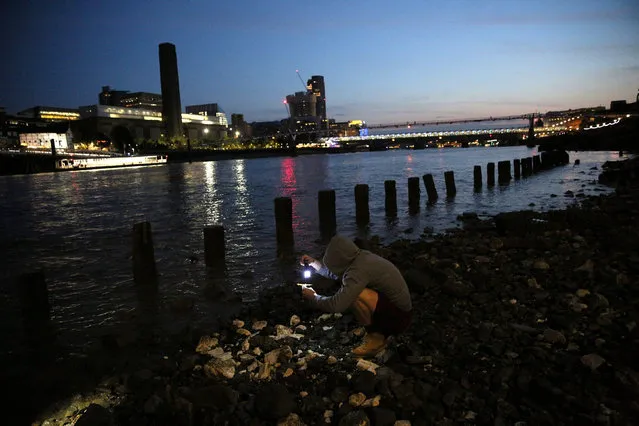
A mudlark uses a torch to look for items on the bank of the River Thames in London, Britain June 06, 2016. Mudlarking is believed to trace its origins to the 18th and 19th century, when scavengers searched the Thames' shores for items to sell. These days, history and archaeology fans are the ones hoping to find old relics such as coins, ceramics, artifacts or everyday items from across centuries. They wait for the low tide and then scour specific areas of exposed shores. "If you're in a field you could be out all day long, with the river you're restricted to about two or three hours," mudlark Nick Stevens said. While many just use the naked eye for their searches, others rely on metal detectors for which a permit from the Port of London Authority is needed. Digging also requires consent. (Photo by Neil Hall/Reuters)

A mudlark uses a torch to look for items on the bank of the River Thames in London, Britain June 06, 2016. Mudlarking is believed to trace its origins to the 18th and 19th century, when scavengers searched the Thames' shores for items to sell. These days, history and archaeology fans are the ones hoping to find old relics such as coins, ceramics, artifacts or everyday items from across centuries. their finds with the Portable Antiquities Scheme. Any item over 300 years old must be recorded. (Photo by Neil Hall/Reuters)
Details
27 Aug 2016 10:43:00
A woman loyal to the Houthi movement holds a rifle as she takes part in a parade to show support to the movement in Sanaa, Yemen September 6, 2016. Dressed in the head to toe garments which obscured their faces, the female fighters brandished machine guns, rocket launchers and grenades. The women also wore hats as they showed support for the Shiite Houthi rebels. The Saudi-led Arab coalition launched a military campaign against the Houthis and their allies in March 2015. It was after the rebels closed in on Gulf-backed President Abedrabbo Mansour Hadi in his southern refuge of Aden, forcing him into exile. The female protesters have pledged to remain supportive and do whatever they can to back the ongoing resistance against the kingdom. Yemen is in the grip of its most severe crisis in years, and is on the brink of civil war. (Photo by Khaled Abdullah/Reuters)

A woman loyal to the Houthi movement holds a rifle as she takes part in a parade to show support to the movement in Sanaa, Yemen September 6, 2016. The Saudi-led Arab coalition launched a military campaign against the Huthis and their allies in March 2015, after the rebels closed in on Gulf-backed President Abedrabbo Mansour Hadi in his southern refuge of Aden, forcing him into exile. (Photo by Khaled Abdullah/Reuters)
Details
07 Sep 2016 10:24:00
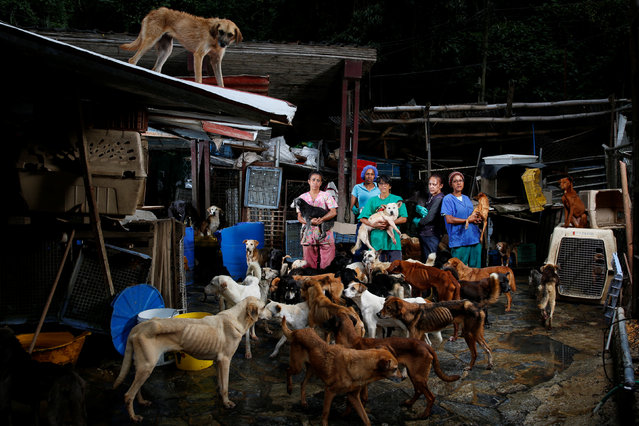
(L-R) Maria Silva, Milena Cortes, Maria Arteaga, Jackeline Bastidas and Gissy Abello pose for a picture at the Famproa dogs shelter where they work, in Los Teques, Venezuela, August 25, 2016. Venezuelans struggling to feed their families let alone their pets are dumping animals on the streets, in parks and at makeshift homes overrun with scrawny animals amid an economic crisis. An hour from Caracas in Los Teques, hundreds of dogs bark and run around the streets scavenging for food outside a makeshift shelter. People come by every few hours to hand over scrawny dogs which are fed by volunteers every day. Venezuela is undergoing a major economic and social crisis, with shortages of basic foods and medicines. Triple digit inflation is hitting everybody hard, including those who own pets. (Photo by Carlos Garcia Rawlins/Reuters)

(L-R) Maria Silva, Milena Cortes, Maria Arteaga, Jackeline Bastidas and Gissy Abello pose for a picture at the Famproa dogs shelter where they work, in Los Teques, Venezuela, August 25, 2016. Venezuelans struggling to feed their families let alone their pets are dumping animals on the streets, in parks and at makeshift homes overrun with scrawny animals amid an economic crisis. An hour from Caracas in Los Teques, hundreds of dogs bark and run around the streets scavenging for food outside a makeshift shelter. (Photo by Carlos Garcia Rawlins/Reuters)
Details
08 Sep 2016 10:01:00
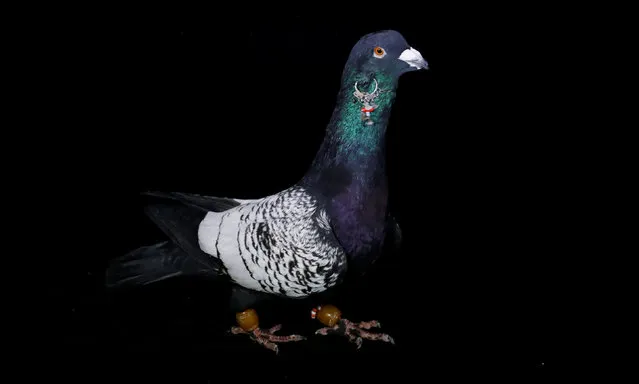
A pigeon, known as Siyah Kinifirli, with an approximate market value of 1000 Turkish Lira ($263), bred by 23-year-old Ismail Ozbek, is pictured in Sanliurfa, Turkey, December 23, 2016. As night-time approaches in Sanliurfa, southeastern Turkey, most of the alleyways of the city's old bazaar are emptying out of buyers and vendors, except for one. The bustle of daytime trading has died down, but on this little street, a stream of men carry cardboard boxes filled with pigeons to a cluster of three teahouses. Here, they sell the birds at Sanliurfa's famed auctions to a dedicated band of pigeon keepers and breeders, a pastime that has been thriving for hundreds of years across the region and over the nearby border into war-torn Syria. In a country where the minimum wage is about 1,400 Liras ($367) a month, enthusiasts regularly easily spend hundreds of dollars for one bird. “I once sold a pair of pigeons for 35,000 Turkish Lira”, says auctioneer Imam Dildas. “This is a passion, a hobby you cannot quit. I've been known to sell the fridge and my wife's gold bracelets to pay for pigeons”. (Photo by Umit Bektas/Reuters)

A pigeon, known as Siyah Kinifirli, with an approximate market value of 1000 Turkish Lira ($263), bred by 23-year-old Ismail Ozbek, is pictured in Sanliurfa, Turkey, December 23, 2016. As night-time approaches in Sanliurfa, southeastern Turkey, most of the alleyways of the city's old bazaar are emptying out of buyers and vendors, except for one. (Photo by Umit Bektas/Reuters)
Details
17 Jan 2017 12:05:00
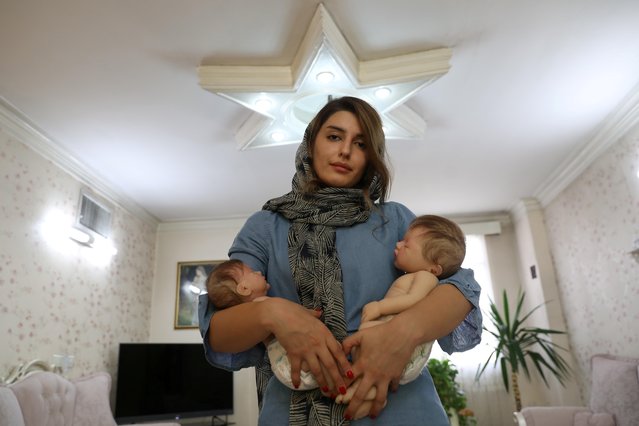
Twenty-four-year-old Maryam Aghayee makes hyper-realistic baby dolls acting as surrogates for some Iranian families who are apprehensive of having more children. “It has been about three or four months since I started this work”, says Maryam in Tehran, Iran on October 7, 2020. “After making my second doll, many orders have been coming in. The second doll was much more realistic than the previous one. After making my second doll, I said that from now on I can take customer orders. I did not intend to start a business from the beginning because it was a hobby, but after the second doll, the demand for these kinds of dolls increased, customers want to have such dolls”. (Photo by Majid Asgaripour/WANA (West Asia News Agency) via Reuters)

Twenty-four-year-old Maryam Aghayee makes hyper-realistic baby dolls acting as surrogates for some Iranian families who are apprehensive of having more children. “It has been about three or four months since I started this work”, says Maryam in Tehran, Iran on October 7, 2020. “After making my second doll, many orders have been coming in. The second doll was much more realistic than the previous one. After making my second doll, I said that from now on I can take customer orders. I did not intend to start a business from the beginning because it was a hobby, but after the second doll, the demand for these kinds of dolls increased, customers want to have such dolls”. (Photo by Majid Asgaripour/WANA (West Asia News Agency) via Reuters)
Details
25 Oct 2020 00:01:00
People take part in a military exercise for civilians conducted by veterans of the Ukrainian National Guard Azov battalion, amid threat of Russian invasion, in Kyiv, Ukraine on January 30, 2022. According to a survey conducted by the Kiev International Institute of Sociology (KIIS) from December 2021, 50.2 percent of Ukrainians said they would resist in case of a Russian military intervention into their city, town or village. Every third respondent to the poll said they were ready to engage in armed resistance, and 21.7 percent said they were ready to participate in civil resistance actions. (Photo by Gleb Garanich/Reuters)

People take part in a military exercise for civilians conducted by veterans of the Ukrainian National Guard Azov battalion, amid threat of Russian invasion, in Kyiv, Ukraine on January 30, 2022. According to a survey conducted by the Kiev International Institute of Sociology (KIIS) from December 2021, 50.2 percent of Ukrainians said they would resist in case of a Russian military intervention into their city, town or village. Every third respondent to the poll said they were ready to engage in armed resistance, and 21.7 percent said they were ready to participate in civil resistance actions. (Photo by Gleb Garanich/Reuters)
Details
07 Mar 2023 03:30:00