Loading...
Done
In this photograph taken on October 4, 2016, an Afghan baker prepares bread at his shop as he waits for customers in Lashkar Gah, the capital city of Helmand province For years Helmand was the centerpiece of the Western military intervention in Afghanistan only for it to slip deeper into a quagmire of instability, with almost the entire southern province teetering on the verge of collapse. Intensified fighting has killed hundreds and forced thousands to flee to besieged capital Lashkar Gah, sparking a humanitarian crisis as the city – one of the last government- held enclaves – risks falling to the Taliban' s repeated ferocious assaults. (Photo by Wakil Kohsar/AFP Photo)

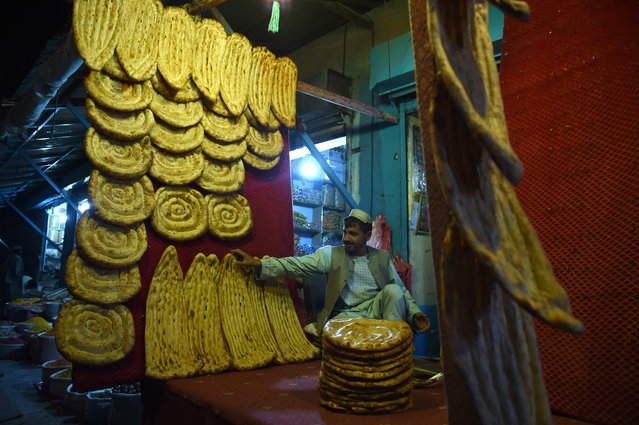
In this photograph taken on October 4, 2016, an Afghan baker prepares bread at his shop as he waits for customers in Lashkar Gah, the capital city of Helmand province. For years Helmand was the centerpiece of the Western military intervention in Afghanistan only for it to slip deeper into a quagmire of instability, with almost the entire southern province teetering on the verge of collapse. Intensified fighting has killed hundreds and forced thousands to flee to besieged capital Lashkar Gah, sparking a humanitarian crisis as the city – one of the last government- held enclaves – risks falling to the Taliban' s repeated ferocious assaults. (Photo by Wakil Kohsar/AFP Photo)
Details
08 Dec 2016 12:41:00
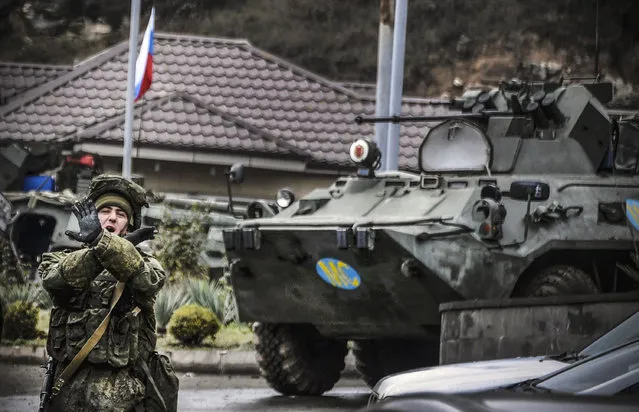
A Russian peacekeeper shouts “No pictures!” at a checkpoint outside the city of Stepanakert on November 13, 2020, during a ceasefire in the military conflict between Armenia and Azerbaijan over the breakaway region of Nagorno-Karabakh. Russian began deploying 2,000 peacekeepers to Nagorno-Karabakh on November 10 after Armenia and Azerbaijan agreed a peace deal to end weeks of fierce fighting over the disputed region. The Moscow-brokered agreement came after a string of Azerbaijani victories in its fight to retake the ethnic Armenian enclave. It sparked celebrations in Azerbaijan but fury in Armenia, where protesters took to the streets to denounce their leaders for losses in the territory, which broke from Azerbaijan's control during a war in the early 1990s. (Photo by Alexander Nemenov/AFP Photo)

A Russian peacekeeper shouts “No pictures!” at a checkpoint outside the city of Stepanakert on November 13, 2020, during a ceasefire in the military conflict between Armenia and Azerbaijan over the breakaway region of Nagorno-Karabakh. Russian began deploying 2,000 peacekeepers to Nagorno-Karabakh on November 10 after Armenia and Azerbaijan agreed a peace deal to end weeks of fierce fighting over the disputed region. (Photo by Alexander Nemenov/AFP Photo)
Details
15 Nov 2020 00:07:00
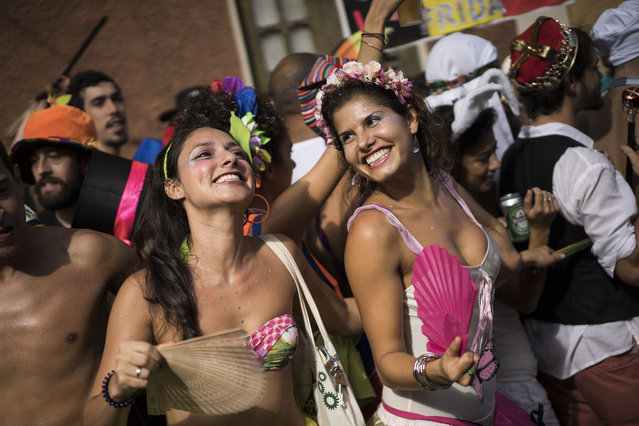
Revelers dance during the “Ceu na Terra”, or Heaven on earth, carnival parade in Rio de Janeiro, Brazil, Saturday, February 7, 2015. Rio's over-the-top Carnival is the highlight of the year for many local residents. Hundreds of thousands of merrymakers are beginning to take to the streets in open-air “blocos” parties. (Photo by Felipe Dana/AP Photo)

Revelers dance during the “Ceu na Terra”, or Heaven on earth, carnival parade in Rio de Janeiro, Brazil, Saturday, February 7, 2015. Rio's over-the-top Carnival is the highlight of the year for many local residents. Hundreds of thousands of merrymakers are beginning to take to the streets in open-air “blocos” parties. (Photo by Felipe Dana/AP Photo)
Details
10 Feb 2015 12:33:00
Revellers participate in a parade on the street during a carnival in the village of Vevcani, south of Skopje, Macedonia January 13, 2016. Vevcani village marks the annual Orthodox St. Vasilij Day with a carnival that features a 1,400-year-old celebration with pagan roots. The highlights of the carnival include a political satire where masked villagers act out current events. (Photo by Ognen Teofilovski/Reuters)

Revellers participate in a parade on the street during a carnival in the village of Vevcani, south of Skopje, Macedonia January 13, 2016. Vevcani village marks the annual Orthodox St. Vasilij Day with a carnival that features a 1,400-year-old celebration with pagan roots. The highlights of the carnival include a political satire where masked villagers act out current events. (Photo by Ognen Teofilovski/Reuters)
Details
15 Jan 2016 08:05:00
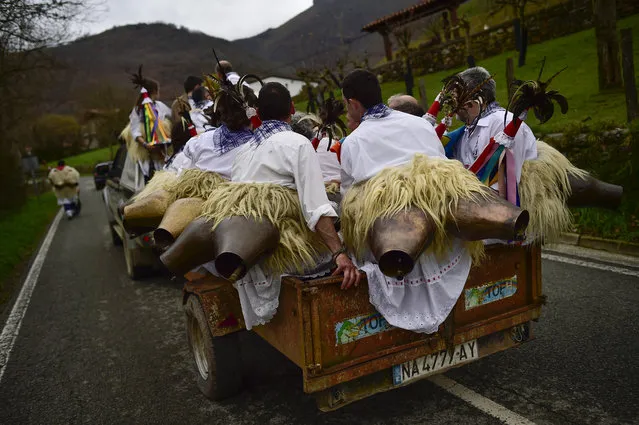
Joaldunaks return in a trailer to their town at the end of Carnival between of the Pyrenees villages of Ituren and Zubieta, northern Spain, Monday, February 1, 2016. In one of the most ancient carnivals in Europe, dating from before the Roman empire, companies of Joaldunak (cowbells) made up of residents of two towns, Ituren and Zubieta, parade the streets costumed in sandals, lace petticoats, sheepskins around the waist and shoulders, coloured neckerchiefs, conical caps with ribbons and a hyssop of horsehair in their right hands and cowbells hung across their lower back. (Photo by Alvaro Barrientos/AP Photo)

Joaldunaks return in a trailer to their town at the end of Carnival between of the Pyrenees villages of Ituren and Zubieta, northern Spain, Monday, February 1, 2016. In one of the most ancient carnivals in Europe, dating from before the Roman empire, companies of Joaldunak (cowbells) made up of residents of two towns, Ituren and Zubieta, parade the streets costumed in sandals, lace petticoats, sheepskins around the waist and shoulders, coloured neckerchiefs, conical caps with ribbons and a hyssop of horsehair in their right hands and cowbells hung across their lower back. (Photo by Alvaro Barrientos/AP Photo)
Details
02 Feb 2016 13:07:00
The 27 curvy candidates for this year's eagerly-awaited Miss Bumbum pageant showed off all their assets as they paraded on one of Sao Paulo's busiest streets – Avenida Paulista – for the launch promotional race on August 8, 2016. Unsurprisingly, they stopped traffic. The girls will be fighting it out for the coveted title in a public vote before being whittled down to 15 finalists for the grand finale in November. (Photo by Leo Marinho/Splash News and Pictures)

The 27 curvy candidates for this year's eagerly-awaited Miss Bumbum pageant showed off all their assets as they paraded on one of Sao Paulo's busiest streets – Avenida Paulista – for the launch promotional race on August 8, 2016. Unsurprisingly, they stopped traffic. The girls will be fighting it out for the coveted title in a public vote before being whittled down to 15 finalists for the grand finale in November. (Photo by Leo Marinho/Splash News and Pictures)
Details
10 Aug 2016 10:27:00
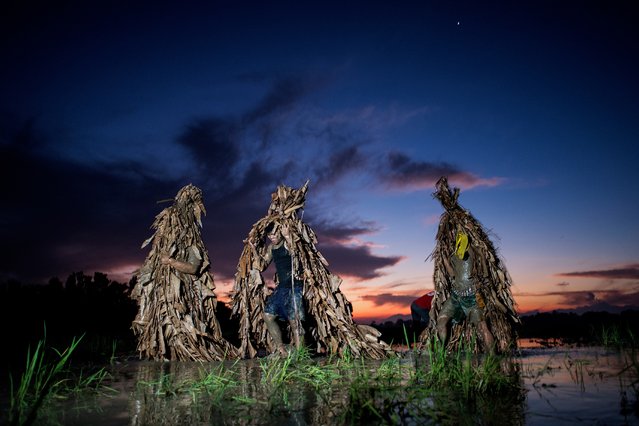
Devotees wear costumes made of banana leaves as they head to church to attend mass as part of a religious festival, in honor of St. John the Baptist, also known locally as the “mud people” festival, in Aliaga town, Nueva Ecija province, north of Manila, on June 24, 2017. Farmers coated in mud paraded in Philippine villages on June 24 to mark one of the Catholic nation's most colourful religious festivals. (Photo by Noel Celis/AFP Photo)

Devotees wear costumes made of banana leaves as they head to church to attend mass as part of a religious festival, in honor of St. John the Baptist, also known locally as the “mud people” festival, in Aliaga town, Nueva Ecija province, north of Manila, on June 24, 2017. Farmers coated in mud paraded in Philippine villages on June 24 to mark one of the Catholic nation's most colourful religious festivals. (Photo by Noel Celis/AFP Photo)
Details
27 Jun 2017 08:30:00
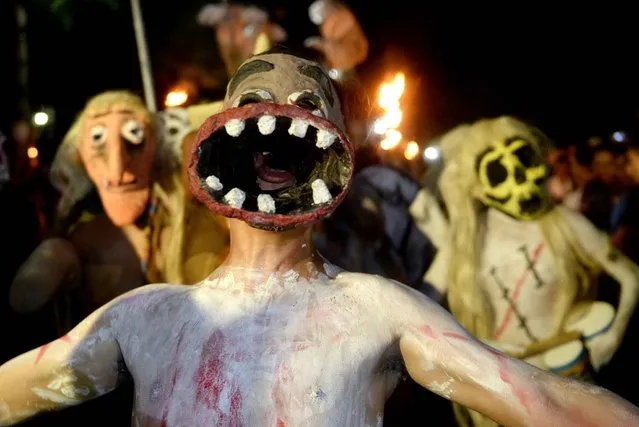
Young revelers take part in a parade called "La Calabiuza" on November 1, 2015, on the eve of the Day of the Dead in Tonacatepeque, 20 kms (13 miles) north of San Salvador. During the celebration, the residents of Tonacatepeque, originally an indigenous community, recall the characters from the mythology of Cuscatlan – pre-Columbian west and central regions of El Salvador – and their dead relatives. (Photo by Marvin Recinos/AFP Photo)

Young revelers take part in a parade called "La Calabiuza" on November 1, 2015, on the eve of the Day of the Dead in Tonacatepeque, 20 kms (13 miles) north of San Salvador. During the celebration, the residents of Tonacatepeque, originally an indigenous community, recall the characters from the mythology of Cuscatlan – pre-Columbian west and central regions of El Salvador – and their dead relatives. (Photo by Marvin Recinos/AFP Photo)
Details
04 Nov 2015 11:50:00