Loading...
Done
The maid-themed cafe in Hangzhou, China on September 29, 2016. (Photo by AsiaWire)

The maid-themed cafe in Hangzhou, China on September 29, 2016. A cafe has been bringing in droves of new customers after hiring young women to dress up in Frech maid costumes while serving diners. Curious coffee- and coffee-lovers are coming from all corners of Hangzhou, capital of East China's Zhejiang Province, to get a taste of the “maid cafe” experience. The business is said to have been opened by a man surnamed Yu and his friends, all whom are natives or graduates of the city. The all-female staff who donned the black and white French maid outfits are also students currenting living or studying in Hangzhou, allowing them to marry their passion for serving with the part-time job. (Photo by AsiaWire)
Details
30 Sep 2016 09:14:00
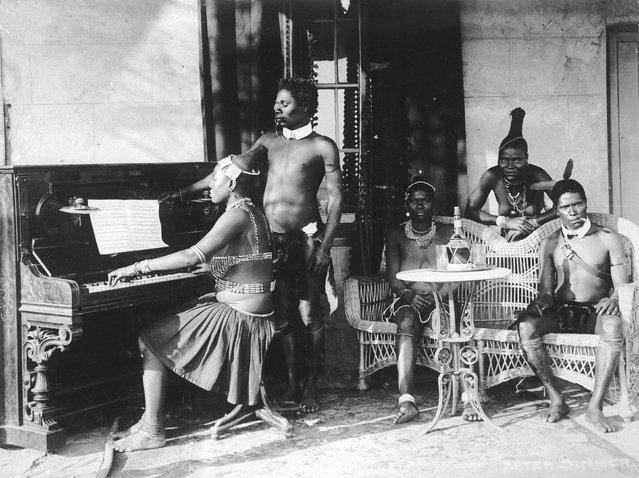
circa 1925:  A Zulu woman playing the piano while a group of others sit and listen.  (Photo by General Photographic Agency/Getty Images)

“The Zulu are the largest South African ethnic group, with an estimated 10–11 million people living mainly in the province of KwaZulu-Natal. Small numbers also live in Zimbabwe, Zambia, and Mozambique. Their language, Zulu, is a Bantu language; more specifically, part of the Nguni subgroup. The Zulu Kingdom played a major role in South African history during the 19th and 20th centuries. Under apartheid, Zulu people were classed as third-class citizens and suffered from state-sanctioned discrimination. They remain today the most numerous ethnic group in South Africa, and now have equal rights along with all other citizens”. – Wikipedia.

Photo: A Zulu woman playing the piano while a group of others sit and listen (to put it briefly, Englishmen scoff over Zulu). South Africa, circa 1925. (Photo by General Photographic Agency)

Details
03 Feb 2014 09:40:00
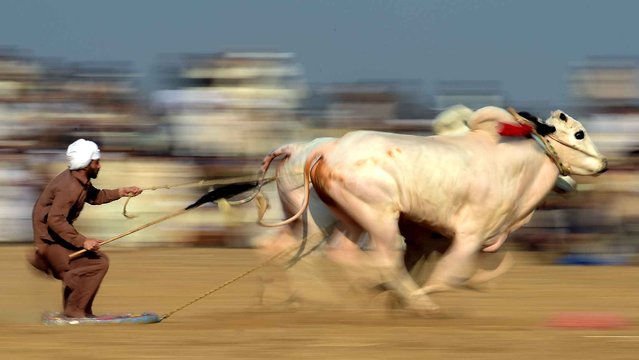
A Pakistani farmer guides his bulls as he competes in a traditional bull race in Khunda village in the northwestern district of Attock, some 80 kilometers from Islamabad on January 3, 2015. Tens of thousands of people gather whenever there is a bull race held in Pakistan which are usually the highlight of festivals organized in rural areas of the Asian country, and attract lots of spectators due to their thrilling nature. (Photo by Aamir Qureshi/AFP Photo)

A Pakistani farmer guides his bulls as he competes in a traditional bull race in Khunda village in the northwestern district of Attock, some 80 kilometers from Islamabad on January 3, 2015. Tens of thousands of people gather whenever there is a bull race held in Pakistan which are usually the highlight of festivals organized in rural areas of the Asian country, and attract lots of spectators due to their thrilling nature. The traditional competition attracts landlords and farmers from all around the province where the race is held, and they all bring their fastest and strongest bulls in hopes of gaining a reputation. (Photo by Aamir Qureshi/AFP Photo)
Details
10 Jan 2015 12:58:00
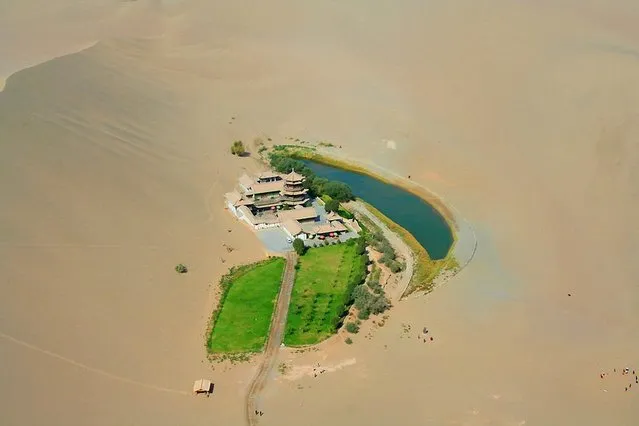
Crescent Lake In China

Yueyaquan is a crescent-shaped lake in an oasis, 6 km south of the city of Dunhuang in Gansu Province, China. It was named Yueyaquan in the Qing Dynasty. According to measurements made in 1960, the average depth of the lake was 4 to 5 meters, with a maximum depth of 7.5 metres In the following 40 years, the depth of the lake continually declined. In the early 1990s, its area had shrunk to only 5,500 m2 with an average depth of 0.9 meter (maximum 1.3 meter). In 2006, the local government with help of the central government started to fill the lake and restore its depth; its depth and size have been growing yearly since then. The lake and the surrounding deserts are very popular with tourists, who are offered camel and 4x4 rides.
Details
25 Jun 2013 10:29:00
Meerim Momunova wrestles with her fellow Kyrgyz teammate Anara Ryskulova during a performance of a traditional style of wrestling called “Alysh”. Momunova is a champion in Asia and has been competing since 2015, after a background in judo. According to Momunova, one of the advantages of “Alysh” is the ease of the uniform for women – even Muslim women who cover their faces can compete. Momunova holds a degree in sports coaching and hopes to see more women come into this sport. (Photo by Eleanor Moseman/The Guardian)

This year’s World Nomad Games, a celebration of nomadic heritage, took place in the Issyk-Kul province of Kyrgyzstan. Eleanor Moseman photographed female competitors who had travelled from all over central Asia and eastern Europe, and explored the difficulties and challenges they face as competitors. (Photo by Eleanor Moseman/The Guardian)
Details
20 Sep 2018 00:05:00
12-year-old Chinese girl Sun Yangyang suffering from Cockayne syndrome

“Cockayne syndrome (also called Weber-Cockayne syndrome, or Neill-Dingwall Syndrome) is a rare autosomal recessive congenital disorder characterized by growth failure, impaired development of the nervous system, abnormal sensitivity to sunlight (photosensitivity), and premature aging. Hearing loss and eye abnormalities (pigmentary retinopathy) are other common features, but problems with any or all of the internal organs are possible. It is associated with a group of disorders called leukodystrophies. The underlying disorder is a defect in a DNA repair mechanism. It is named after English physician Edward Alfred Cockayne (1880–1956)”. – Wikipedia

Photo: Mother of 12-year-old Chinese girl Sun Yangyang suffering from Cockayne syndrome, tends her at the First Affiliated Hospital of Jilin University on November 11, 2006 in Changchun of Jilin Province, China. The disease results in the senile appearance of Yangyang and also causes eyesight, hearing weakness and other problems. Doctors failed to cure the girl... (Photo by China Photos/Getty Images)
Details
08 Aug 2011 11:17:00
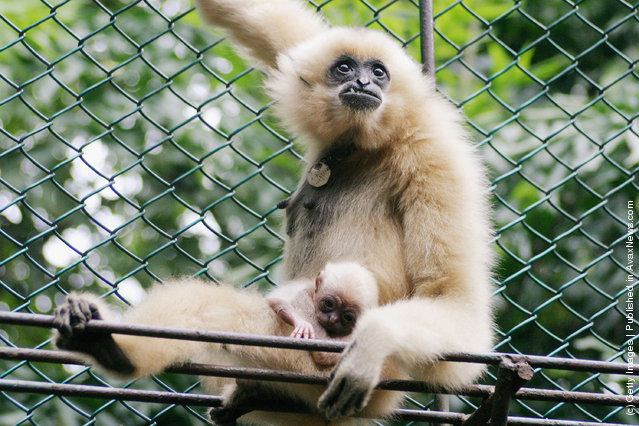
Newborn White-Cheeked Gibbon Nomascus

“Nomascus is the second most speciose genus of gibbons (family Hylobatidae). Originally this genus was a subgenus of Hylobates, and all individuals were considered one species, Hylobates concolor. Species within Nomascus are characterized by 52 chromosomes. Some species are all black, some light with a distinct black tuft of crown fur, and some by distinct, light-colored cheek patches. Nomascus is found from southern China (Yunnan) to southern Vietnam, and also on Hainan Island. One of the genus' species, Nomascus nasutus, has been deemed “the most critically endangered ape species in the world”. All of the species in this genus are endangered or critically endangered”. – Wikipedia

Photo: A newborn White-Cheeked Gibbon clings to its mother in the Nanning Zoo on April 12, 2004 in Nanning, Guangxi province, China. The White-Cheeked Gibbon's natural habitat is Southern China as well as Vietnam and Laos. They are classified as highly endangered and are on the brink of extinction due to poaching and reduction of natural rainforests. (Photo by Getty Images)
Details
12 Aug 2011 11:51:00
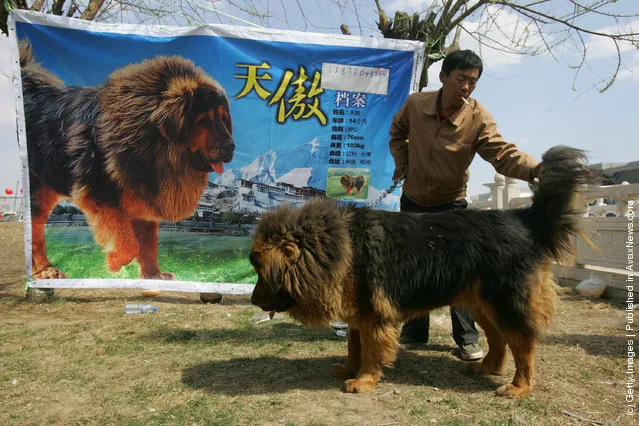
Tibetan Mastiff

“The Tibetan Mastiff also known as Do-khyi (variously translated as “home guard”, “door guard”, “dog which may be tied”, “dog which may be kept”), reflects its use as a guardian of herds, flocks, tents, villages, monasteries, and palaces, much as the old English ban-dog (also meaning tied dog) was a dog tied outside the home as a guardian. However, in nomad camps and in villages, the Do-khyi is traditionally allowed to run loose at night and woe be unto the stranger who walks abroad after dark”. – Wikipedia

Photo: A man displays a Tibetan Mastiff he raised during the Tibetan Mastiff exposition on April 7, 2007 in Langfang of Hebei Province, China. (Photo by China Photos/Getty Images)
Details
05 Oct 2011 14:27:00