Loading...
Done
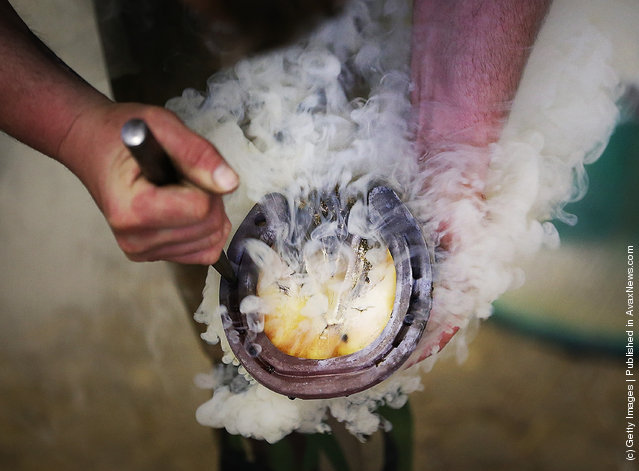
A farrier attaches a horse shoe still hot from the furnace at The Household Cavalry Mounted Regiment (HCMR) at Hyde Park Barracks

A farrier attaches a horse shoe still hot from the furnace at The Household Cavalry Mounted Regiment (HCMR) at Hyde Park Barracks on March 28, 2012 in London, England. (Photo by Peter Macdiarmid/Getty Images)
Details
29 Mar 2012 11:09:00
Photographers: Robert Wilson

“Born in London in 1969 Robert has had a passion for photography since the age of 14. After studying photography at Blackpool and Flyde College he undertook and completed a personal project, which went on to be published into a book called ‘One, Images of a Goalkeeping Season’. Robert has been commissioned for editorial and advertising projects by client based throughout Europe and the U.S. and undertakes commissions for many of the top advertising agencies”. – Tim Mitchell
Details
05 Apr 2012 10:50:00
Hands by Ray Massey

Ray Massey is a London-based photographer who shoots mainly liquids, drinks, hands and still life. Retouchers based in the studio enable photography and retouching to be produced concurrently, streamlining production and enhancing the creative process. Ray’s reputation has been established by realising conceptual advertising and producing cutting edge final images for clients around the world.
Details
10 Sep 2012 08:03:00
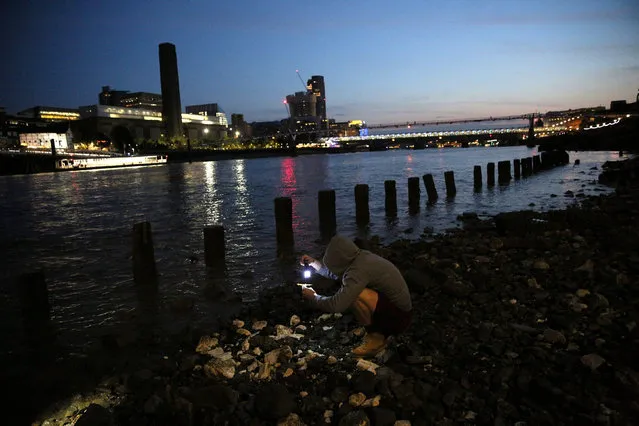
A mudlark uses a torch to look for items on the bank of the River Thames in London, Britain June 06, 2016. Mudlarking is believed to trace its origins to the 18th and 19th century, when scavengers searched the Thames' shores for items to sell. These days, history and archaeology fans are the ones hoping to find old relics such as coins, ceramics, artifacts or everyday items from across centuries. They wait for the low tide and then scour specific areas of exposed shores. "If you're in a field you could be out all day long, with the river you're restricted to about two or three hours," mudlark Nick Stevens said. While many just use the naked eye for their searches, others rely on metal detectors for which a permit from the Port of London Authority is needed. Digging also requires consent. (Photo by Neil Hall/Reuters)

A mudlark uses a torch to look for items on the bank of the River Thames in London, Britain June 06, 2016. Mudlarking is believed to trace its origins to the 18th and 19th century, when scavengers searched the Thames' shores for items to sell. These days, history and archaeology fans are the ones hoping to find old relics such as coins, ceramics, artifacts or everyday items from across centuries. their finds with the Portable Antiquities Scheme. Any item over 300 years old must be recorded. (Photo by Neil Hall/Reuters)

Details
27 Aug 2016 10:43:00
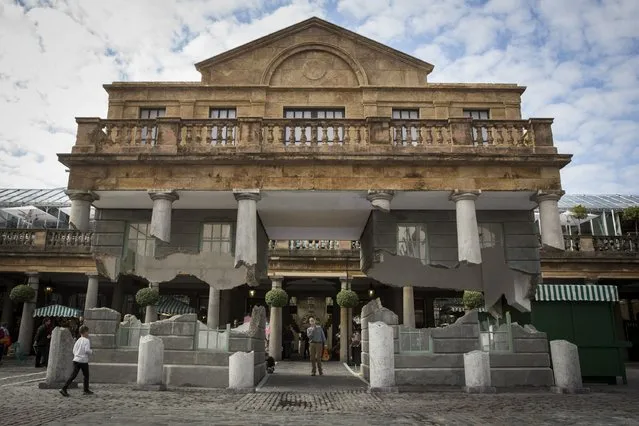
An installation entitled “Take my lightning but don't steal my thunder” by British artist Alex Chinneck stands in Covent Garden on October 2, 2014 in London, England.  The installation is intended to cast the illusion that a 40-foot section of the Covent Garden's 184-year old market building is floating. “Take my lightning but don't steal my thunder” will be on display from 2nd to 24th October 2014. (Photo by Rob Stothard/Getty Images)

An installation entitled “Take my lightning but don't steal my thunder” by British artist Alex Chinneck stands in Covent Garden on October 2, 2014 in London, England. The installation is intended to cast the illusion that a 40-foot section of the Covent Garden's 184-year old market building is floating. “Take my lightning but don't steal my thunder” will be on display from 2nd to 24th October 2014. (Photo by Rob Stothard/Getty Images)
Details
03 Oct 2014 11:40:00
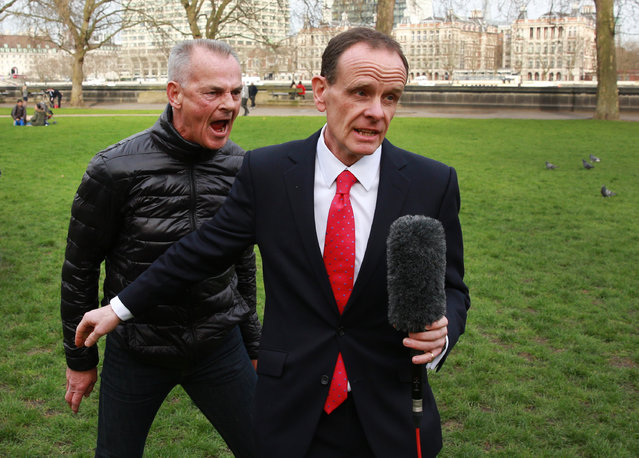
Protestor Bill Maloney (L) shouts during a live TV broadcast by BBC News Channel chief political correspondent Norman Smith after earlier forcing Deputy Prime Minister Nick Clegg to abandon a photocall near Parliament on March 19, 2014 in London, England. The Chancellor of the Exchequer, George Osborne has delivered his Budget statement to Members of Parliament in the House of Commons. (Photo by Peter Macdiarmid/Getty Images)

Protestor Bill Maloney (L) shouts during a live TV broadcast by BBC News Channel chief political correspondent Norman Smith after earlier forcing Deputy Prime Minister Nick Clegg to abandon a photocall near Parliament on March 19, 2014 in London, England. The Chancellor of the Exchequer, George Osborne has delivered his Budget statement to Members of Parliament in the House of Commons. (Photo by Peter Macdiarmid/Getty Images)
Details
22 Mar 2014 14:05:00
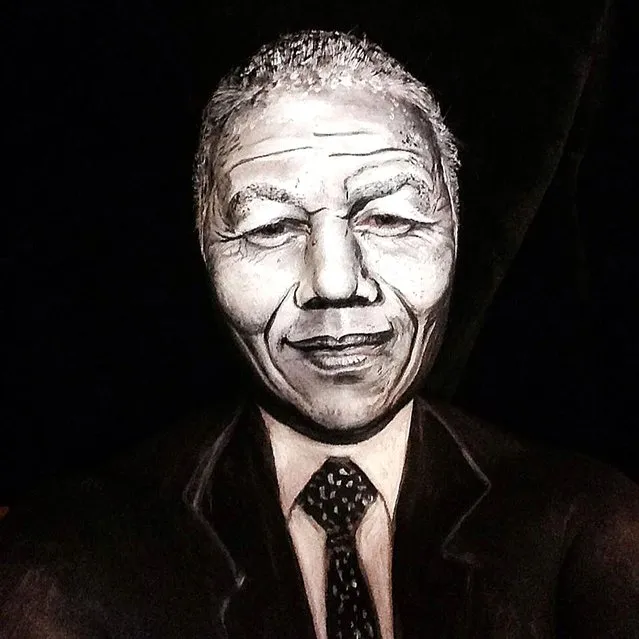
Nelson Mandela make up complete. 40-year-old London-based makeup artist, Maria Malone-Guerbaa has the ability to transform herself into any celebrity or creature using only her basic makeup essentials. Maria used only make up and face paints to create the illusion of Nelson Mandela, Britain's Queen Elizabeth II, and many other A-list celebrities. (Photo by Maria Malone-Guerbaa/Rex Features USA)

Nelson Mandela make up complete. 40-year-old London-based makeup artist, Maria Malone-Guerbaa has the ability to transform herself into any celebrity or creature using only her basic makeup essentials. Maria used only make up and face paints to create the illusion of Nelson Mandela, Britain's Queen Elizabeth II, and many other A-list celebrities. (Photo by Maria Malone-Guerbaa/Rex Features USA)
Details
20 Jun 2014 12:18:00
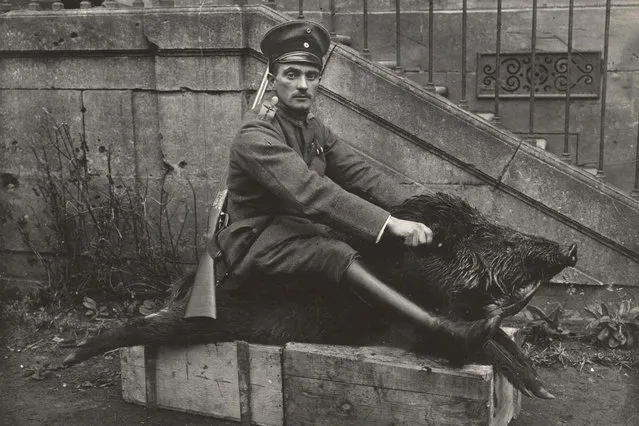
A German Air Force Officer sits astride a dead boar outside a house where he is stationed near the Western Front, in this 1918 handout picture. This picture is part of a previously unpublished set of World War One (WWI) images from a private collection. The pictures offer an unusual view of varied and contrasting aspects of the conflict, from high tech artillery to mobile pigeon lofts, and from officers partying in their headquarters to the grim reality of life and death in the trenches. The year 2014 marks the centenary of the start of the war. (Photo by Reuters/Archive of Modern Conflict London)

A German Air Force Officer sits astride a dead boar outside a house where he is stationed near the Western Front, in this 1918 handout picture. This picture is part of a previously unpublished set of World War One (WWI) images from a private collection. The pictures offer an unusual view of varied and contrasting aspects of the conflict, from high tech artillery to mobile pigeon lofts, and from officers partying in their headquarters to the grim reality of life and death in the trenches. The year 2014 marks the centenary of the start of the war. (Photo by Reuters/Archive of Modern Conflict London)
Details
26 Jun 2014 12:13:00