Loading...
Done
Stockholm metro

The Stockholm metro (Swedish: Stockholms tunnelbana) is a metro system in Stockholm, Sweden. The first line opened in 1950, and today the system has 100 stations in use, of which 47 are underground and 53 above ground. There are seven lines numbered from 10 to 19, in three groups identified by a color: the Green, Red and Blue lines. Each color line has two or three numbered lines on shared sections through the Stockholm City Centre.
Details
12 Sep 2012 05:10:00
A dog rides a wave during the Surf City Surf Dog competition in Huntington Beach, California, U.S., September 25, 2016. (Photo by Lucy Nicholson/Reuters)

A dog rides a wave during the Surf City Surf Dog competition in Huntington Beach, California, U.S., September 25, 2016. The dogs compete in contest categories ranging from small to extra large, to two dogs on a board, as well as owner and dog. (Photo by Lucy Nicholson/Reuters)
Details
27 Sep 2016 09:43:00
A woman is rescued from a car after a flash flood in Nizhny Novgorod, Russia on June 19, 2018. (Photo by Lucy Nicholson/Reuters)

This absolute hero came to the rescue when flash floods in a World Cup city left two women stranded in their submerged cars. Here: A woman is rescued from a car after a flash flood in Nizhny Novgorod, Russia on June 19, 2018. (Photo by Lucy Nicholson/Reuters)
Details
21 Jun 2018 00:01:00
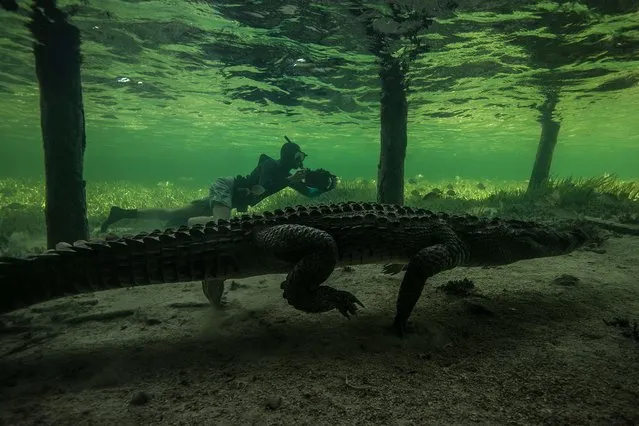
A thrill-seeking photographer risked life and limb as he swam alongside a ten-foot-long American crocodile near Belize. (Photo by Rodrigo Friscione/Mediadrumwor.com)

A thrill-seeking photographer risked life and limb as he swam alongside a ten-foot-long American crocodile near Belize. Stunning pictures show Mexican underwater photographer Rodrigo Friscione getting up close and personal with the two-hundred-pound predator. (Photo by Rodrigo Friscione/Mediadrumwor.com)
Details
09 Sep 2016 09:27:00
Tillie. (Photo by CatsDog Photography/Caters News Agency)

These photos were snapped at just the right moment – leading to some truly unusual images. Some of the pups are sticking out their tongue, while others are just looking at the camera – and the results are hilarious. Cat Race, 33, a dog photographer from Preston, Lancashire, in the U.K., captured the funny moments in the northwest of England over the past two years. Here: Tillie. (Photo by CatsDog Photography/Caters News Agency)
Details
30 Oct 2019 00:05:00


The second of six C-17 Globemaster III airlifters for the United Arab Emirates Air Force and Air Defence is being assembled at the Boeing assembly facility on May 10, 2011 in Long Beach, California. The UAE will take delivery of three more C-17s this year and two in 2012 as it modernizes its airlift capabilities. (Photo by Kevork Djansezian/Getty Images)
Details
11 May 2011 10:34:00
Third place: the rear leg, claw and respiratory trachea of a louse (Haematopinus suis). (Photo by Frank Reiser/Nassau Community College/Nikon Small World Photomicrography 2021)

Third place: the rear leg, claw and respiratory trachea of a louse (Haematopinus suis). (Photo by Frank Reiser/Nassau Community College/Nikon Small World Photomicrography 2021)
Details
15 Sep 2021 02:36:00
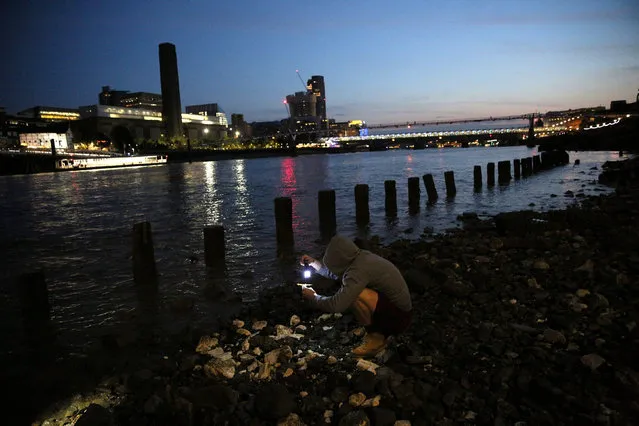
A mudlark uses a torch to look for items on the bank of the River Thames in London, Britain June 06, 2016. Mudlarking is believed to trace its origins to the 18th and 19th century, when scavengers searched the Thames' shores for items to sell. These days, history and archaeology fans are the ones hoping to find old relics such as coins, ceramics, artifacts or everyday items from across centuries. They wait for the low tide and then scour specific areas of exposed shores. "If you're in a field you could be out all day long, with the river you're restricted to about two or three hours," mudlark Nick Stevens said. While many just use the naked eye for their searches, others rely on metal detectors for which a permit from the Port of London Authority is needed. Digging also requires consent. (Photo by Neil Hall/Reuters)

A mudlark uses a torch to look for items on the bank of the River Thames in London, Britain June 06, 2016. Mudlarking is believed to trace its origins to the 18th and 19th century, when scavengers searched the Thames' shores for items to sell. These days, history and archaeology fans are the ones hoping to find old relics such as coins, ceramics, artifacts or everyday items from across centuries. their finds with the Portable Antiquities Scheme. Any item over 300 years old must be recorded. (Photo by Neil Hall/Reuters)
Details
27 Aug 2016 10:43:00