Loading...
Done
Kenyan photographer and art director Barbara Minishi (L) takes pictures of her room mate and fashion stylist Wambui Thimba (R) wearing a creation by a Kenyan fashion designer on the rooftop of their apartment in Nairobi, Kenya, on June 1, 2020. After their scheduled works was cancelled due to the spread of the COVID-19 coronavirus, Minishi and Thimba have started their own project called “the Kenya Fashion & Style Diary in 21 days” to showcase a Kenyan fashion brand everyday for 3 weeks on social networking services since May 22, 2020 by only shooting at their apartment. (Photo by Yasuyoshi Chiba/AFP Photo)

Kenyan photographer and art director Barbara Minishi (L) takes pictures of her room mate and fashion stylist Wambui Thimba (R) wearing a creation by a Kenyan fashion designer on the rooftop of their apartment in Nairobi, Kenya, on June 1, 2020. After their scheduled works was cancelled due to the spread of the COVID-19 coronavirus, Minishi and Thimba have started their own project called “the Kenya Fashion & Style Diary in 21 days” to showcase a Kenyan fashion brand everyday for 3 weeks on social networking services since May 22, 2020 by only shooting at their apartment. (Photo by Yasuyoshi Chiba/AFP Photo)
Details
03 Jul 2020 00:05:00
A government employee reacts as she is sprayed with disinfectant before entering a government office building to curb the spread of COVID-19 on March 19, 2020 in Pasig city, Metro Manila, Philippines. The Philippine government has sealed off Luzon, the country's largest and most populous island, to prevent the spread of COVID-19. Land, sea, and air travel has been suspended, while government work, schools, businesses, and public transportation have been ordered shut in a bid to keep some 55 million people at home. The Philippines' Department of Health has so far confirmed 217 cases of the new coronavirus in the country, with at least 17 recorded fatalities. (Photo by Ezra Acayan/Getty Images)

A government employee reacts as she is sprayed with disinfectant before entering a government office building to curb the spread of COVID-19 on March 19, 2020 in Pasig city, Metro Manila, Philippines. The Philippine government has sealed off Luzon, the country's largest and most populous island, to prevent the spread of COVID-19. Land, sea, and air travel has been suspended, while government work, schools, businesses, and public transportation have been ordered shut in a bid to keep some 55 million people at home. The Philippines' Department of Health has so far confirmed 217 cases of the new coronavirus in the country, with at least 17 recorded fatalities. (Photo by Ezra Acayan/Getty Images)
Details
07 Jan 2021 00:05:00
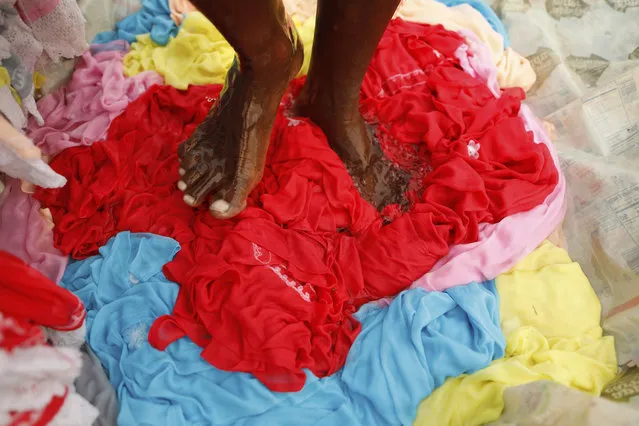
A dhobi, or a washerman washes cloths on the banks of the River Gomti in Lucknow, India, Saturday, September 12, 2020. Dhobis are traditional laundry workers who wash clothes by hand and dry them in the sun, an occupation which has been in existence for generations. Most cities in India have a Dhobi Ghat, or washermen's area, where the city's pile of clothes is laundered. This practice is still popular in India, despite of modern technology. Around 1,000 families work in Lucknow's Dhobi Ghat. However, in light of the novel coronavirus, their wages have decreased drastically. With each family earning around US$100-200 per month. (Photo by Rajesh Kumar Singh/AP Photo)

A dhobi, or a washerman washes cloths on the banks of the River Gomti in Lucknow, India, Saturday, September 12, 2020. Dhobis are traditional laundry workers who wash clothes by hand and dry them in the sun, an occupation which has been in existence for generations. Most cities in India have a Dhobi Ghat, or washermen's area, where the city's pile of clothes is laundered. This practice is still popular in India, despite of modern technology. Around 1,000 families work in Lucknow's Dhobi Ghat. However, in light of the novel coronavirus, their wages have decreased drastically. With each family earning around US$100-200 per month. (Photo by Rajesh Kumar Singh/AP Photo)
Details
25 Sep 2020 00:03:00
A 17 year old girl lays dead next to her doll after she and her friend were killed by unknown motorcycle-riding gunmen, in an alley in Manila, Philippines early October 26, 2016. According to the police, a sign on a cardboard reading “Tulak ka, hayop ka”, which translates to “You are a (drug) pusher, you are an animal” was found with the body of girl's friend. (Photo by Damir Sagolj/Reuters)

Damir Sagolj has won Reuters photojournalist of the year for his 2016 work, which included documenting the deadly Philippine drug war and the North Korea congress. Here: A 17 year old girl lays dead next to her doll after she and her friend were killed by unknown motorcycle-riding gunmen, in an alley in Manila, Philippines early October 26, 2016. According to the police, a sign on a cardboard reading “Tulak ka, hayop ka”, which translates to “You are a (drug) pusher, you are an animal” was found with the body of girl's friend. (Photo by Damir Sagolj/Reuters)
Details
06 Mar 2017 00:03:00
An empty camp is shown beneath a colourful sky in Siberia, December 2016. (Photo by Timothy Allen/Barcroft Productions)

A British photographer has captured life at the “edge of the world”. Timothy Allen, best known for his work on BBC's Human Planet, trekked through the freezing Siberian wilderness for 16 days as he joined part of an 800km migration of reindeer in the Yamal-Nenets region – a name that roughly translates to “edge of the world”. The stunning pictures feature the nomadic Nenets tribe, who drink blood to survive in -45°C temperatures. Timothy's epic journey, which will be revealed in an eight-minute documentary on Animal Planet USA, saw him travel across the bleak terrain of the frozen Ob River with the Nenets people in December last year. Here: An empty camp is shown beneath a colourful sky in Siberia, December 2016. (Photo by Timothy Allen/Barcroft Productions)
Details
19 Sep 2017 07:48:00
(L-R) A man nicknamed "Barcelona", Alexey Bolotov and Alexey Jakushin drink vodka as they travel by a pioneer motorised railcar on their way to Kalach, Sverdlovsk region, Russia October 18, 2015. The "pioneer," a light auxiliary rail vehicle, is a popular form of transport among people who live along the Alapayevsk railway. (Photo by Maxim Zmeyev/Reuters)

(L-R) A man nicknamed "Barcelona", Alexey Bolotov and Alexey Jakushin drink vodka as they travel by a pioneer motorised railcar on their way to Kalach, Sverdlovsk region, Russia October 18, 2015. The "pioneer," a light auxiliary rail vehicle, is a popular form of transport among people who live along the Alapayevsk railway. In a remote corner of the Urals region at the end of a narrow-gauge railway is Kalach, population about a dozen. Three decades ago 600 people called the village home, but the local forestry industry suffered as the former Soviet Union imploded and people moved away in search of work. In Kalach today there are no telephones, no mobile reception and only a few hours of electricity a day. (Photo by Maxim Zmeyev/Reuters)
Details
15 Nov 2015 08:06:00
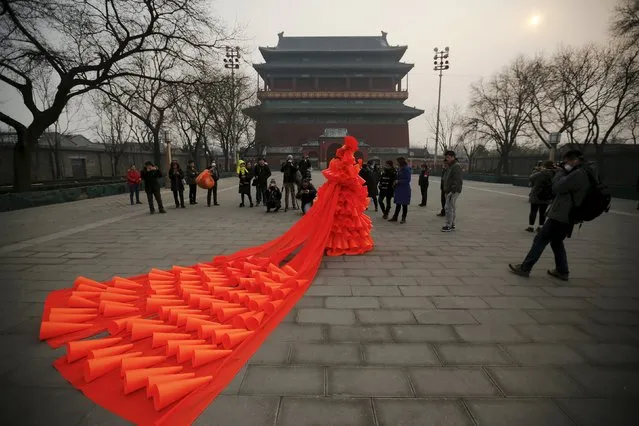
Chinese artist Kong Ning walks in her costume made of hundreds of orange plastic blowing horns during her art performance raising awareness of the hazardous smog in front of the Drum tower in a historical part of Beijing on a very polluted day December 7, 2015. (Photo by Damir Sagolj/Reuters)

Chinese artist Kong Ning walks in her costume made of hundreds of orange plastic blowing horns during her art performance raising awareness of the hazardous smog in front of the Drum tower in a historical part of Beijing on a very polluted day December 7, 2015. Kong, whose works include themes related to China's air pollution problem, named her new performance “The Orange Horns Bride Marries the Blue Sky” and presented it dressed in orange, the colour of the second highest pollution alert level issued again in Beijing as hazardous smog blankets the capital. (Photo by Damir Sagolj/Reuters)
Details
09 Dec 2015 08:05:00
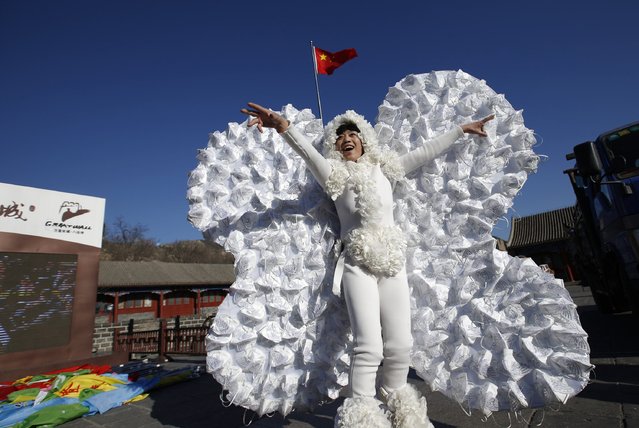
Chinese artist Kong Ning poses in a costume symbolizing a butterfly, which is decorated with 365 masks on its wings to represent the number of days in a year, during her performance art at the Badaling section of the Great Wall on the outskirts of Beijing January 1, 2015. (Photo by Kim Kyung-Hoon/Reuters)

Chinese artist Kong Ning poses in a costume symbolizing a butterfly, which is decorated with 365 masks on its wings to represent the number of days in a year, during her performance art at the Badaling section of the Great Wall on the outskirts of Beijing January 1, 2015. Kong, whose works include themes related to China's air pollution problem, named her new performance art “Hua Die” (transforming into a butterfly) and performed it on the first day of the new year as she hopes that China has clean air for this year. (Photo by Kim Kyung-Hoon/Reuters)
Details
02 Jan 2015 12:24:00