Loading...
Done
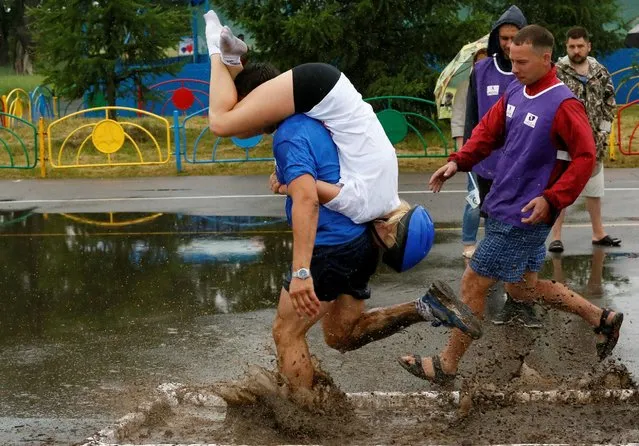
A man carries his wife over an obstacle while competing in the Wife Carrying Championship to mark City Day in Krasnoyarsk, Siberia, Russia, June 25, 2016. (Photo by Ilya Naymushin/Reuters)

A man carries his wife over an obstacle while competing in the Wife Carrying Championship to mark City Day in Krasnoyarsk, Siberia, Russia, June 25, 2016. (Photo by Ilya Naymushin/Reuters)
Details
26 Jun 2016 13:11:00
The sun rises over the north sea as The Couple by artist Sean Henery sits just of the coast at Newbiggin-by-the-Sea, England, Wednesday October 8, 2014. (Photo by Owen Humphreys/AP Photo/PA Wire)

The sun rises over the north sea as The Couple by artist Sean Henery sits just of the coast at Newbiggin-by-the-Sea, England, Wednesday October 8, 2014. (Photo by Owen Humphreys/AP Photo/PA Wire)
Details
10 Oct 2014 13:09:00
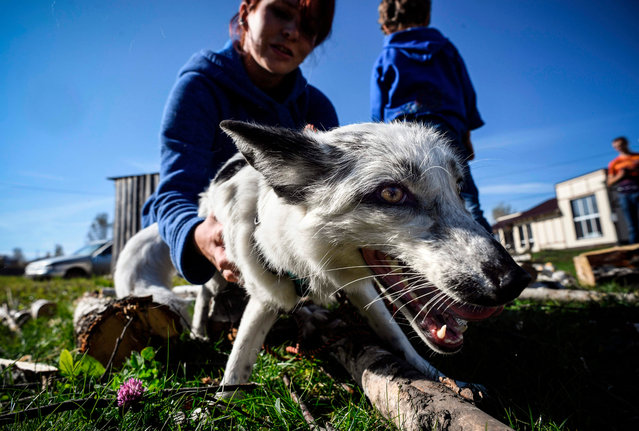
Tatyana Abramova, 33, plays with her home fox Plombir at her countryside house outside Siberian city of Novosibirsk on September 12, 2020. The official start of the Soviet experiment to better understand the domestication of animals by humans began in 1959, and was initiated by geneticists Dmitri Beliaiev and Lioudmila Trout on a farm in Akademgorodok, the scientific center of excellence in Siberia. Their primary objective was to domesticate foxes, to understand how the ancestor of wolves, another canine, evolved into a loyal and loving dog. And understand what this domestication tells us about the genetic evolution of species. (Photo by Alexander Nemenov/AFP Photo)

Tatyana Abramova, 33, plays with her home fox Plombir at her countryside house outside Siberian city of Novosibirsk on September 12, 2020. The official start of the Soviet experiment to better understand the domestication of animals by humans began in 1959, and was initiated by geneticists Dmitri Beliaiev and Lioudmila Trout on a farm in Akademgorodok, the scientific center of excellence in Siberia. Their primary objective was to domesticate foxes, to understand how the ancestor of wolves, another canine, evolved into a loyal and loving dog. And understand what this domestication tells us about the genetic evolution of species. (Photo by Alexander Nemenov/AFP Photo)

Details
25 Oct 2020 00:05:00
People enjoy spring break festivities ahead of an 8pm curfew imposed by local authorities, amid the coronavirus disease (COVID-19) pandemic, in Miami Beach, Florida, U.S., March 27, 2021. (Photo by Marco Bello/Reuters)

People enjoy spring break festivities ahead of an 8pm curfew imposed by local authorities, amid the coronavirus disease (COVID-19) pandemic, in Miami Beach, Florida, U.S., March 27, 2021. (Photo by Marco Bello/Reuters)
Details
05 Apr 2021 08:41:00
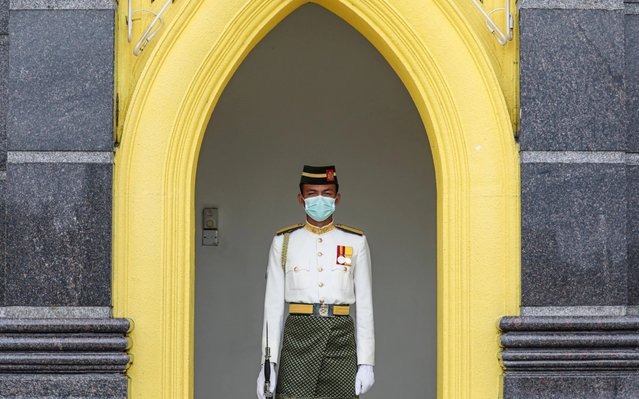
A Malaysian Royal Guard wears a protective mask while he stands guard outside National Palace, following the outbreak of a new coronavirus in China, in Kuala Lumpur, Malaysia, February 10, 2020. (Photo by Lim Huey Teng/Reuters)

A Malaysian Royal Guard wears a protective mask while he stands guard outside National Palace, following the outbreak of a new coronavirus in China, in Kuala Lumpur, Malaysia, February 10, 2020. (Photo by Lim Huey Teng/Reuters)
Details
12 Feb 2020 00:07:00
Cars slowly move along a bridge in traffic jam in central Moscow, Russia on December 11, 2018. (Photo by Yuri Kadobnov/AFP Photo)

Cars slowly move along a bridge in traffic jam in central Moscow, Russia on December 11, 2018. (Photo by Yuri Kadobnov/AFP Photo)
Details
31 Jul 2020 00:01:00
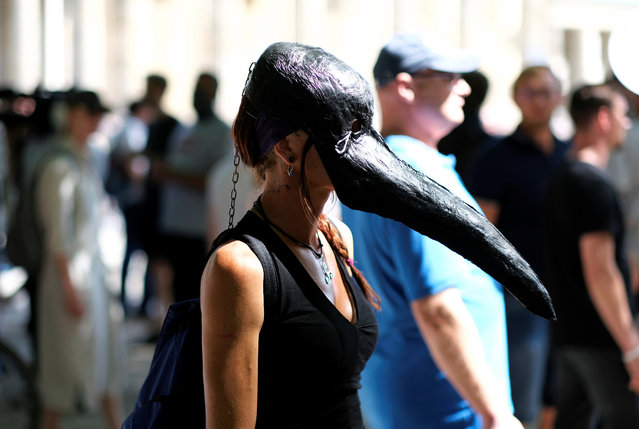
A demonstrator wearing a mask is seen during a protest against the government's restrictions amid the coronavirus disease (COVID-19) outbreak, in Berlin, Germany, August 1, 2020. (Photo by Christian Mang/Reuters)

A demonstrator wearing a mask is seen during a protest against the government's restrictions amid the coronavirus disease (COVID-19) outbreak, in Berlin, Germany, August 1, 2020. (Photo by Christian Mang/Reuters)
Details
04 Aug 2020 00:07:00
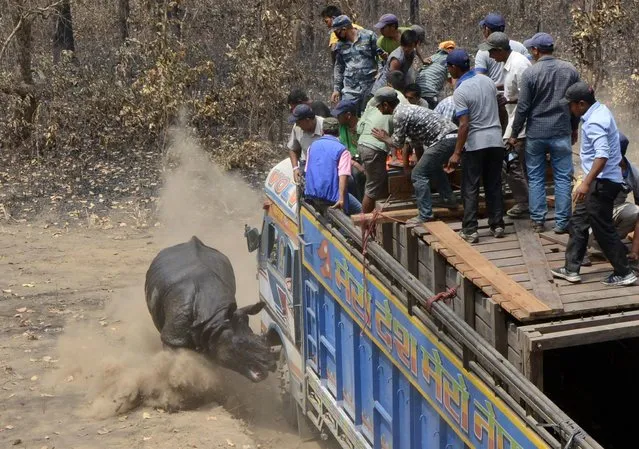
A Nepalese vetinary and technical team release a rhino after it is relocated in Chitwan National Park some of 250 Kilometer South of Kathmandu on April 4, 2017. Conservationists on April 3 captured a rare one-horned rhinoceros in Nepal as part of an attempt to increase the number of the vulnerable animals, which are prized by wildlife poachers. Five rhinos – one male and four female – will be released into a national park in Nepal's far west over the coming week in the hope of establishing a new breeding group. (Photo by Prakash Mathema/AFP Photo)

A Nepalese vetinary and technical team release a rhino after it is relocated in Chitwan National Park some of 250 Kilometer South of Kathmandu on April 4, 2017. Conservationists on April 3 captured a rare one-horned rhinoceros in Nepal as part of an attempt to increase the number of the vulnerable animals, which are prized by wildlife poachers. Five rhinos – one male and four female – will be released into a national park in Nepal's far west over the coming week in the hope of establishing a new breeding group. (Photo by Prakash Mathema/AFP Photo)
Details
05 Apr 2017 09:19:00