Loading...
Done
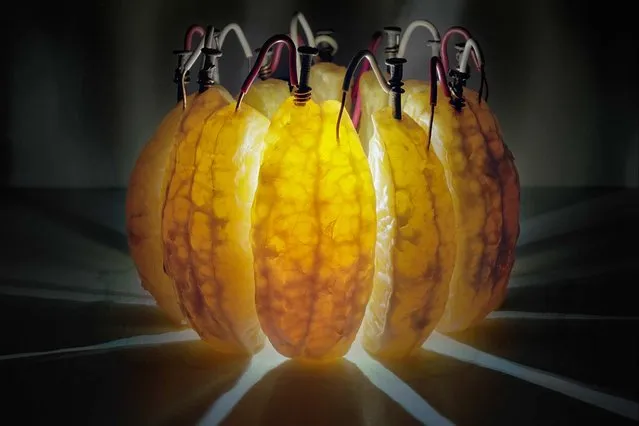
Wedges of an orange generate enough current and electrical juice – 3.5 volts – to power an LED. The fruit’s citric acid helps electrons flow from galvanized nails to copper wire in this 14-hour exposure. This image was published in September’s Visions of Earth, a trio of photos that appear in each issue of National Geographic. (Photo by Caleb Charland/National Geographic)

Wedges of an orange generate enough current and electrical juice – 3.5 volts – to power an LED. The fruit’s citric acid helps electrons flow from galvanized nails to copper wire in this 14-hour exposure. This image was published in September’s Visions of Earth, a trio of photos that appear in each issue of National Geographic. (Photo by Caleb Charland/National Geographic)
Details
06 Jan 2014 12:09:00
President Donald Trump speaks at a campaign rally at Duluth International Airport, Wednesday, September 30, 2020, in Duluth, Minn. (Photo by Alex Brandon/AP Photo)

President Donald Trump speaks at a campaign rally at Duluth International Airport, Wednesday, September 30, 2020, in Duluth, Minn. (Photo by Alex Brandon/AP Photo)
Details
06 Oct 2020 00:01:00
Britain's skip Eve Muirhead, right, embraces Anna Sloan after defeating Switzerland to win the women's curling bronze medal at the 2014 Winter Olympics, Thursday, February 20, 2014, in Sochi, Russia. (Photo by Robert F. Bukaty/AP Photo)

Britain's skip Eve Muirhead, right, embraces Anna Sloan after defeating Switzerland to win the women's curling bronze medal at the 2014 Winter Olympics, Thursday, February 20, 2014, in Sochi, Russia. (Photo by Robert F. Bukaty/AP Photo)
Details
22 Feb 2014 13:17:00
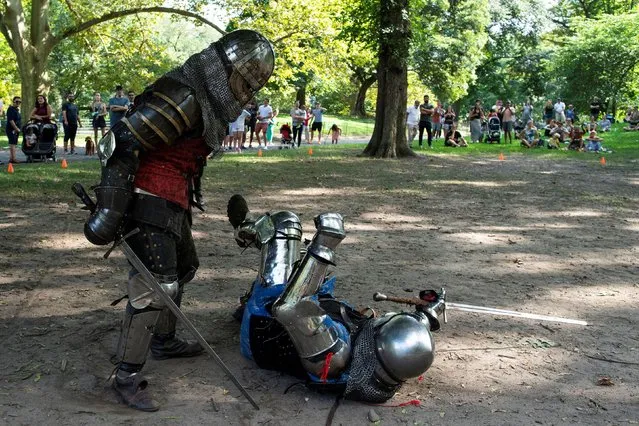
People in full medieval armor take part in a combat at Central Park in New York, U.S., August 14, 2021. (Photo by Eduardo Munoz/Reuters)

People in full medieval armor take part in a combat at Central Park in New York, U.S., August 14, 2021. (Photo by Eduardo Munoz/Reuters)
Details
25 Aug 2021 08:08:00
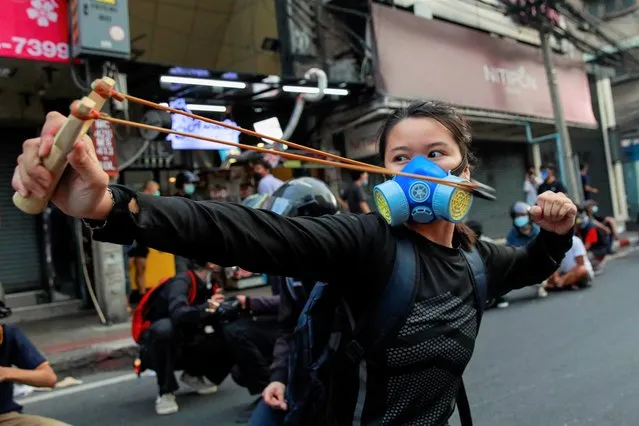
A demonstrator uses a slingshot during clashes with police at a protest against what they call the government's failure in handling the coronavirus disease (COVID-19) outbreak, in Bangkok, Thailand, August 7, 2021. (Photo by Soe Zeya Tun/Reuters)

A demonstrator uses a slingshot during clashes with police at a protest against what they call the government's failure in handling the coronavirus disease (COVID-19) outbreak, in Bangkok, Thailand, August 7, 2021. (Photo by Soe Zeya Tun/Reuters)
Details
28 Apr 2022 05:37:00
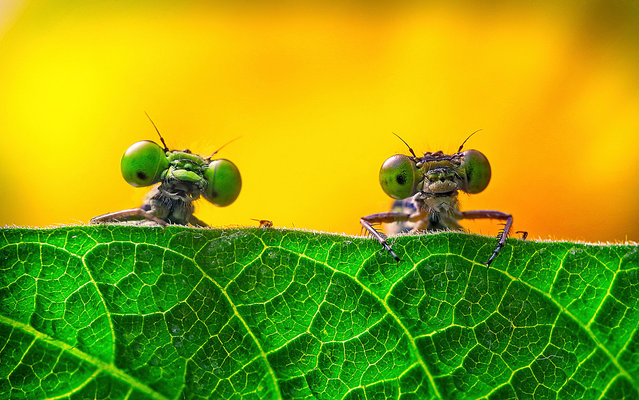
Shortlisted: “Two big eyes” by Miao Yong (Zejiang province, China). Damselflies look over the leaves. “I was photographing insects in a park near my home when suddenly I found two damselflies in the grass. They kept flying and it was very difficult to focus until suddenly they parked behind a leaf”. (Photo by Miao Yong/2017 Royal Society of Biology Photographer of the Year)

Shortlisted: “Two big eyes” by Miao Yong (Zejiang province, China). Damselflies look over the leaves. “I was photographing insects in a park near my home when suddenly I found two damselflies in the grass. They kept flying and it was very difficult to focus until suddenly they parked behind a leaf”. (Photo by Miao Yong/2017 Royal Society of Biology Photographer of the Year)
Details
16 Oct 2017 09:04:00
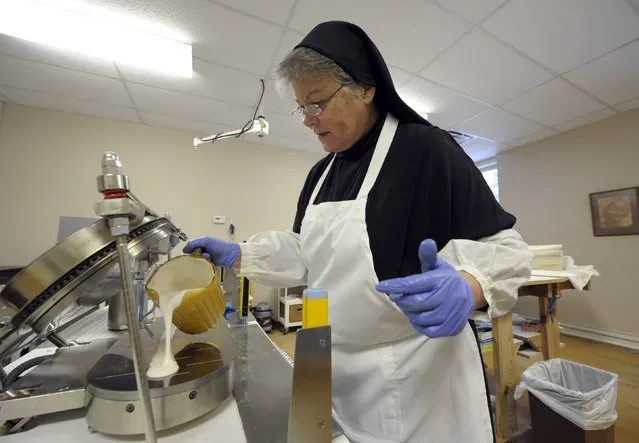
Sister Rebecca Leis pours low-gluten alter bread batter into a machine that bakes the thin bread at the Benedictine Sisters of Perpetual Adoration monastery in Clyde, Missouri, December 18, 2014. The Sisters have made communion wafers since 1910 and began making a low-gluten version in 2003 and have gone from 143 customers in 2004 to more than 11,000 customers from around the world. (Photo by Dave Kaup/Reuters)

Sister Rebecca Leis pours low-gluten alter bread batter into a machine that bakes the thin bread at the Benedictine Sisters of Perpetual Adoration monastery in Clyde, Missouri, December 18, 2014. The Sisters have made communion wafers since 1910 and began making a low-gluten version in 2003 and have gone from 143 customers in 2004 to more than 11,000 customers from around the world. (Photo by Dave Kaup/Reuters)
Details
25 Dec 2014 13:21:00
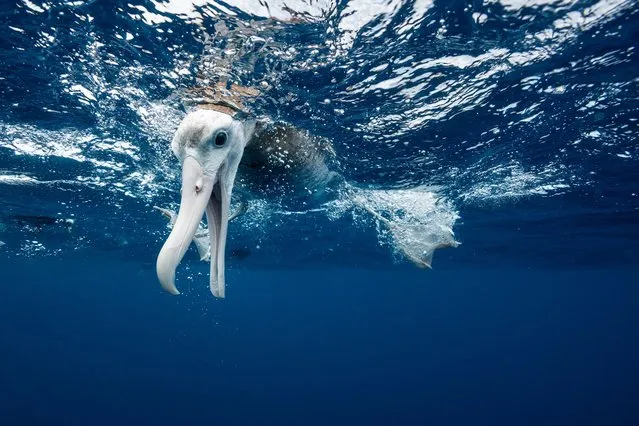
The endangered antipodean albatross, which is often caught in fishing nets, won most first-choice votes out of the more than 55,000 votes cast during the 2020 New Zealand’s bird of the year competition. (Photo by Wildestanimal/Getty Images)

The endangered antipodean albatross, which is often caught in fishing nets, won most first-choice votes out of the more than 55,000 votes cast during the 2020 New Zealand’s bird of the year competition. (Photo by Wildestanimal/Getty Images)
Details
20 Dec 2020 00:05:00