Loading...
Done
Sophia Fernandes, a member of the Kalunga quilombo, the descendants of runaway slaves, dons traditional afro braids, during the culmination of the week-long pilgrimage and celebration for the patron saint “Nossa Senhora da Abadia” or Our Lady of Abadia, in the rural area of Cavalcante in Goias state, Brazil, Saturday, August 13, 2022.  Devotees celebrate Our Lady of Abadia at this time of the year with weddings, baptisms and by crowning distinguished community members, as they maintain cultural practices originating from Africa that mix with Catholic traditions. (Photo by Eraldo Peres/AP Photo)

Sophia Fernandes, a member of the Kalunga quilombo, the descendants of runaway slaves, dons traditional afro braids, during the culmination of the week-long pilgrimage and celebration for the patron saint “Nossa Senhora da Abadia” or Our Lady of Abadia, in the rural area of Cavalcante in Goias state, Brazil, Saturday, August 13, 2022. Devotees celebrate Our Lady of Abadia at this time of the year with weddings, baptisms and by crowning distinguished community members, as they maintain cultural practices originating from Africa that mix with Catholic traditions. (Photo by Eraldo Peres/AP Photo)
Details
21 Aug 2022 03:48:00
Ocean voyage

Do you think that history is a science? Well, not exactly. First, and foremost, history is the state's “legend of wars”, it’s official regalia. Of course, public historians are not interested in scientific truth – quite the opposite. In this respect, any attempt to present a state’s history as altruistic and benevolent as possible is welcomed and encouraged – as opposed to any revisionism attempts that may be more accurate. In this matter, Chinese have surpassed us all – they revised in highly creative manner (but rather shamelessly) the technology already invented by Europeans, a process that resulted in oldest state on the planet. Here is an interesting paradox: ask any sinologist about the Middle Kingdom during second century B.C., and he will describe it to you in such a vivid manner as if he has been living there all his life – but as soon as you will ask him to describe Chinese history in the 19-20th centuries… let's say, his eagerness will be greatly diminished. However, we will discuss China in a different article, and in the meantime we will try to understand how exactly historic “legend of wars” is formed and functions – based on a specific and well-known example. A great example is Ferdinand Magellan's first voyage around the world.
Details
14 Nov 2011 09:11:00
Fantasy  Scenery  By Sarel Theron

Sarel Theron is a freelance digital matte painter and concept artist from Cape Town, South Africa. Theron has worked on numerous projects for local and international clients, including book cover illustrations, matte paintings for commercials, concept art for various pitches, and tutorials for digital art magazines.
Details
09 Nov 2013 07:21:00
1924:  Vladimir Ilyich Lenin lying in state in the Kremlin

Photo: Vladimir Ilyich Lenin (1870 – 1924) lying in state in the Kremlin. (Photo by Hulton Archive/Getty Images). 1924

Important! For the same article in Russian language click here.

Something quite intriguing is happening within Russian-speaking internet during the last few – should you type a fully academic inquiry (at least, according to Russian academic requirements) in national search engines for "Lenin's mausoleum" – the first thing you get (even in top 10 searches) is website pages talking about black magic and occult. Website authors view this construction differently, but unconditionally agree on one thing: the mausoleum of the "leader of the world proletariat” – the essence of a magical artifact, a sort of “energy vampire”. It was built with a certain purpose: to drain the energy out of miserable Soviet citizens on one hand; and to poison the anthroposphere of one-sixth part of the earth with its vibes (the exact territory that was occupied by the former Soviet Union), depriving the Russian people of will to resist on the other hand. Complete nonsense? No doubt. Nevertheless, an intriguing one. Well, probably because some oddities do exist in mausoleum's history. These oddities are the thing we are going to discuss this time. First, let me refresh you memory on the subject.
Details
16 Oct 2011 11:27:00
Abbas (1944 – 25 April 2018) was an Iranian photographer known for his photojournalism in Biafra, Vietnam and South Africa in the 1970s, and for his extensive essays on religions in later years. He was a member of Sipa from 1971 to 1973, a member of Gamma from 1974 to 1980, and joined Magnum Photos in 1981. Here: Kuwait, 1991. (Photo by Abbas Attar/Magnum Photos)

Abbas (1944 – 25 April 2018) was an Iranian photographer known for his photojournalism in Biafra, Vietnam and South Africa in the 1970s, and for his extensive essays on religions in later years. He was a member of Sipa from 1971 to 1973, a member of Gamma from 1974 to 1980, and joined Magnum Photos in 1981. Here: Kuwait, 1991. (Photo by Abbas Attar/Magnum Photos)
Details
28 Apr 2018 00:03:00
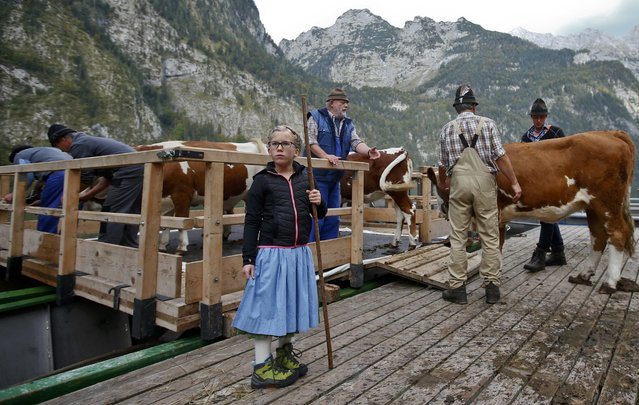
Bavarian farmers load their cows on a boat before they drive over the picturesque Lake Koenigssee, Germany, October 3, 2015. (Photo by Michael Dalder/Reuters)

Bavarian farmers load their cows on a boat before they drive over the picturesque Lake Koenigssee, Germany, October 3, 2015. Before the winter season approaches the farmers have to drive their cattle down from their Alpine meadows to a narrow valley that can only be reached by boat. (Photo by Michael Dalder/Reuters)
Details
06 Oct 2015 08:01:00
Dancers wait to perform on stage. (Photo by Andy Hall/The Observer)

Photographer Andy Hall joins the thousands of fans from west Africa who have gathered for Baaba Maal's annual Blues du Fleuve festival in Senegal. Here: Dancers wait to perform on stage. (Photo by Andy Hall/The Observer)
Details
04 Jan 2016 08:03:00
Watermelons are one of the sweetest parts of summer, but there’s no reason not to have some fun with them before you start eating. Artist Clive Cooper of Sparksfly Design saw beauty in the rinds and got to work carving sculptures out of the fruit before digging in.

Watermelons are one of the sweetest parts of summer, but there’s no reason not to have some fun with them before you start eating. Artist Clive Cooper of Sparksfly Design saw beauty in the rinds and got to work carving sculptures out of the fruit before digging in. (Photo by Clive Cooper)
Details
30 Jun 2014 12:12:00