Loading...
Done
A young girl plays on the glass bottom platform of the Oriental Pear TV Tower as she travels with her family on the second day of the Chinese Lunar New Year holiday, also known as Spring Festival, in Shanghai, China on February 18, 2018. Some 287 million tourists travelled in China during the first four days of the week-long Chinese Lunar New Year holiday, up 11.1 percent from the same period last year, new data showed Sunday (18 February 2018). Tourism revenue rose 11.6 percent to 352.7 billion yuan (55.61 billion U.S. dollars) in the four days, the China National Tourism Administration (CNTA) said. On Sunday alone, some 73 million tourist trips were made across the country, up 15.3 percent, while tourism revenue rose 16.6 percent to 94.4 billion yuan. (Photo by Imaginechina/Rex Features/Shutterstock)

A young girl plays on the glass bottom platform of the Oriental Pear TV Tower as she travels with her family on the second day of the Chinese Lunar New Year holiday, also known as Spring Festival, in Shanghai, China on February 18, 2018. Some 287 million tourists travelled in China during the first four days of the week-long Chinese Lunar New Year holiday, up 11.1 percent from the same period last year, new data showed Sunday. (Photo by Imaginechina/Rex Features/Shutterstock)
Details
21 Feb 2018 00:03:00
Greek actress Xanthi Georgiou, playing the role of the High Priestess, lights up the torch during the flame lighting ceremony for the Beijing 2022 Winter Olympics at the Ancient Olympia archeological site, birthplace of the ancient Olympics in southern Greece on October 18, 2021. The Olympic flame will once again be lit in an empty stadium on Ovtober 18, 2021, as it starts its truncated journey to Beijing for the Winter Games in February. Like the ceremony in March 2020 to light the flame for Tokyo, and like those Games, which were put back a year, Monday's ceremony is a victim of coronavirus restrictions. (Photo by Aris Messinis/AFP Photo)

Greek actress Xanthi Georgiou, playing the role of the High Priestess, lights up the torch during the flame lighting ceremony for the Beijing 2022 Winter Olympics at the Ancient Olympia archeological site, birthplace of the ancient Olympics in southern Greece on October 18, 2021. The Olympic flame will once again be lit in an empty stadium on Ovtober 18, 2021, as it starts its truncated journey to Beijing for the Winter Games in February. Like the ceremony in March 2020 to light the flame for Tokyo, and like those Games, which were put back a year, Monday's ceremony is a victim of coronavirus restrictions. (Photo by Aris Messinis/AFP Photo)
Details
19 Oct 2021 08:13:00
In this May 21, 2021, file photo, JoJo Hamner, a cast member of the “Sexxy After Dark: Where Dinner Meets Play” show, gets the Pfizer COVID-19 vaccine during a pop-up vaccine clinic at Larry Flynt's Hustler Club in Las Vegas. It's one of several methods health officials are employing here and across the country to bring vaccines directly to people to counter waning demand. In tiny towns, ballparks, strip clubs, and marijuana dispensaries, officials are setting up shop and offering incentives to entice people who so far have not gotten shots. (Photo by Ellen Schmidt/Las Vegas Review-Journal via AP Photo/File)

In this May 21, 2021, file photo, JoJo Hamner, a cast member of the “Sexxy After Dark: Where Dinner Meets Play” show, gets the Pfizer COVID-19 vaccine during a pop-up vaccine clinic at Larry Flynt's Hustler Club in Las Vegas. It's one of several methods health officials are employing here and across the country to bring vaccines directly to people to counter waning demand. In tiny towns, ballparks, strip clubs, and marijuana dispensaries, officials are setting up shop and offering incentives to entice people who so far have not gotten shots. (Photo by Ellen Schmidt/Las Vegas Review-Journal via AP Photo/File)
Details
06 Feb 2022 06:30:00
Tatyana Abramova, 33, plays with her home fox Plombir at her countryside house outside Siberian city of Novosibirsk on September 12, 2020. The official start of the Soviet experiment to better understand the domestication of animals by humans began in 1959, and was initiated by geneticists Dmitri Beliaiev and Lioudmila Trout on a farm in Akademgorodok, the scientific center of excellence in Siberia. Their primary objective was to domesticate foxes, to understand how the ancestor of wolves, another canine, evolved into a loyal and loving dog. And understand what this domestication tells us about the genetic evolution of species. (Photo by Alexander Nemenov/AFP Photo)

Tatyana Abramova, 33, plays with her home fox Plombir at her countryside house outside Siberian city of Novosibirsk on September 12, 2020. The official start of the Soviet experiment to better understand the domestication of animals by humans began in 1959, and was initiated by geneticists Dmitri Beliaiev and Lioudmila Trout on a farm in Akademgorodok, the scientific center of excellence in Siberia. Their primary objective was to domesticate foxes, to understand how the ancestor of wolves, another canine, evolved into a loyal and loving dog. And understand what this domestication tells us about the genetic evolution of species. (Photo by Alexander Nemenov/AFP Photo)
Details
25 Oct 2020 00:05:00
A fire-eater of the “Diables de Terrassa” performs during Sitges' little “Festa Major”, “Santa Tecla” in Sitges, Spain on September 19, 2016. This celebration brings together some of Catalonia’s most emblematic festive traditions. The central axis of the celebrations is the traditional parade, made up of “big-head” carnival figures and characters who dance to music played on different traditional instruments. One of the most popular events is the Correfoc or fire-running, which is also the closing event of the fiesta. The people run and jump over characters dressed up as devils and dragons, carrying fire. (Photo by Matthias Oesterle/ZUMA Press/Splash News)

A fire-eater of the “Diables de Terrassa” performs during Sitges' little “Festa Major”, “Santa Tecla” in Sitges, Spain on September 19, 2016. This celebration brings together some of Catalonia’s most emblematic festive traditions. The central axis of the celebrations is the traditional parade, made up of “big-head” carnival figures and characters who dance to music played on different traditional instruments. One of the most popular events is the Correfoc or fire-running, which is also the closing event of the fiesta. The people run and jump over characters dressed up as devils and dragons, carrying fire. (Photo by Matthias Oesterle/ZUMA Press/Splash News)
Details
20 Sep 2016 09:28:00
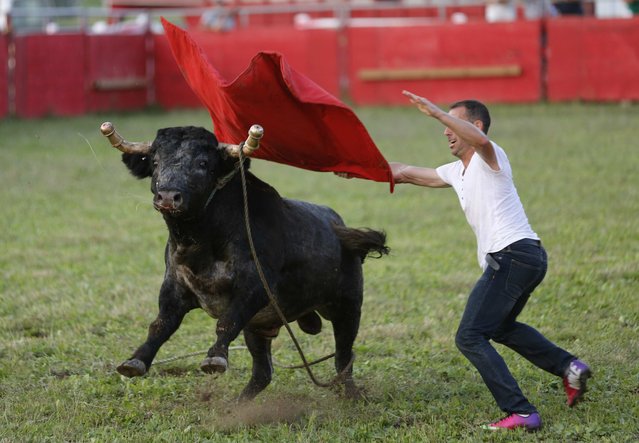
Matador Marco Espinola, who emigrated from the Azores two years ago, challenges a bull during an Azorean “tourada a corda” (bullfight by rope) in Brampton, Ontario August 15, 2015. (Photo by Chris Helgren/Reuters)

Matador Marco Espinola, who emigrated from the Azores two years ago, challenges a bull during an Azorean “tourada a corda” (bullfight by rope) in Brampton, Ontario August 15, 2015. Bulls in a tourada a corda are held by a rope controlled by a team of men to make sure the animal does not cause injury. Bulls are never killed, in contrast with bullfighting in Spain. The Portuguese population in Canada, numbering 429,000 in the 2011 census, mainly centers around Toronto with immigrants from the nine islands of the mid-Atlantic Azores archipelago. (Photo by Chris Helgren/Reuters)
Details
18 Aug 2015 13:39:00
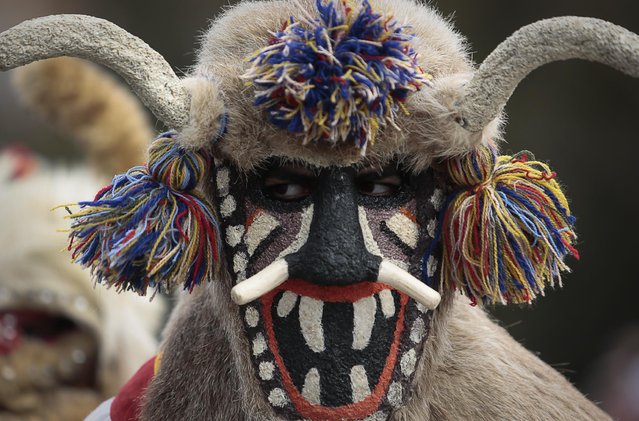
A masked Bulgarian dancer takes part in the second competition day of the 24th International Festival of Masquerade Games “Surva” in the town of Pernik, Bulgaria Saturday, January 31, 2015. (Photo by Valentina Petrova/AP Photo)

A masked Bulgarian dancer takes part in the second competition day of the 24th International Festival of Masquerade Games “Surva” in the town of Pernik, Bulgaria Saturday, January 31, 2015. Some 5,000 people are expected to take part in the three-day festival devoted to an ancient Bulgarian pagan rite. Surva is performed by costumed men, some in sheepskin, or other colorful garments, bells and masks, who walk around and dance to scare away the evil spirits, in hope to provide a good harvest, health, fertility, and happiness. (Photo by Valentina Petrova/AP Photo)

Details
01 Feb 2015 11:14:00
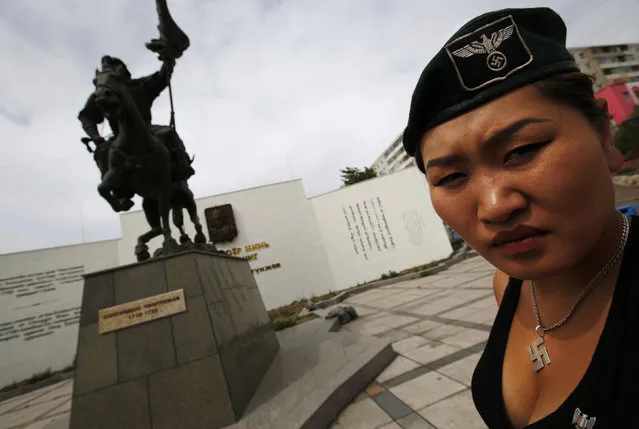
Uranjargal, a leader of the Mongolian neo-Nazi group Tsagaan Khass, stands next to a statue of Chingunjav, a Mongolian national hero, in Ulan Bator June 22, 2013. (Photo by Carlos Barria/Reuters)

Uranjargal, a leader of the Mongolian neo-Nazi group Tsagaan Khass, stands next to a statue of Chingunjav, a Mongolian national hero, in Ulan Bator June 22, 2013. The group has rebranded itself as an environmentalist organisation fighting pollution by foreign-owned mines, seeking legitimacy as it sends Swastika-wearing members to check mining permits. Over the past years, ultra-nationalist groups have expanded in the country and among those garnering attention is Tsagaan Khass, which has recently shifted its focus from activities such as attacks on women it accuses of consorting with foreign men to environmental issues, with the stated goal of protecting Mongolia from foreign mining interests. This ultra-nationalist group was founded in the 1990s and currently has 100-plus members. (Photo by Carlos Barria/Reuters)
Details
09 Jul 2013 07:23:00