Loading...
Done
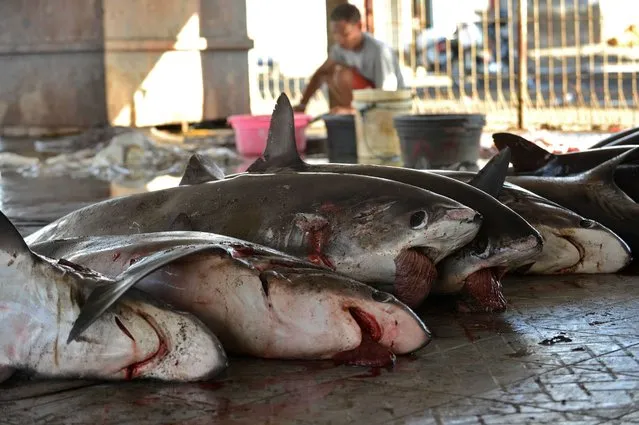
This picture taken on November 9, 2014 shows sharks for sale as a man removes the fins at a traditional market in Tanjung Luar in Lombok, West Nusa Teggara. Hundreds of sharks are hauled ashore every day at a busy market on the central Indonesian island of Lombok, the hub of a booming trade that provides a livelihood for local fishermen but is increasingly alarming environmentalists. (Photo by Sonny Tumbelaka/AFP Photo)

This picture taken on November 9, 2014 shows sharks for sale as a man removes the fins at a traditional market in Tanjung Luar in Lombok, West Nusa Teggara. Hundreds of sharks are hauled ashore every day at a busy market on the central Indonesian island of Lombok, the hub of a booming trade that provides a livelihood for local fishermen but is increasingly alarming environmentalists. The fins are sold to other Asian nations, including Singapore, Hong Kong and Taiwan, where shark-fin soup is considered a delicacy. (Photo by Sonny Tumbelaka/AFP Photo)
Details
23 Dec 2014 13:52:00
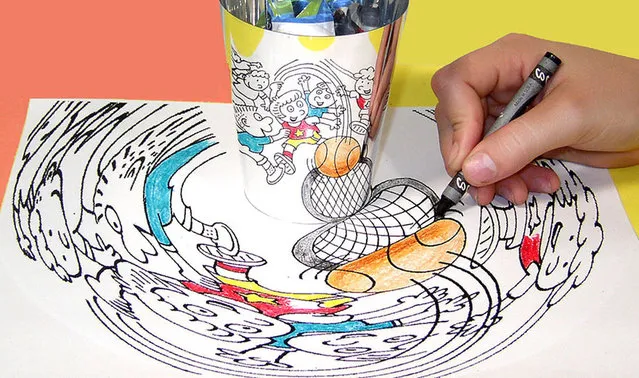
Anamorphic Art By Jonty Hurwitz

The truth can never be seen right away. Only by looking from a certain angle can we view the true nature of things. At other times, only with the help of some special object can we discern order in chaos. Anamorphosis is a form of art that allows us to see an object only by viewing it from a certain angle or by using cylindrical or conical mirror. Unsurprisingly, the first person in history to ever use this type of technique was the Leonardo Da Vinci. During late Renaissance period this technique was popularized as a children’s toy. Now, however, few people use this form of imagery due to its intricacy. Istvan Orosz, born in 1951, is one of the few people who specialize in anamorphosis. In our opinion, his most stunning piece of art is the one where a shipwreck scene turns into a portrait when viewed through a cylindrical mirror. (Photo by Jonty Hurwitz)
Details
05 Jan 2015 13:07:00
Pakistani Waseem Akram, 27, dances during a private party in Rawalpindi, Pakistan. By day, Akram sells mobile phone accessories from an alleyway shop in an old neighborhood of this Pakistani city, Thursday, January 15, 2015. (Photo by Muhammed Muheisen/AP Photo)

Pakistani Waseem Akram, 27, dances during a private party in Rawalpindi, Pakistan. By day, Akram sells mobile phone accessories from an alleyway shop in an old neighborhood of this Pakistani city, Thursday, January 15, 2015. Across conservative Pakistan, where Islamic extremists launch near-daily attacks and many follow a strict interpretation of their Muslim faith, male cross-dressers and the transgendered face a challenge of balancing two identities. Some left their villages for the anonymity of a big city, fearing the reactions of their families while still concealing their identity from neighbors and co-workers. (Photo by Muhammed Muheisen/AP Photo)
Details
21 Jan 2015 13:27:00
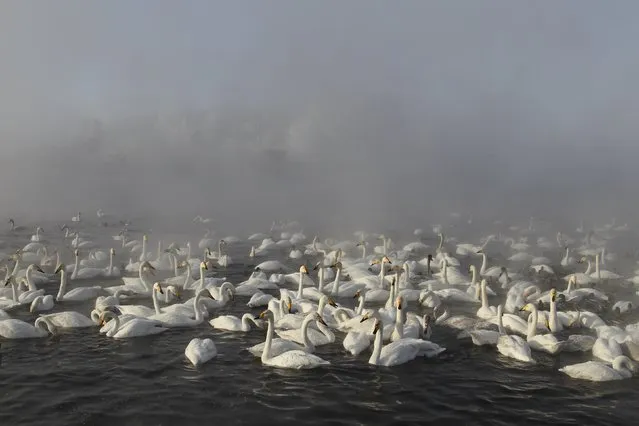
Swans swim over a lake, with the air temperature at about minus 35 degrees Celsius (minus 31 degrees Fahrenheit) as steam ascends above the water during sunset near the village of Urozhainy, Sovetsky district of Altai region, January 26, 2015. (Photo by Andrei Kasprishin/Reuters)

Swans swim over a lake, with the air temperature at about minus 35 degrees Celsius (minus 31 degrees Fahrenheit) as steam ascends above the water during sunset near the village of Urozhainy, Sovetsky district of Altai region, January 26, 2015. About 600 swans annually migrate to the lake, which is heated by warm springs, where they spend their winter being fed by yagers, which helps them to survive the severe cold. (Photo by Andrei Kasprishin/Reuters)
Details
28 Jan 2015 11:40:00
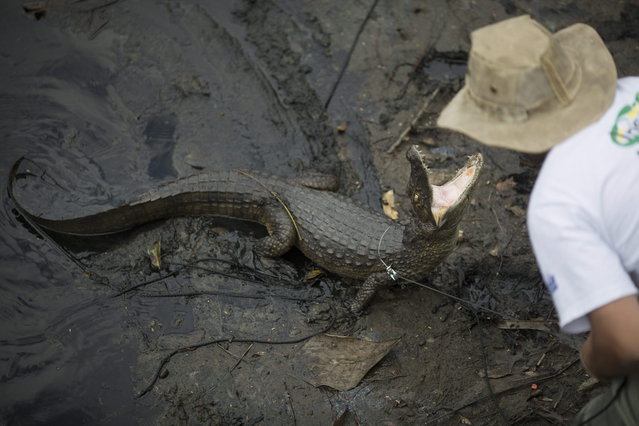
In this October 14, 2013 photo, ecology professor Ricardo Freitas catches a broad-snouted caiman to examine, then release back into the water channel in the affluent Recreio dos Bandeirantes suburb of Rio de Janeiro, Brazil. (Photo by Felipe Dana/AP Photo)

In this October 14, 2013 photo, ecology professor Ricardo Freitas catches a broad-snouted caiman to examine, then release back into the water channel in the affluent Recreio dos Bandeirantes suburb of Rio de Janeiro, Brazil. Caimans are like tanks, a very old species with a remarkable capacity for renovation that allows them to survive under extreme conditions where others couldn't, said Freitas, who runs the Instituto Jacare, or the Caiman Institute, which aims to protect the reptiles. (Photo by Felipe Dana/AP Photo)
Details
18 Oct 2013 09:05:00
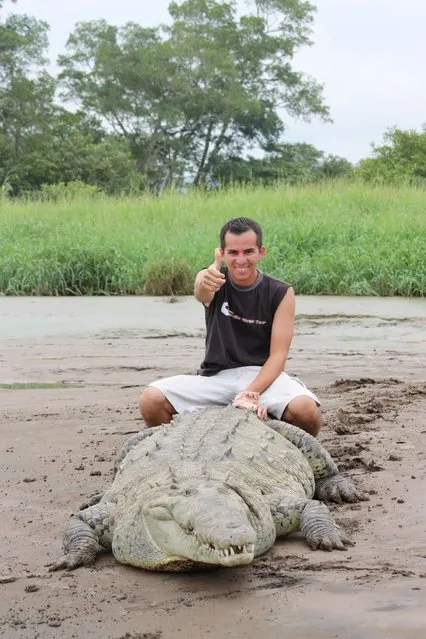
A tour guide shows a thumbs up as he sits on top of a crocodile on the Tarcoles river in Tarcoles, Costa Rica. (Photo and caption by Barcroft Media)

To most of us, hand-feeding crocodiles might sound like a one-way ticket to a watery grave. But for Jose Eduardo Chaves Salas, 32, coming within inches of the fearsome creatures’ razor-sharp teeth is all in a day’s work. He runs Jose's Crocodile River Tour on the Tarcoles River in Costa Rica, where tourists can watch him feed crocs up to 17 feet long. Photo: A tour guide shows a thumbs up as he sits on top of a crocodile on the Tarcoles river in Tarcoles, Costa Rica. (Photo and caption by Barcroft Media)
Details
20 Oct 2013 09:06:00
“Flashy Lady”. (Photo and caption by Roderique Arisiaman)

Some artists want to convey some deep message through their art, while some are simply satisfied with shocking the audience. Roderique Arisiaman is the latter kind. Though his works do not play on the strings of our emotion, they can pique the interest with their flashy and sometimes humorous appearance. Many of his works have a zombie theme, and are surprisingly well done, especially the one where a man pushes his fingers through his cheek and into his eye. If given the chance, Roderique Arisiaman would probably do a great job of designing a poster for some zombie apocalypse movie. (Photo and caption by Roderique Arisiaman)
Details
18 Mar 2015 09:27:00
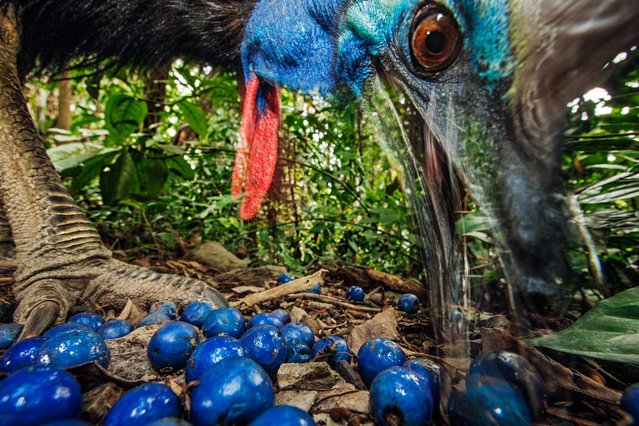
“Cassowaries are large, flightless birds related to emus and (more distantly) to ostriches, rheas, and kiwis”, writes Olivia Judson in the September issue of National Geographic magazine. (Photo by Christian Ziegler/National Geographic)

“Cassowaries are large, flightless birds related to emus and (more distantly) to ostriches, rheas, and kiwis”, writes Olivia Judson in the September issue of National Geographic magazine. How large? People-size: Adult males stand well over five foot five and top 110 pounds. Females are even taller, and can weigh more than 160 pounds. Dangerous when roused, they’re shy and peaceable when left alone. But even birds this big and tough are prey to habitat loss. The dense New Guinea and Australia rain forests where they live have dwindled. Today cassowaries might number 1,500 to 2,000. And because they help shape those same forests – by moving seeds from one place to another – “if they vanish”, Judson writes, “the structure of the forest would gradually change” too. (Photo by Christian Ziegler/National Geographic)
Details
06 Jan 2014 12:21:00