Loading...
Done
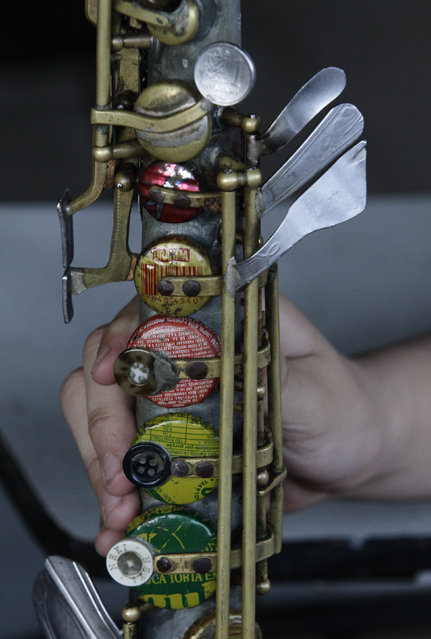
A student of the Orchestra of Recycled Instruments of Cateura holds an instrument made from recycled material by craftsman Nicolas Gomez, in Cateura, near Asuncion, May 9, 2013. The orchestra is the brainchild of its conductor Favio Chavez, who wanted to help the children of garbage pickers at the local landfill, and the instruments are made from salvaged materials by craftsman Gomez. (Photo by Jorge Adorno/Reuters)

A student of the Orchestra of Recycled Instruments of Cateura holds an instrument made from recycled material by craftsman Nicolas Gomez, in Cateura, near Asuncion, May 9, 2013. The orchestra is the brainchild of its conductor Favio Chavez, who wanted to help the children of garbage pickers at the local landfill, and the instruments are made from salvaged materials by craftsman Gomez. The orchestra now involves 30 schoolchildren who have toured countries in Latin America, North America and Europe to play music ranging from Beethoven and Mozart to the Beatles and Paraguayan folk songs. (Photo by Jorge Adorno/Reuters)
Details
12 Jul 2013 09:23:00
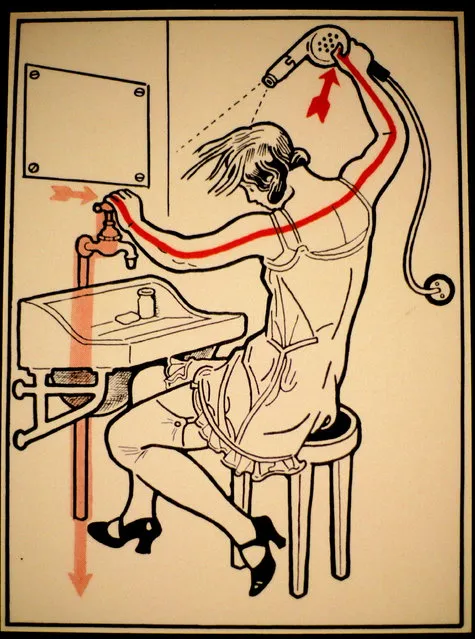
The book “Elektroschutz in 132 Bildern” (Electrical Protection in 132 Pictures) was published in Vienna in the early 1900s by a Viennese physician named Stefan Jellinek (1878-1968, a founder of the Electro-Pathological Museum). The pictures are nice and direct and unambiguous; they teach, graphically, that the surest way to kill yourself with electricity is to form a complete path from source (usually the bright red arrow) to ground (the screened back, pink arrow). Arrowheads provide the path for current flow. (Photo by The Vienna Technical Museum)

The book “Elektroschutz in 132 Bildern” (Electrical Protection in 132 Pictures) was published in Vienna in the early 1900s by a Viennese physician named Stefan Jellinek (1878-1968, a founder of the Electro-Pathological Museum). The pictures are nice and direct and unambiguous; they teach, graphically, that the surest way to kill yourself with electricity is to form a complete path from source (usually the bright red arrow) to ground (the screened back, pink arrow). Arrowheads provide the path for current flow. (Photo by The Vienna Technical Museum)
Details
11 Aug 2014 11:10:00
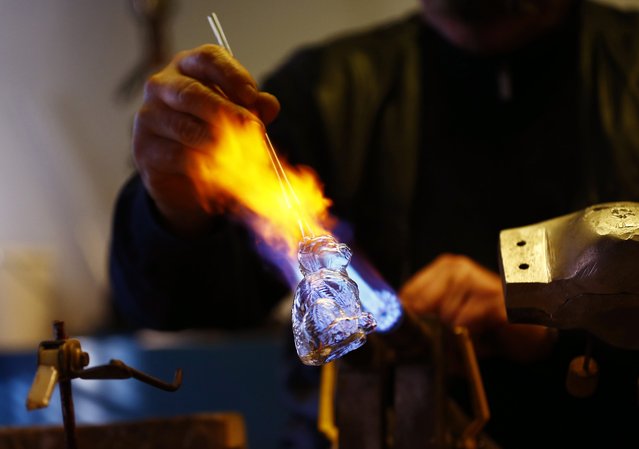
A worker heats a glass cat-shape ornament at the Silverado manufacture of hand-blown Christmas ornaments in town of Jozefow outside Warsaw December 2, 2014. (Photo by Kacper Pempel/Reuters)

A worker heats a glass cat-shape ornament at the Silverado manufacture of hand-blown Christmas ornaments in town of Jozefow outside Warsaw December 2, 2014. (Photo by Kacper Pempel/Reuters)
Details
04 Dec 2014 11:55:00
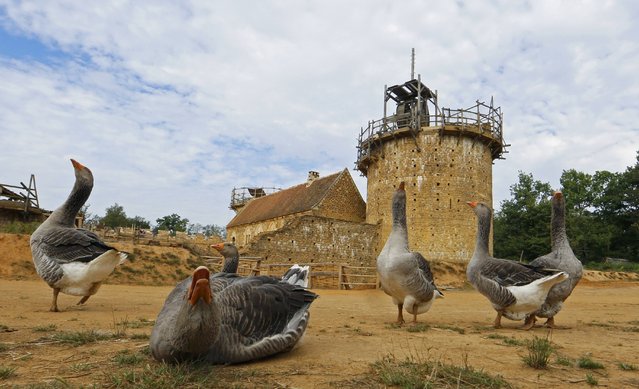
A view of the construction site of the Chateau de Guedelon near Treigny in the Burgundy region of France, September 13, 2016. Blacksmiths, stonemasons and quarry men are hard at work in a Burgundy forest building a 13th-century-style castle using the most basic tools and materials, replicating the methods used hundreds of years ago to better understand them. Forgoing all modern technology, workers use hammers to break stones and forge iron, operate wooden wheels to hoist their materials up to where they are needed, and rely on a quarry for stone, clay and sand as they build up a castle from scratch. Construction on Guedelon Castle in central France began in 1997 after an archaeological survey revealed a medieval fortress hidden inside the walls of nearby Chateau de Saint-Fargeau. Those behind the project hope to answer questions about medieval construction and provide lessons on sustainable building. (Photo by Jacky Naegelen/Reuters)

A view of the construction site of the Chateau de Guedelon near Treigny in the Burgundy region of France, September 13, 2016. Blacksmiths, stonemasons and quarry men are hard at work in a Burgundy forest building a 13th-century-style castle using the most basic tools and materials, replicating the methods used hundreds of years ago to better understand them. (Photo by Jacky Naegelen/Reuters)
Details
15 Sep 2016 09:43:00
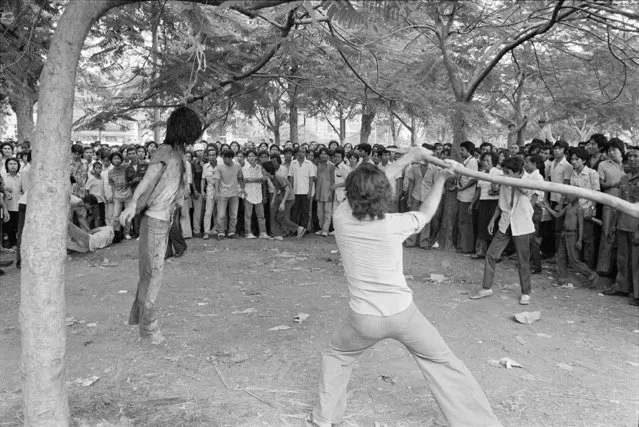
In this October 6, 1976 file photo a member of a Thai political faction strikes at the lifeless body of a hanged student outside Thammasat University in Bangkok Oct. 6, 1976. (Photo by Neal Ulevich/AP Photo)

In this October 6, 1976 file photo a member of a Thai political faction strikes at the lifeless body of a hanged student outside Thammasat University in Bangkok October 6, 1976. For some Thais, the bloody events of October 6, 1976 are still a nightmare. On that day, heavily armed security forces shot up Bangkok's Thammasat University campus and killed scores of students, while right-wing vigilantes captured would-be escapees, subjecting them to ghoulish lynchings. (Photo by Neal Ulevich/AP Photo)
Details
05 Oct 2016 09:22:00
A fan cosplays as Aloy from Horizon Zero Dawn during the 2017 New York Comic Con, Day 4 on October 8, 2017 in New York City. (Photo by Roy Rochlin/WireImage)

A fan cosplays as Aloy from Horizon Zero Dawn during the 2017 New York Comic Con, Day 4 on October 8, 2017 in New York City. (Photo by Roy Rochlin/WireImage)
Details
10 Oct 2017 06:37:00
Mongolian President Tsakhiagiin Elbegdorj (C) walks towards the media after casting his vote for the parliamentary elections at a polling station in Ulaanbaatar, Mongolia, June 29, 2016. (Photo by Jason Lee/Reuters)

Mongolian President Tsakhiagiin Elbegdorj (C) walks towards the media after casting his vote for the parliamentary elections at a polling station in Ulaanbaatar, Mongolia, June 29, 2016. (Photo by Jason Lee/Reuters)
Details
01 Jul 2016 12:25:00
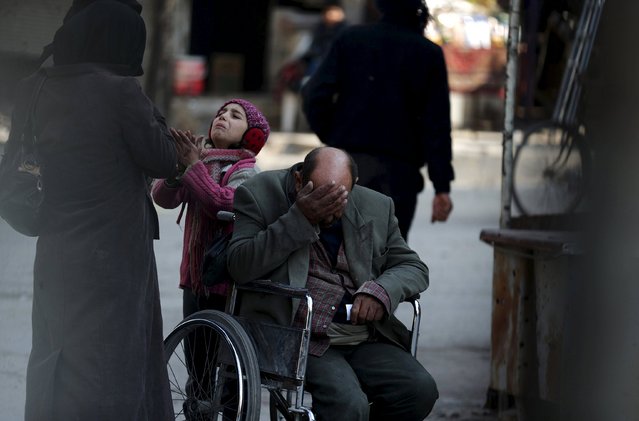
A girl asks a passerby for help to pay a medical bill as her father sits in his wheelchair in the Douma neighbourhood of Damascus Syria February 3, 2016. (Photo by Bassam Khabieh/Reuters)

Hadeel, 10, asks a passerby for help to pay a medical bill as her father Shahrour, 54, sits in his wheelchair in the Douma neighbourhood of Damascus Syria February 3, 2016. Shahrour said he developed diabetes at the beginning of the war in Syria. A lack of insulin led to his medical condition worsening and his right foot had to be amputated. Recently he also suffered a stroke that paralysed half his face. He and part of his extended family, a total of 18 people, live together and struggle to get by. (Photo by Bassam Khabieh/Reuters)
Details
12 Feb 2016 12:46:00