Loading...
Done
Kawakanih Yawalapiti, 9, Upper Xingu region of Mato Grosso, Brazil, 2018: Kawakanih lives with her tribe, the Yawalapiti, in Xingu national park, a preserve in the Amazon basin of Brazil. The Yawalapiti collect seeds to preserve species unique to their ecosystem, which lies between the rain forest and savannah. Kawakanih’s diet is simple, consisting mainly of fish, cassava, porridge, fruit and nuts. “It takes five minutes to catch dinner”, says Kawakanih. “When you’re hungry, you just go to the river with your net”. (Photo by Gregg Segal/The Guardian)

Photographer Gregg Segal travelled the world to document children and the food they eat in a week. Partly inspired by the increasing problems of childhood obesity, he tracked traditional regional diets as yet unaffected by globalisation, and ironically, found that the healthiest diets were often eaten by the least well off. (Photo by Gregg Segal/The Guardian)
Details
03 Jul 2019 00:03:00
We're getting some feedback: “Hi, I have a question. Why is it that 90% of your posts are about women? You don't seem to acknowledge the existence of men unless they were migrants. You're seriously telling me that you can't find a few great accomplishments that MEN are making?? If this is a feminist website I think you should make that public. I've been viewing your posts since 2010 I think, since you first created avaxnews. Now I'm seriously considering blocking you guys”.


And we can reply: We like women more and for that humbly beg for your forgiveness. In general you are right. We promise to rectify the situation somehow.
Details
17 Sep 2018 17:53:00
A Tara BONETHROWER pumpkin created by the Maniac Pumpkin Carvers at Cotton Candy Machine in Brooklyn, N.Y. on October 18, 2014. (Photo by Siemond Chan/Yahoo Finance)


In time for Halloween the Maniac Pumpkin Carvers, creative art studio, held the Cotton Candy Machine workshop in Brooklyn, N.Y., demonstrating techniques and tools to create intricate pumpkin art. Maniac Pumpkin Carvers, which focuses on elevating the art of pumpkin carving, were a past winner of the Food Network's Halloween Wars. Their work has been displayed at MOMA, the Whitney Museum and Yankee Stadium. Here: A Tara Bonethrower pumpkin created by the Maniac Pumpkin Carvers at Cotton Candy Machine in Brooklyn, N.Y. on October 18, 2014. (Photo by Siemond Chan/Yahoo Finance)
Details
22 Oct 2014 14:08:00
A destroyed T-72 tank, which presumably came from Russia, is seen on a battlefield near separatist-controlled Starobesheve, eastern Ukraine, October 2, 2014.(Photo by Maria Tsvetkova/Reuters)

A destroyed T-72 tank, which presumably came from Russia, is seen on a battlefield near separatist-controlled Starobesheve, eastern Ukraine, October 2, 2014. The burnt-out remains of dozens of tanks and armoured vehicles in fields near the small village of Horbatenko bear witness to the ferocity of a battle that turned the tide of the conflict in eastern Ukraine. Among the debris, Reuters found the blackened carcasses of what military experts have since identified as two Russian army tanks, supporting statements by Kiev and the West that the rebels were backed by troops and equipment sent by Moscow. (Photo by Maria Tsvetkova/Reuters)
Details
24 Oct 2014 12:14:00
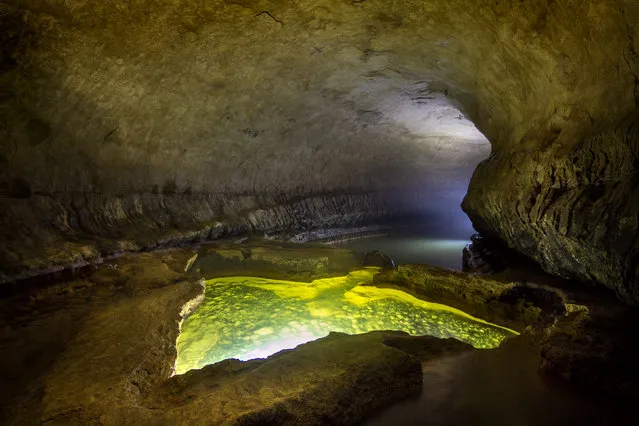
A large pool of water inside one of the tunnels. (Photo by Vladimir Mulde/Caters News)

These otherworldly images give a rare glimpse inside caves barely ever seen by the human eye. With its peculiar pools of water and strange colored sediments, the bizarre looking tunnels of the Shakuranskaya cave could be a set straight out of a science fiction film. Found in the disputed region of Abkhazia, around 75 miles outside of Sochi, Russia, it is rumored the incredible underground chambers were formed after a huge earthquake struck the area in 1892. After causing part of a nearby mountain to collapse into the Amtkel River, it is thought the dam-like affect has created a series of interconnecting underground tunnels. Here: a large pool of water inside one of the tunnels. (Photo by Vladimir Mulde/Caters News)
Details
07 Nov 2014 12:45:00
Portal To Hell

If we were to burn NH4Cr2O7 with HgSCN in the Dark Ages in Europe and show it to anyone, it is us who would be burning next on a fiery cross of Inquisition. And it’s no wonder, since this experiment produces a truly marvelous result. At first, as you ignite the mixture of NH4Cr2O7 and HgSCN, all you can see is that it is slowly burning with a reddish flame. After a while, however, a crater is formed in the middle of the burning pile, and then, suddenly, tentacle-like appendages start sprouting from the burning mixture. And you can almost hear the scream of the mad occultist – “Come forth, Kraken! Come forth!” But of course, this is simply a chemical reaction that is called the "Pharoah's Serpent". It was also often sold in firework stores until people realized that it was toxic.
Details
01 Dec 2014 13:51:00
Magical Contamination By Antoine Bridier-Nahmias

Modern art is truly fascinating. Not in a way that it produces some novel things that will fascinate future generations for decades and even centuries to come. No, that is very far from the truth. On the contrary, modern art is essentially anything (yes, any little thing) that is a bit unusual and was created by a famous person. Let’s take the creation of Antoine Bridier-Nahmias for example. His brainchild is a set of pictures of petri dishes that were contaminated by various cultures of fungi. If this is art, I missed my chance of becoming famous when I accidentally left a piece of bread in a bag in a cupboard for about six months, and didn’t take a picture of the rather shocking results that awaited me when I finally discovered it. (Photo by Antoine Bridier-Nahmias)
Details
12 Dec 2014 13:03:00
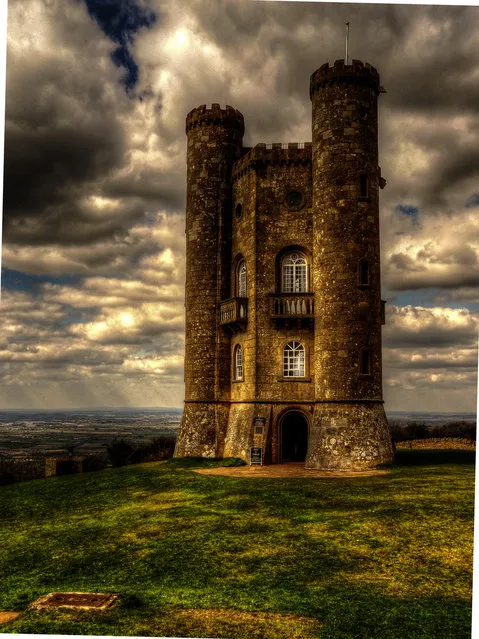
Broadway Tower In English

Broadway Tower is a folly located on Broadway Hill, near the village of Broadway, in the English county of Worcestershire, at the second highest point of the Cotswolds after Cleeve Hill. Broadway Tower's base is 1,024 feet (312 metres) above sea level. The tower itself stands 55 feet (17 metres) high. The “Saxon” tower was designed by James Wyatt in 1794 in the form of a castle, and built for Lady Coventry in 1799. The tower was built on a “beacon” hill, where beacons were lit on special occasions. Lady Coventry wondered if a beacon on this hill could be seen from her house in Worcester – approximately 22 miles (35 km) away – and sponsored the construction of the folly to find out. The beacon could be seen clearly.
Details
19 Dec 2013 10:06:00