The Greyfriars Bobby statue is pictured wearing a mask as the spread of the coronavirus disease (COVID-19) continues, in Edinburgh, Scotland, Britain, March 23, 2020. (Photo by Russell Cheyne/Reuters)
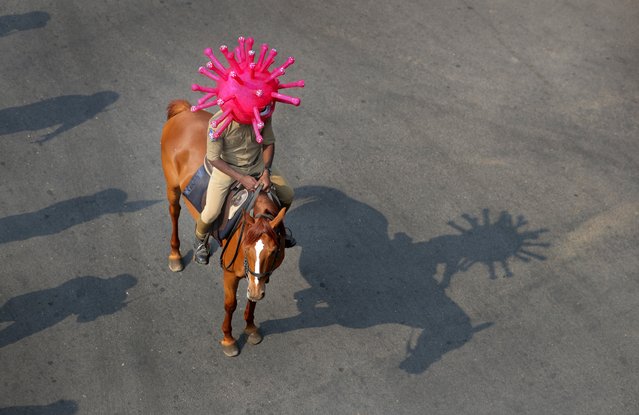
An Indian policeman wearing a virus themed helmet rides on a horse during an awareness rally aimed at preventing the spread of new coronavirus in Hyderabad, India, Thursday, April 2, 2020. (Photo by Mahesh Kumar A./AP Photo)
A man shakes a wooden disk to keep it on fire during the Schieweschlawe festival in Offwiller, eastern France, Sunday, February 26, 2023. The Schieweschlawe festival is a celtic tradition to drive away evil spirit and celebrates equinox. (Photo by Jean-Francois Badias/AP Photo)
Relatives of the Palestinians, who lost their lives as a result of the Israeli attacks on the public market in the Sheikh Ridan neighborhood where people were waiting for aid, mourn as the dead bodies are brought the Al-Shifa Hospital for burial process on August 13, 2025 in Deir Al Balah, Gaza. (Photo by Mahmoud Issa/Anadolu via Getty Images)
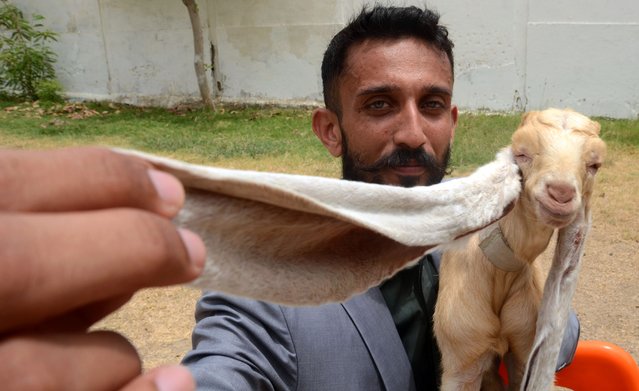
A baby goat named Simba, has the World's longest ears which are 48 cm, is seen with her owner in Karachi, Pakistan on June 16, 2022. (Photo by Yousuf Khan/Anadolu Agency via Getty Images)
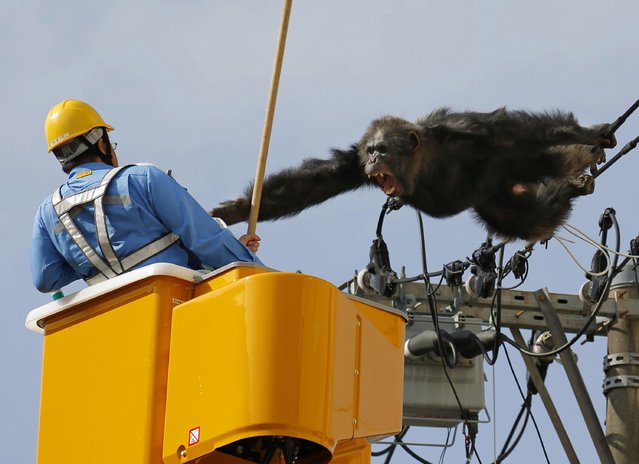
Chacha, the male chimp, screams at a worker in Sendai, northern Japan, Thursday, April 14, 2016 after fleeing from a zoo. The chimpangzee tried desperately to avoid being captured by climbing an electric pole. Chacha was on the loose nearly two hours Thursday after it disappeared from the Yagiyama Zoological Park in Sendai, the city that's hosting finance ministers from the Group of Seven industrialized nations in May. (Photo by Kyodo News via AP Photo)
Japanese college students look at cheerleaders during a job-hunting rally in Tokyo January 29, 2014. According to the rally organizers, about 1,500 students from vocational schools attend the rally to boost their morale ahead of their job hunt. (Photo by Yuya Shino/Reuters)
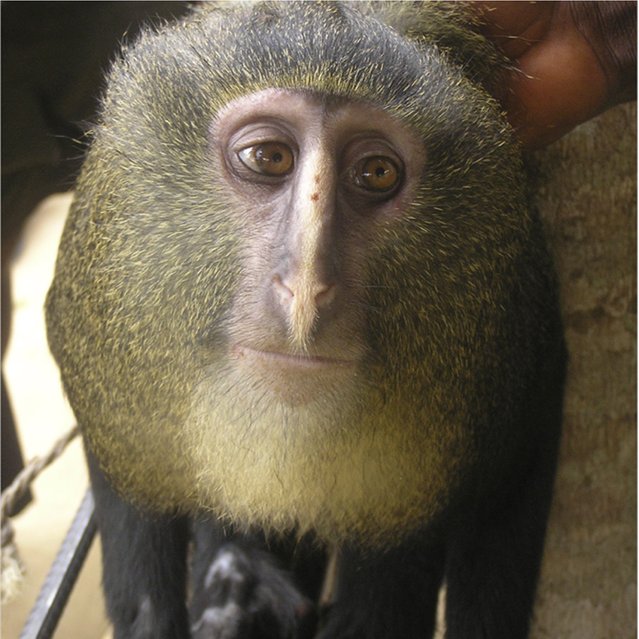
A new species of monkey found in the Democratic Republic of the Congo and identified as Lesula (Cercopithecus lomamiensis) is seen in this undated photograph from an article published September 12, 2012 in the science journal PLOS One. The monkey was first seen in 2007 by researchers John and Terese Hart of the Peabody Museum of Natural History at Yale Research Project. The finding of C. lomamiensis represents only the second new species of African monkey to be discovered in the past 28 years, according to the research article. (Photo by Hart J. A., Detwiler K. M., Gilbert C. C./Reuters)