Loading...
Done


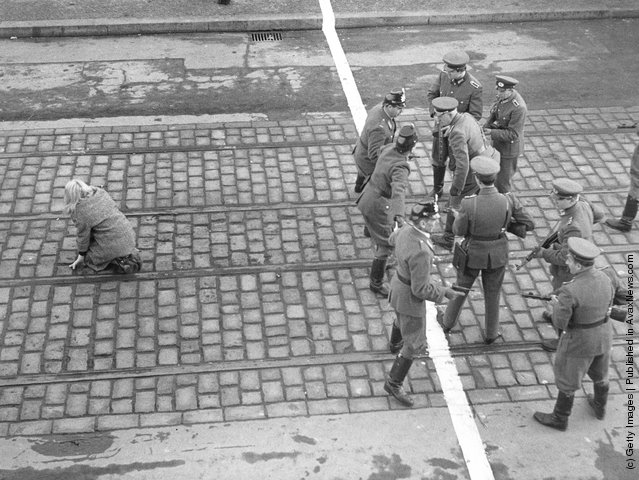
“The Berlin Wall (German: Berliner Mauer) was a barrier constructed by the German Democratic Republic (GDR, East Germany) starting on 13 August 1961, that completely cut off West Berlin from surrounding East Germany and from East Berlin. The barrier included guard towers placed along large concrete walls, which circumscribed a wide area (later known as the “death strip”) that contained anti-vehicle trenches, “fakir beds” and other defenses. The Soviet-dominated Eastern Bloc officially claimed that the wall was erected to protect its population from fascist elements conspiring to prevent the “will of the people” in building a socialist state in East Germany. However, in practice, the Wall served to prevent the massive emigration and defection that marked Germany and the communist Eastern Bloc during the post-World War II period”. – Wikipedia

Photo: West Berlin policemen and East German Volkspolizei face each other across the border in Berlin, circa 1955. (Photo by Three Lions/Hulton Archive/Getty Images)
Details
22 May 2011 10:49:00


“Kumbh Mela is a mass Hindu pilgrimage in which Hindus gather at the Ganges river. The normal Kumbh Mela is celebrated every 3 years, the Ardh (half) Kumbh Mela is celebrated every six years at Haridwar and Prayag, the Purna (complete) Kumbh takes place every twelve years, at four places (Prayag (Allahabad), Haridwar, Ujjain, and Nashik). The Maha (great) Kumbh Mela which comes after 12 “Purna Kumbh Melas”, or 144 years, is held at Allahabad.

The last Ardh Kumbh Mela was held over a period of 45 days beginning in January 2007, more than 70 million Hindu pilgrims took part in the Ardh Kumbh Mela at Prayag, and on January 15, the most auspicious day of the festival of Makar Sankranti, more than 5 million participated. The previous Maha Kumbh Mela, held in 2001, was attended by around 60 million people, making it at the time the largest gathering anywhere in the world in recorded history”. – Wikipedia

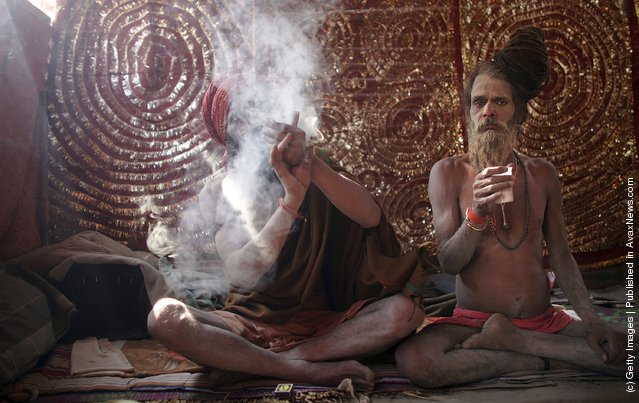
Photo: Sadhus (holy men) smoke at their camp near the ritual site at Sangam, the confluence of the Ganges, Yamuna and mythical Saraswati rivers during the Ardh Kumbh Mela festival (Half Pitcher festival) January 18, 2007 in Allahabad, India. Millions of Hindu pilgrims have flocked to the largest religious gathering in the world which lasts for 45 days in northern India. The festival commemorates the mythical conflict between gods and demons over a pitcher filled with the “nectar of immortality”. Devotees believe that taking a holy dip in the Ganges at this time washes away their sins and paves the path to salvation. (Photo by Mario Tama/Getty Images)
Details
30 Jun 2011 10:27:00
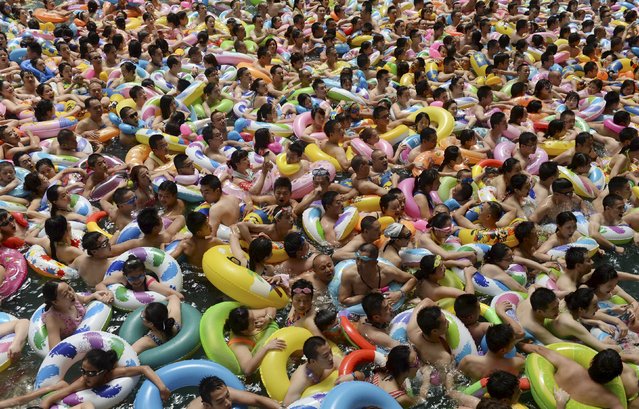
Visitors crowd an artificial wave swimming pool at a tourist resort to escape the summer heat in Daying county of Suining, Sichuan province, China, July 11, 2015. (Photo by Reuters/Stringer)

Visitors crowd an artificial wave swimming pool at a tourist resort to escape the summer heat in Daying county of Suining, Sichuan province, China, July 11, 2015. (Photo by Reuters/Stringer)
Details
12 Jul 2015 14:06:00
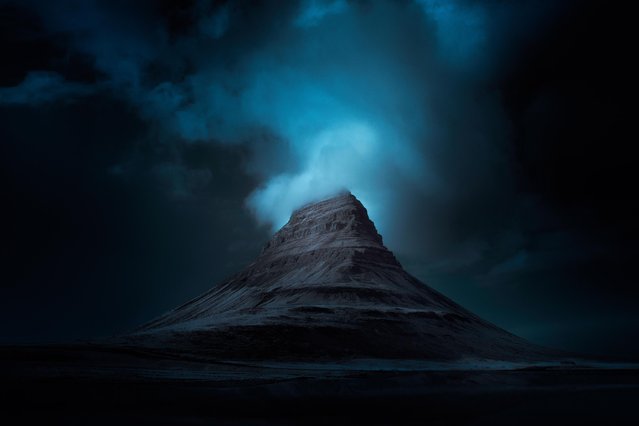
Location: Kirkjufell. These eerily stunning images taken using infrared lighting reveal the landscapes of Iceland in all their natural glory. (Photo by Andy Lee/Caters News)

“These eerily stunning images taken using infrared lighting reveal the landscapes of Iceland in all their natural glory. Andy Lee, 45, uses a special technique which blocks out light from some visible wavelengths and picks up light from others invisible to the naked eye”. – Caters News. Photo: Location: Kirkjufell. These eerily stunning images taken using infrared lighting reveal the landscapes of Iceland in all their natural glory. (Photo by Andy Lee/Caters News)
Details
04 Jul 2014 10:49:00
A Chinese shopper sleeps on a bed in the showroom of the IKEA store on July 6, 2014 in Beijing, China. Of the world's ten biggest Ikea stores, 8 of them are in China to cater to the country's growing middle class. The stores are designed with extra room displays given the tendency for customers to make a visit an all-day affair. Store management does not discourage shoppers from sleeping on Ikea furniture, even marking them with signs inviting customers to try them out. (Photo by Kevin Frayer/Getty Images)

A Chinese shopper sleeps on a bed in the showroom of the IKEA store on July 6, 2014 in Beijing, China. Of the world's ten biggest Ikea stores, 8 of them are in China to cater to the country's growing middle class. The stores are designed with extra room displays given the tendency for customers to make a visit an all-day affair. Store management does not discourage shoppers from sleeping on Ikea furniture, even marking them with signs inviting customers to try them out. (Photo by Kevin Frayer/Getty Images)
Details
09 Jul 2014 12:27:00
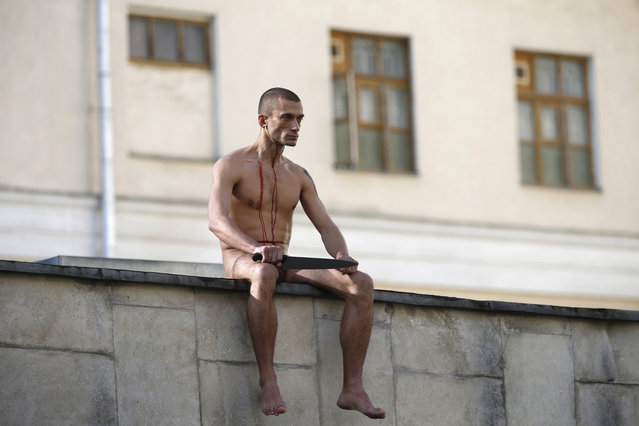
Artist Pyotr Pavlensky sits on the wall enclosing the Serbsky State Scientific Center for Social and Forensic Psychiatry after he cut off a part of his earlobe during his protest action titled “Segregation” in Moscow October 19, 2014. (Photo by Maxim Zmeyev/Reuters)

Artist Pyotr Pavlensky sits on the wall enclosing the Serbsky State Scientific Center for Social and Forensic Psychiatry after he cut off a part of his earlobe during his protest action titled “Segregation” in Moscow October 19, 2014. Pavlensky protested against the usage of forensic psychiatry for politically motivated purposes. He cut off his earlobe to demonstrate how authorities could “cut off” an unwanted individual from society by using psychiatric and medical diagnosis to forcefully send a person to a penitentiary hospital, according to Pavlensky. (Photo by Maxim Zmeyev/Reuters)
Details
21 Oct 2014 12:10:00
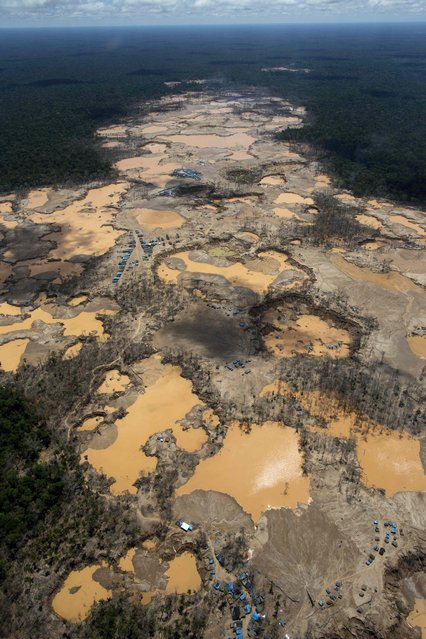
This November 11, 2014 aerial photo, shows a deforested area dotted with blue tarps, marking the area where miners reside, and craters filled with water, caused by illegal gold mining activities, in La Pampa, in Peru's Madre de Dios region. (Photo by Rodrigo Abd/AP Photo)

This November 11, 2014 aerial photo, shows a deforested area dotted with blue tarps, marking the area where miners reside, and craters filled with water, caused by illegal gold mining activities, in La Pampa, in Peru's Madre de Dios region. Less than a month before Peru plays host to global climate talks, the government sent a battalion of police into southeastern jungles to dismantle illegal gold-mining mining camps. Peru's anti-illegal mining czar, retired army Gen. Augusto Soto, marched the men to the wasteland known as La Pampa, where 50,000 hectares of rainforest have been obliterated in the past six years. (Photo by Rodrigo Abd/AP Photo)
Details
21 Nov 2014 12:35:00
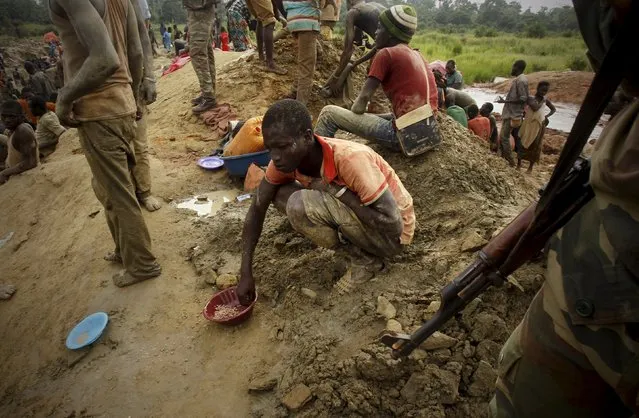
A gold prospector sits and eats close to a soldier at a gold mine near the village of Gamina, in western Ivory Coast, March 18, 2015. (Photo by Luc Gnago/Reuters)

Nestled among the cocoa plantations of western Ivory Coast is a gold mine that does not feature on any official maps. It is not run by an industrial mining company, nor does it pay taxes to the central government. The unlicensed mine is a key part of a lucrative business empire headed by the deputy commander of the West African nation's elite Republican Guard, United Nations investigators allege. Here: A gold prospector sits and eats close to a soldier at a gold mine near the village of Gamina, in western Ivory Coast, March 18, 2015. (Photo by Luc Gnago/Reuters)
Details
08 May 2015 13:54:00