Loading...
Done
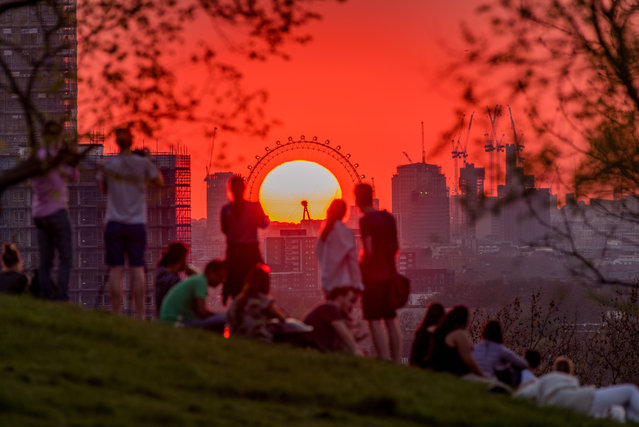
Londoners enjoying the magnificent sight of sun setting perfectly in the middle of London Eye as seen from Greenwich Park in London, England on the warmest day of the year on April 19, 2018. (Photo by London Viewpoints/Rex Features/Shutterstock)

Londoners enjoying the magnificent sight of sun setting perfectly in the middle of London Eye as seen from Greenwich Park in London, England on the warmest day of the year on April 19, 2018. (Photo by London Viewpoints/Rex Features/Shutterstock)
Details
27 Jul 2018 00:03:00
A group of PETA supporters protest Canada Goose's use of coyote fur, with “Canada Goose Kills” painted on their backs in New York, USA on October 18, 2018. (Photo by Erik Pendzich/Rex Features/Shutterstock)

A group of PETA supporters protest Canada Goose's use of coyote fur, with “Canada Goose Kills” painted on their backs in New York, USA on October 18, 2018. (Photo by Erik Pendzich/Rex Features/Shutterstock)
Details
14 Nov 2018 00:01:00
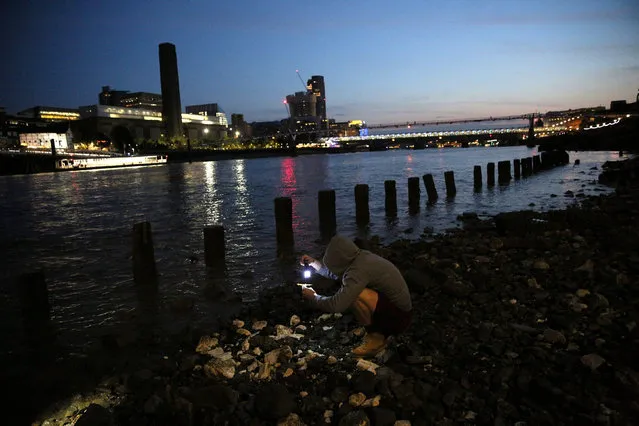
A mudlark uses a torch to look for items on the bank of the River Thames in London, Britain June 06, 2016. Mudlarking is believed to trace its origins to the 18th and 19th century, when scavengers searched the Thames' shores for items to sell. These days, history and archaeology fans are the ones hoping to find old relics such as coins, ceramics, artifacts or everyday items from across centuries. They wait for the low tide and then scour specific areas of exposed shores. "If you're in a field you could be out all day long, with the river you're restricted to about two or three hours," mudlark Nick Stevens said. While many just use the naked eye for their searches, others rely on metal detectors for which a permit from the Port of London Authority is needed. Digging also requires consent. (Photo by Neil Hall/Reuters)

A mudlark uses a torch to look for items on the bank of the River Thames in London, Britain June 06, 2016. Mudlarking is believed to trace its origins to the 18th and 19th century, when scavengers searched the Thames' shores for items to sell. These days, history and archaeology fans are the ones hoping to find old relics such as coins, ceramics, artifacts or everyday items from across centuries. their finds with the Portable Antiquities Scheme. Any item over 300 years old must be recorded. (Photo by Neil Hall/Reuters)
Details
27 Aug 2016 10:43:00
“Mr Big Dipper”, Nicholas Roemmelt (Denmark). A stargazer observes the constellation of the Big Dipper perfectly aligned with the window of the entrance to a large glacier cave in Engadin, Switzerland. This is a panorama of two pictures, and each is a stack of another two pictures: one for the stars and another one for the foreground, but with no composing or time blending. (Photo by Nicholas Roemmelt/National Maritime Museum/The Guardian)

“Mr Big Dipper”, Nicholas Roemmelt (Denmark). A stargazer observes the constellation of the Big Dipper perfectly aligned with the window of the entrance to a large glacier cave in Engadin, Switzerland. This is a panorama of two pictures, and each is a stack of another two pictures: one for the stars and another one for the foreground, but with no composing or time blending. (Photo by Nicholas Roemmelt/National Maritime Museum/The Guardian)
Details
27 Jul 2017 06:50:00
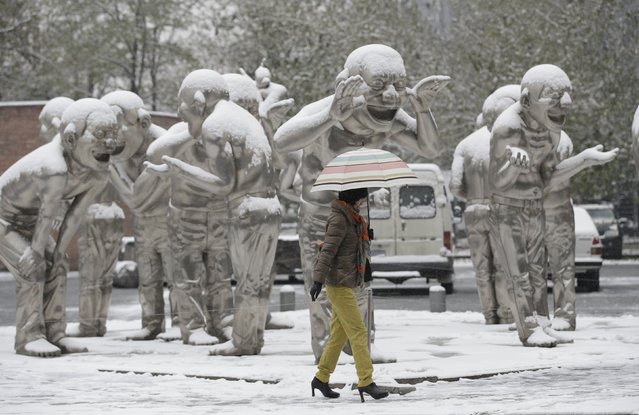
A woman holding an umbrella walks past the sculpture by Chinese artist Yue Minjun beside a road during a snow in Beijing, China, November 22, 2015. (Photo by Jason Lee/Reuters)

A woman holding an umbrella walks past the sculpture by Chinese artist Yue Minjun beside a road during a snow in Beijing, China, November 22, 2015. (Photo by Jason Lee/Reuters)
Details
24 Nov 2015 08:05:00
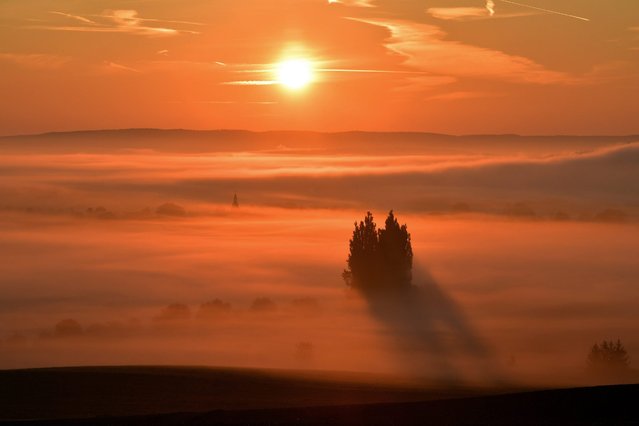
A layer of morning mist still covers the fields as the sun rises into the morning sky over Hohenfelden, Thuringia state, Germany, early 07 September 2016. Meteorologists predict the weather to become warm and sunny in the region with temperatures reaching around 256 degrees Celsius. (Photo by Martin Schutt/EPA)

A layer of morning mist still covers the fields as the sun rises into the morning sky over Hohenfelden, Thuringia state, Germany, early 07 September 2016. Meteorologists predict the weather to become warm and sunny in the region with temperatures reaching around 256 degrees Celsius. (Photo by Martin Schutt/EPA)
Details
22 Oct 2016 10:36:00
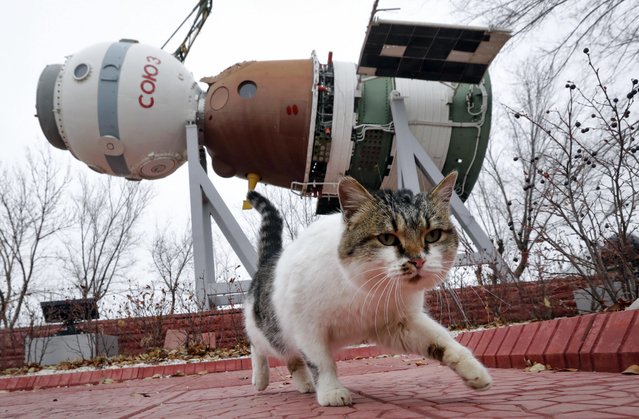
A cat walks past a Soyuz space ship installed at a museum, at the Russian leased Baikonur cosmodrome, Kazakhstan, Tuesday, November 15, 2016. The start of the new Soyuz mission to the International Space Station (ISS) is scheduled on early Friday, Nov. 18 local time. The Russian rocket will carry French astronaut Thomas Pesquet, Russian cosmonaut Oleg Novitsky and U.S. astronaut Peggy Annette Whitson. (Photo by Dmitri Lovetsky/AP Photo)

A cat walks past a Soyuz space ship installed at a museum, at the Russian leased Baikonur cosmodrome, Kazakhstan, Tuesday, November 15, 2016. The start of the new Soyuz mission to the International Space Station (ISS) is scheduled on early Friday, Nov. 18 local time. The Russian rocket will carry French astronaut Thomas Pesquet, Russian cosmonaut Oleg Novitsky and U.S. astronaut Peggy Annette Whitson. (Photo by Dmitri Lovetsky/AP Photo)
Details
16 Nov 2016 11:25:00
An Orthodox priest conducts a blessing in front of the Soyuz TMA-20M for the next International Space Station (ISS) crew, comprised of Jeff Williams of the U.S. and Oleg Skriprochka and Alexey Ovchinin of Russia, at the launchpad at the Baikonur cosmodrome, Kazakhstan, March 17, 2016, ahead of its launch scheduled on March 19. (Photo by Shamil Zhumatov/Reuters)

An Orthodox priest conducts a blessing in front of the Soyuz TMA-20M for the next International Space Station (ISS) crew, comprised of Jeff Williams of the U.S. and Oleg Skriprochka and Alexey Ovchinin of Russia, at the launchpad at the Baikonur cosmodrome, Kazakhstan, March 17, 2016, ahead of its launch scheduled on March 19. (Photo by Shamil Zhumatov/Reuters)
Details
18 Mar 2016 12:13:00